Quantity reconciliation with AI: A guide for construction teams

Quantity reconciliation with AI means using software to extract quantities from drawings, specifications, BIM models and bills of quantities (BOQ), line them up item by item, and flag every gap for a person to explain. The AI finds and groups the differences. An engineer or quantity surveyor still decides what each difference means and signs it off. Most pages on this topic concern bank and ledger matching, which is a different discipline. This guide covers the construction meaning of the term.

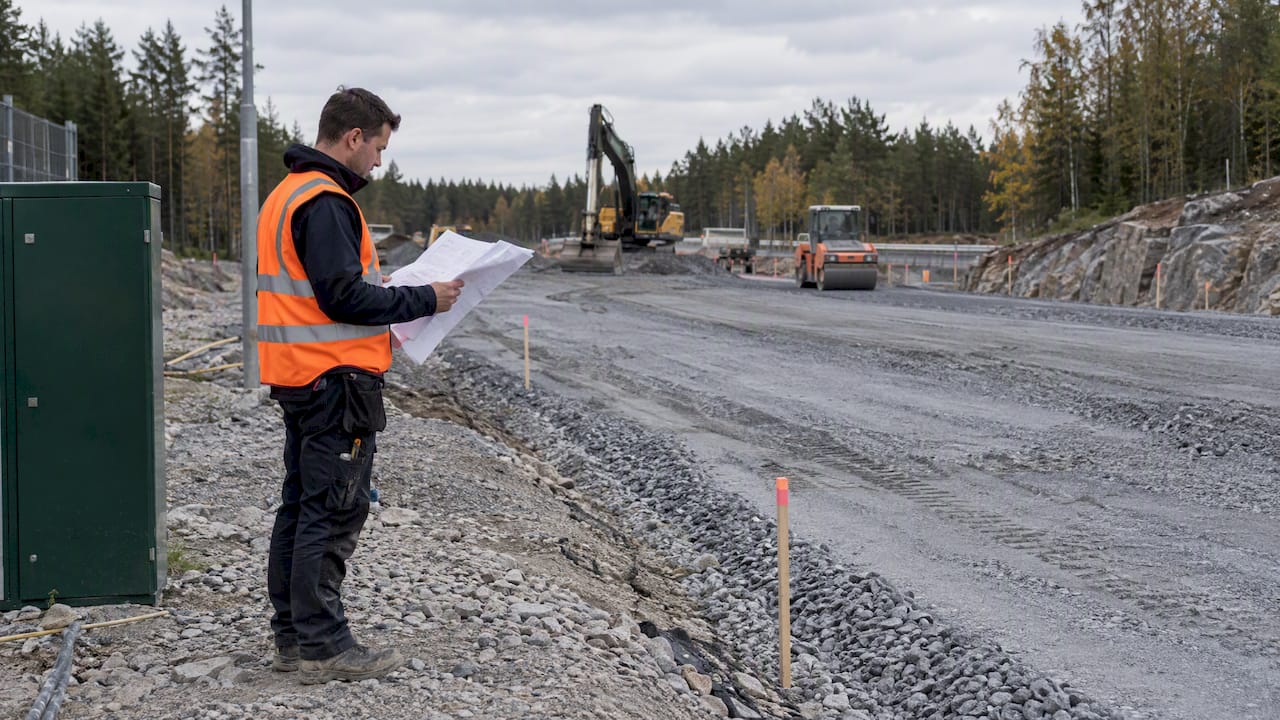
Engineer checking measured road quantities on site

TL;DR

  • Reconciliation in construction compares quantities across records (takeoff, BOQ, progress returns, certificates) and requires an explained cause for every gap.
  • AI is good at extraction, semantic matching and flagging inconsistencies between revisions. Variance arithmetic and totals should stay deterministic.
  • Public owners already require independent quantity checks, and unresolved differences go to the engineer of record. AI fits into that routine; it does not replace it.
  • No checked source reports a general accuracy rate for AI quantity reconciliation, so the review step and audit trail carry the weight.
  • Keep the result in a register that can be audited without the AI tool.

What quantity reconciliation means on a construction project

A bill of quantities lists items with brief descriptions and estimated quantities of the works. It forms part of the contract documents and is a basis for payment. On a remeasurement contract, those quantities are approximate and are subject to remeasurement on completion of the works on site, according to the Hong Kong Civil Engineering and Development Department’s project administration handbook.

That gap between estimate and as-built is where reconciliation lives. The exercise lines up what the drawings imply, what the BOQ states, what the site has measured and what has been claimed or certified, then demands an explanation for each difference. Typical causes fall into four groups: remeasurement, a variation, an error, or timing (work measured in one period and certified in another). The cause decides the action, and the cause can only be assigned by someone who holds the contract and the records.

The term is also used by owners’ resident offices. Florida DOT’s construction manual, revised August 4, 2026, requires resident offices to track quantities monthly and reconcile them within 30 days of pay-item closeout, documenting quantity changes and entering backup documentation in its document system. Reconciliation is therefore a contractual and an administrative duty, and neither can be handed to a model.

Which records get compared

The records differ by contract form, but the usual set is consistent:

  • Drawings and their revision history.
  • Specifications.
  • BIM or IFC models.
  • The BOQ, with item codes and units.
  • Dimension sheets and site measurement records.
  • Progress returns, payment statements and certificates.

Quantity takeoff itself measures and classifies quantities from drawings, specifications and BIM models and can map them to the BOQ, according to the EKG Catalog, a professional knowledge-graph reference. That mapping is the first link in the reconciliation chain: if the takeoff cannot be traced to a BOQ item, nothing downstream can be tied out.

Contract hierarchy matters too. Under FIDIC 2017 Red Book Sub-Clause 1.5, the Specification and Drawings rank above the Schedules, and under Sub-Clause 12.1 a BOQ quantity is an estimate, as a FIDIC commentary on reconciling the BOQ explains. In practice, when a BOQ line and a drawing disagree, the drawing usually wins on obligation, and the BOQ gap becomes a commercial question rather than a scope reduction. Other contract forms rank documents differently, so check the one you are on.

A bounded scope helps. A trade-level document such as a caulking scope of work for new construction shows how a single package defines what is measured, which is exactly what a reconciliation run needs to anchor each line to.

What AI does well in the reconciliation chain

Extraction and linking

Generative AI can extract quantities from unstructured documents, link them to their source and scope item, map them to the BOQ and flag inconsistencies across revisions. The same source describes maintaining versioned quantity deltas with traceable assumptions. For a team handling dozens of drawing revisions, a delta log is the difference between knowing that wall quantities moved and knowing why.

Matching

Matching is the semantic part. The BOQ says “150 mm reinforced concrete slab, grade C30”, the model calls the same element something else, and the dimension sheet uses a third wording. AI is suited to proposing those candidate matches. A write-up on architecting an AI reconciliation engine draws the useful line: AI identifies candidate matches, while deterministic business logic calculates variances and validates results.

Model checks

For BIM, checks include looking for duplicates, overlaps and missing elements, applying measurement rules, and comparing the checked figure with a manual take-off. Those are mechanical tests that software repeats tirelessly, and a model that double counts a wall shared between two rooms is a classic target.

Revision comparison

Other tools are catching up with document comparison generally. The Colorado DOT bridge manual notes that Copilot in SharePoint can compare up to five files and detect differences in items such as dates, titles, authors and content summaries. That is metadata and text comparison, not quantity verification, but it shows the direction: a changed drawing can be flagged before anyone reads it.

A workable reconciliation workflow

A production workflow, as described by an integration engineering firm, normalizes source data, uses AI for semantic matching, calculates variances with deterministic logic, independently recalculates totals, verifies required fields and schemas, and routes ambiguous cases to human review. Translated into a construction setting:

  1. Fix the item structure. Agree on the BOQ item codes and units before any run. Quantities in cubic yards on one record and cubic meters on another will produce phantom variances.
  2. Extract per source. Pull quantities from the model, drawings and site records separately, each tied to its document and revision.
  3. Match by code, then by meaning. Match on item code first. Use semantic matching only for what is left over, and mark every non-exact match as a proposal.
  4. Compute variances outside the model. Subtraction, aggregation and unit conversion belong in a formula, not in a language model’s prose.
  5. Classify each gap. Assign remeasurement, variation, error or timing. The AI may suggest a cause. The responsible engineer or QS confirms it from the records.
  6. Tie to a control total. The register total must agree with the certificate. If it does not, the work is unfinished.
  7. Archive. Keep the register, the source versions and the decisions together.

The seventh step is easy to skip. One practitioner guide recommends keeping the reconciliation as an Excel register with a control total, so that it can be audited without the chat session that produced it. The principle holds for any tool: the evidence must outlive the conversation.

Reviewing what the AI flags

AI changes how fast discrepancies surface. It does not change who is accountable for resolving them. The review practices that public owners already enforce are a good template.

Colorado DOT requires an independent quantity check: once both sets of quantities are complete, they are compared and any differences resolved. Differences that cannot be resolved are referred to the Engineer of Record. An AI run can act as the second, independent set, provided the first set was produced separately by someone else or by another method.

Nevada DOT’s alternative delivery process uses a similar logic on price: it prepares blinded variance reports comparing contractor and independent cost estimates and notes whether the contractor’s figure sits in an acceptable range (a draft document, April 2025). The lesson transfers: compare two independent views, and keep one from contaminating the other.

Concentrate review where risk sits

A course published by CED Engineering advises that quality assurance should verify AI-generated quantities against multiple checkpoints, focusing intensive review on high-risk, complex or unusual items. The same material suggests reasonableness testing, using benchmarks such as cost per square foot or labor hours per unit to flag line items outside historical norms. Benchmarks need local context: a commercial construction estimate guide for one California market shows how regional conditions shape what a plausible figure looks like, which is why a national average is a poor yardstick on its own.

Record every correction

The same course states that audit trails recording AI outputs, human corrections and approval decisions are essential for post-project analysis and dispute resolution. It also recommends continuous calibration of QA procedures based on observed AI error patterns, so validation effort stays proportionate to risk. In a claim, the question will not be whether AI was used. It will be who decided which quantity stood, on what evidence, and when.

Limits worth stating plainly

None of the checked sources reports an accuracy rate for AI quantity reconciliation. The owner manuals specify independent checks and tolerances; the engineering write-ups describe deterministic validation and a human exception queue. A vendor figure for “percent matched” without a stated test set tells you little. Ask how the figure was measured, on which project types, and what happened to the items that were not matched.

Several failure patterns recur:

  • Dirty inputs. AI can match long lists by item code and highlight gaps, but only when it is given clean, coded extracts and told to aggregate by code before comparing.
  • Silent unit and revision errors. A quantity taken from superseded drawing revision C will reconcile perfectly against a BOQ that was itself built from revision C, and both will be wrong.
  • Plausible explanations. A language model can write a convincing reason for a variance that has nothing to do with the real cause. Causes come from the records, not from fluent prose.
  • Scanned and low-quality drawings. Extraction from scans carries more risk than extraction from a native model, which is why the manual sample remains the heart of any model quantity check.

For drawing-based work, our own note on where 2D takeoff automation works and where it fails goes through the same boundary from the measurement side.

Our perspective

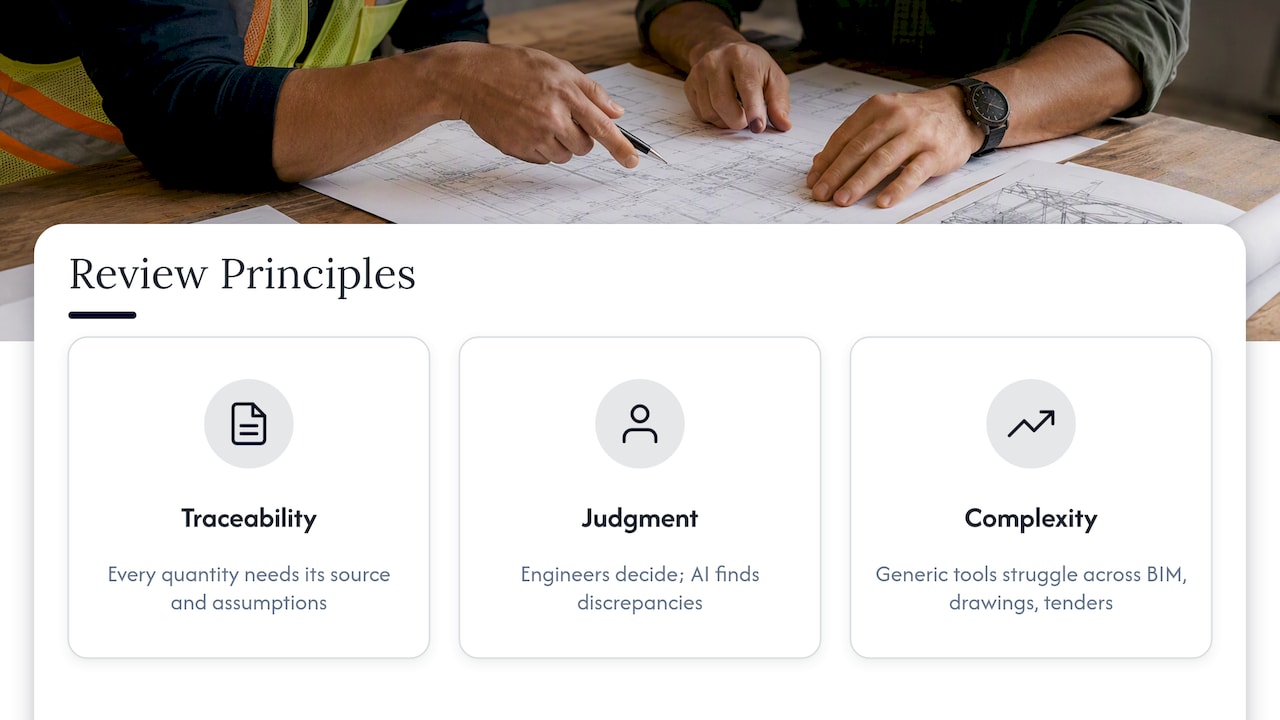
We build Yesper as an AI civil engineer, and we hold a firm view on this subject: reconciliation is a review discipline first and a calculation exercise second. The valuable part of an AI system is not that it produces a number. It is that the number arrives with its source, its assumptions written down, and a path back to the document it came from, so a colleague can review it the way they would review another engineer’s work.

Our perspective

Three convictions follow from that. First, a quantity without traceability is a liability, however plausible it looks. Second, the engineer’s judgment is the control, so the system should reduce the time spent finding discrepancies and leave the time spent deciding on them. Third, the difference between general models and construction-specific ones shows up as complexity grows: reading one clean schedule is easy, while producing comparable quantities from a BIM model, a set of drawings and a stack of tenders is where generic tools lose the thread.

That is also why we separate the tasks. Extraction from drawings and models is one job, covered in our pieces on auditable BIM takeoffs and on building a bill of quantities from the IFC model. Reconciliation is the next one, and it should rest on the same principle of human sign-off.

Where Yesper fits

Yesper works inside your projects: it searches project documents, produces quantities from BIM models and drawings, runs compliance and error checks, and writes down its assumptions for review. Teams at companies such as AFRY, NRC Group and Netel use it across their organizations. For tender-side comparisons, see how tender document analysis is handled with human sign-off, or look at Yesper to see how it works for construction and infrastructure teams.

Practical checklist before you start

A short set of preconditions keeps the first reconciliation run from becoming a debugging session.

  • Records: gather drawing revisions, the BOQ, dimension sheets and site measurement records. Hong Kong’s CEDD calls for independent checks of measurements and calculations as part of the measurement procedure.
  • Scope: start with one package or one pay item group rather than the whole contract. Compare a few hundred lines you know well before widening.
  • Independent check: decide who or what produces the second set of quantities, and keep it separate from the first.
  • Sampling: plan a manual sample against the model, because model quantities depend on how elements were modeled. Our note on keeping human sign-off with AI for BIM sets out how to size that sample.
  • Security: confirm what happens to project documents before they are uploaded. See what to protect and ask about AI data security.
  • Audit: agree the register format, the control total and where the decisions are stored.

Single-trade work offers a quick sanity check. A metal roofing materials calculator, for example, gives a fast independent figure for one trade that can be set beside an AI-derived roofing quantity. A mismatch is a prompt to look, not a verdict.

What is quantity reconciliation in construction?

It is the process of comparing quantities across the takeoff, BOQ, progress returns, payment statements and certificates, and explaining every difference. On remeasurement contracts, BOQ quantities are estimates that are adjusted once the work is measured on site. Each gap is assigned a cause, such as remeasurement, variation, error or timing.

Can AI reconcile quantities without an engineer?

No. AI can extract, match and flag, but the cause of each gap and the final quantity are decisions for the engineer or quantity surveyor. Public owners such as Colorado DOT send unresolved differences to the Engineer of Record, and that accountability does not move to software.

What data does an AI reconciliation need?

It needs coded BOQ items with consistent units, drawing or model revisions, dimension sheets and site measurement records. Clean, coded extracts matter more than volume. The result should be stored in an auditable register with a control total that agrees with the certificate.

How accurate is AI quantity reconciliation?

There is no reliable general figure. The checked owner manuals and engineering write-ups describe independent checks, tolerances and human exception queues, but not a measured accuracy rate. Judge any tool on your own project types and review how it treats items it cannot match.

This post was written with AI assistance and published by Yesper. General information, not professional advice: requirements vary by project and jurisdiction, and the professional responsible for the project decides what applies. Spotted an error? Write to benjamin@yesper.ai.

Benjamin Glaser Co-founder at Yesper. Writes about AI and the industry that builds the world. benjamin@yesper.ai

Yesper is the AI civil engineer for construction and infrastructure. AFRY, COWI, NRC Group and other Nordic firms use it to halve the time on a study, rerun calculations in minutes, and catch errors that would otherwise slip through. Get in touch if you'd like to see what it can do for you.

Book demo