Construction tender document analysis: Hours, not days, human signoff

AI-enabled tender document analysis extracts requirements, specifications, deadlines, and risk clauses from a bid pack, flags go or no-go criteria, and produces traceable, citation-backed outputs that evaluation panels can act on within hours rather than days. The gain is speed and auditability, not automation of the decision itself: a human reviewer still signs off on every finding before it carries weight.

Reviewer checking a construction tender specification
  • Automated extraction has exceeded 95% accuracy for contractual reporting requirements, but that measures extraction, not human approval of ambiguous clauses or bid decisions.
  • Apply only evaluation criteria published in the tender, and check mandatory eligibility gates before scoring, since one failed requirement can disqualify a bid.
  • Require source citations for every finding, sample them against original paragraphs, and record reviewer overrides with reasons to preserve an audit trail.
  • Rule based extraction handles familiar clauses more reliably, while models trained on examples can miss familiar obligations expressed in unfamiliar language; reviewers must verify both.

What AI systems pull from a tender pack and how to read the output

A tender pack is, structurally, a pile of obligations disguised as prose. What a well-built extraction system does is sort that prose into categories a panel can score against: eligibility gates, technical specifications, deliverable lists, submission schedules, penalty clauses, and the weighted scoring criteria buried in an annex nobody reads twice.

Extraction tools typically produce a handful of recognizable artifacts:

  • A compliance matrix mapping each requirement to a pass, fail, or needs-review status
  • A risk register listing liability clauses, penalty exposure, and ambiguous obligations
  • Annotated findings, each one linked to its source paragraph or page
  • A go/no-go summary consolidating the gating criteria into one judgment call

One study found automated extraction can exceed 95% accuracy in identifying contractual reporting requirements, against a manual baseline of two to four hours per complex contract for a human reviewer doing the same work by hand. That gap is the whole business case for using these tools, but it says nothing about judgment calls on ambiguous clauses, which is where traceability earns its keep: every flagged item needs a visible link back to the exact paragraph it came from, or the panel has no way to check the machine’s homework.

How to run AI analysis inside a formal evaluation process

Treating an AI tool as a shortcut around procurement procedure is how panels end up defending decisions they cannot fully explain later; practical guidance on how to do this well is available in Defend Your Award: Builder Tender Evaluation for Australian Buyers. The workflow below keeps the tool inside the process rather than replacing it.

  1. Prepare the tender pack. Organize files by section, build a checklist of mandatory annexes, and map the published evaluation criteria before anything gets fed into a tool, since evaluation must apply only the criteria pre-announced in the tender documents.
  2. Run automated extraction. Generate the compliance matrix and risk register in one pass, with every entry carrying a source citation.
  3. Triage by severity. Check eligibility gates and major liability exposure first, since a single failed mandatory clause can eliminate a bid regardless of how strong the rest of it reads.
  4. Map findings to rated criteria. Link each extracted item to its scoring subcriterion and weighting, whether the method is most-economically-advantageous-tender scoring or lowest price.
  5. Hold a moderation meeting. Score independently, resolve disagreements as a group, and record sign-offs with citations attached to each resolved item.

Pro Tip: Run the eligibility-gate check before anyone touches the scored criteria. Disqualifying a noncompliant bid early saves the panel from scoring work that never should have started.

What reviewers should verify before trusting an AI finding

An extraction tool is a first pass, not a verdict. The clauses that disqualify a bid outright deserve the first look: confirm every mandatory pass or fail item actually fails before a bid gets eliminated on an automated flag alone.

From there, the review gets more granular:

  • Sample a portion of findings and trace each one back to its source paragraph to confirm the citation holds up.
  • Check that scoring logic matches the procurement’s actual weightings, since a tool can misclassify a nuanced clause that a rule-based filter reads too literally.
  • Watch for false positives on ambiguous language, particularly clauses that shift cost or liability in ways a keyword match will miss.
  • Log every reviewer override, with a reason, so the audit trail shows who changed what and why.

Knowledge-augmented models that combine database retrieval with LLM reasoning have shown promise on tasks like claimability judgment and unit-price retrieval in EPC contract review, but that kind of system still depends on curated reference data and expert rules sitting underneath it. Research on EPC risk analysis has also found that purely rule-based extraction tends to hold up better on known clause patterns, while ranking models trained on prior examples can struggle the moment a tender uses unfamiliar phrasing for a familiar clause. Neither failure mode is visible unless someone checks.

Building an audit-ready compliance matrix in practice

A construction-focused AI platform applies the same extraction logic described above to a tender pack, but it does it with sector context already built in: it recognizes BoQ line items, retention clauses, and liquidated-damages language the way an engineer would, not the way a generic language model guesses at them.

The output a reviewer sees in practice looks like this:

  • A compliance matrix with every requirement linked to its source page, paragraph, or BoQ cell
  • Reviewer annotation fields built into the matrix itself, so sign-off happens where the citation lives
  • Export formats that slot into an existing panel review process rather than demanding a new one
  • A risk register separating gating clauses from scored criteria, so triage order is clear on first read

Customers using this kind of platform report 50 to 95 percent time saved on project work, with reviewers also catching errors that manual review had missed. That range reflects the breadth of tasks involved, not a single benchmark, and it holds only alongside the human checkpoints described above: the matrix speeds up the panel’s work, it does not replace the panel’s sign-off.

Governance-first adoption of AI in procurement

Governance-First Adoption of AI in Procurement — overview diagram

The temptation in procurement is to bolt AI onto the back end of a process built for paper. That gets the sequencing backward. Risk and value-for-money weighting should be planned during the procurement strategy phase, before the tender is even published, so the evaluation matrix already reflects where automated extraction will carry weight and where it should not.

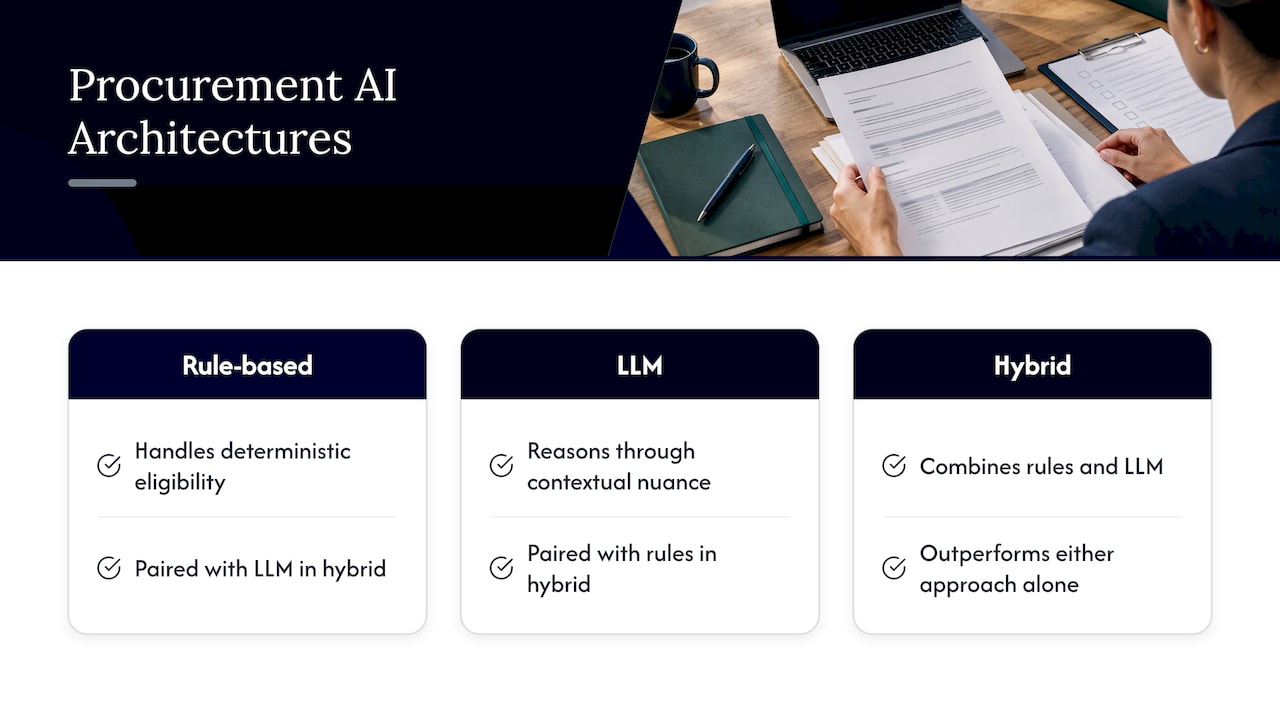
Hybrid architectures, rule-based logic for deterministic eligibility clauses paired with LLM reasoning for contextual nuance, outperform either approach alone, and traceability has to be a precondition for adoption rather than a feature added after panels start losing trust in the outputs. A compliance matrix without a citation is just an assertion with better formatting.

Where a construction-specialized AI fits in your workflow

Our platform is designed for construction and infrastructure workflows, so tender analysis is integrated as a core function that supports producing deliverables end-to-end with transparent assumptions, enabling review similar to that of a colleague’s work.

For teams running tender evaluations, that shows up as:

  • Compliance matrices generated directly from your tender documents, with source citations attached to every line
  • Document question-answering that lets reviewers query a tender pack in plain language instead of searching PDFs by hand
  • Workflow automation that carries findings from extraction through to panel review and sign-off
  • Traceable outputs built for audit, not just for speed

If you want to see how this looks against a real tender review or want to look at a compliance matrix built from actual tender documents, both are documented on our site. To see Yesper at work, book a demo.

How do you analyze a tender document?

Analysis typically runs through formal compliance screening, a technical or substantive review, and a final scoring stage, following whichever criteria the tender itself has pre-announced. AI tools can accelerate the extraction and mapping steps, but the compliance check and final scoring remain human decisions.

What does tender analysis mean?

Tender analysis is the structured review of a bid document against a buyer’s published requirements, covering eligibility, technical compliance, pricing, and scoring criteria. The goal is a defensible, documented judgment on whether a bid qualifies and how it ranks against competitors.

How should you read a tender document?

Start with the mandatory eligibility clauses, since a single failed gate can disqualify a bid before pricing or technical merit matter at all. From there, work through technical specifications, deliverable schedules, and penalty clauses, cross-referencing each against the published scoring weightings.

What is typically included in a tender document?

A tender document generally bundles eligibility requirements, technical specifications, a submission schedule, pricing or bill-of-quantities instructions, contract terms including penalty and liability clauses, and the scoring criteria the buyer will use to evaluate bids. The exact mix varies by sector and procurement method, which is part of why extraction accuracy and traceability matter so much when reviewing one.

How accurate is AI tender document analysis compared to manual review?

Research on contractual clause extraction has reported accuracy exceeding 95% for identifying reporting requirements, against a manual baseline of two to four hours per complex contract. Accuracy figures like this apply to extraction specifically, not to the final compliance or scoring decision, which still requires human review.


This post was written with AI assistance and published by Yesper. General information, not professional advice: requirements vary by project and jurisdiction, and the professional responsible for the project decides what applies. Spotted an error? Write to benjamin@yesper.ai.

Benjamin Glaser Co-founder at Yesper. Writes about AI and the industry that builds the world. benjamin@yesper.ai

Yesper is the AI civil engineer for construction and infrastructure. AFRY, COWI, NRC Group and other Nordic firms use it to halve the time on a study, rerun calculations in minutes, and catch errors that would otherwise slip through. Get in touch if you'd like to see what it can do for you.

Book demo