Construction labor shortage and AI: What actually helps

AI will not lay brick, pour a slab or pull cable. What it can do is take over a large share of the document-heavy work that sits on top of a short-staffed industry: reading specifications, reconciling models with drawings, comparing tenders, checking compliance. That is where the experienced people who remain are currently spending hours they do not have, and it is the part of the labor shortage that software can address today.

Estimator comparing construction tender packages

TL;DR

  • The US shortage is structural: retirements, competition from data centers and other large projects, and hiring friction. Contractors keep reporting open positions even as parts of the market soften.
  • AI does not replace craft labor. Its realistic contribution is to remove administrative and engineering-office load, so scarce experts spend time on judgment.
  • The strongest use cases are estimating and bidding, document review, quantity takeoff, scheduling and compliance checks, all high-volume, semi-structured work.
  • Adoption fails when it is treated as a software purchase. It works as a workflow and governance project with human sign-off on every deliverable.
  • Measure results in hours returned per project and errors caught, not in headcount avoided.

The shortage in numbers: Still there, only shaped differently

The headline figure moves with the economic forecast, which is the first thing to understand. Associated Builders and Contractors (ABC) estimated that the industry needed to attract 439,000 net new workers in 2025. For 2026 its model came down: 349,000 net new workers, a decline ABC’s chief economist attributes to modest spending growth forecasts, with most of the new demand driven by retirement rather than by growth in construction activity.

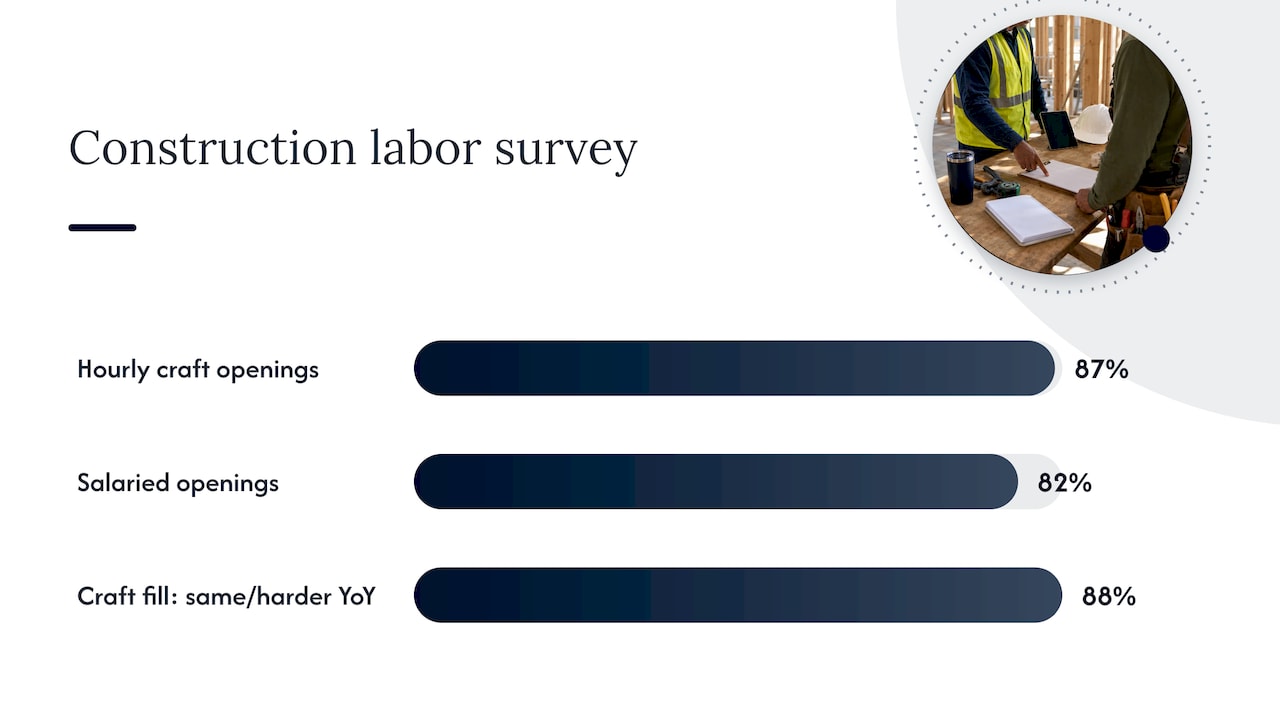
A lower number is not a smaller problem. The 2026 workforce survey by the Associated General Contractors of America (AGC) and NCCER, conducted in July and August 2026, reports that 87 percent of firms have openings for hourly craft workers and 82 percent for salaried positions. Of the firms with craft openings, 88 percent say those positions are as hard or harder to fill than a year earlier. The same survey notes that some firms reduced headcount over the past 12 months while others grew, so the market is uneven: soft in some segments, tight in others.

Survey shares showing construction hiring difficulty

The salaried figure deserves more attention than it usually gets. Public discussion of the shortage tends to concentrate on the trades, yet project managers, estimators, engineers and coordinators are also hard to hire, and those are precisely the roles whose time is consumed by documents.

Why the gap persists

Three forces recur in the sources:

  1. An aging workforce. Retirements are a central driver, with 41 percent of the workforce expected to retire by 2031.
  2. Competition from other megaprojects. In the AGC survey, among firms reporting on data-center effects, 58 percent say those projects have increased competition for skilled workers and 49 percent report wage pressure.
  3. Hiring friction. Immigration enforcement has affected a share of firms, and the AGC data show that failing drug tests and missing licenses and credentials still rank among the most cited reasons contractors struggle to fill positions.

None of these is fixed by software. Nor is the shortage a matter of one trade: Deloitte’s analysis of the US built environment ties it to an aging workforce, inconsistent job site locations and barriers to technology adoption together. The honest framing is therefore narrower than the vendor pitch: AI cannot create workers, but it can change how much non-productive work each worker carries.

What AI cannot do, and why that matters for the argument

Humanoid robots and embodied AI attract the headlines. McKinsey’s perspective on humanoid robots in construction suggests these are longer-term solutions that will first assist with simple, repetitive tasks rather than complex trade work. A contractor short of electricians, pipefitters and equipment operators in 2026 cannot wait for that.

Automation on the jobsite is real but narrow. Automation kits that let a single operator supervise a fleet of robotic haul trucks, for example, appear in the 2025 construction tech landscape report, and the report presents them as helping offload work to machines in specific settings. Useful, yet bounded by site conditions, capital cost and safety.

The office is different. It is where the volume is, where the data is already digital, and where the work is repetitive enough for software to carry. The AGC survey makes the same point from the contractor side: 51 percent of firms expect AI and robotics to have a positive impact over the next five years, and estimating and bidding is the most cited area of impact.

Where AI takes load off a short-staffed team

The pattern across the evidence is consistent. AI is most valuable on semi-structured, document-heavy tasks that are tedious for experts and expensive when they go wrong.

Estimating, tendering and bid comparison

A bid package is a pile of PDFs, spreadsheets and addenda. The scarce resource is the estimator’s attention. Comparing a dozen tenders that arrive in different formats, and sometimes different currencies, is mechanical work that still demands care, because a missed exclusion becomes a change order. Our own write-ups on construction tender document analysis and AI for tender review describe how the first pass can be done in hours rather than days while the decision stays with a human.

Quantity takeoff from BIM and drawings

Quantities extracted from a model are only as good as the model and the rules applied to it. This is a task where AI can do the bulk of the counting and a person checks the result. The condition is review: see our piece on human sign-off for AI in BIM work.

Document review and compliance

Checking drawings against specifications, or deliverables against regulations, is slow and error-prone when done by tired reviewers late in a schedule. Agentic tools, as Noah Intelligence describes them, differ from ordinary generative tools because they pursue objectives rather than merely respond to prompts: one agent might review contract terms while another checks drawings against specifications.

Administrative load in the field and the back office

Supervisors lose hours to forms, dockets, timesheets and site diaries. Reducing that burden does not require anything exotic; a useful illustration is the argument for reducing site paperwork for supervisors through mobile-first digital records. Similarly, AI-assisted tools for document analysis and generation address the routine paperwork of understaffed teams. Neither replaces a worker; both remove reasons a worker is not doing the job they were hired for.

Risk identification

The highest-value use is arguably catching problems earlier. Agentic systems can reconcile data from several sources and flag risks before they become delays, which is how they act on the causes of overruns and not only on their symptoms. Our guidance on piloting construction risk AI with workflow and governance covers how to structure that.


Why general models hit a wall

A general-purpose chatbot can summarize a specification. It struggles when the task is long, quantitative and bound to domain rules: turning raw CPT protocols into a geotechnical report, extracting quantities from a BIM model, or producing one comparable set of numbers from a dozen tenders in three currencies. The failure comes down to a lack of domain-specific logic, and AI performance as capped by the quality of the project’s single source of truth.

The practical consequence is a split between tools that answer questions and tools that perform work end to end with their assumptions written down. For a team that is short of people, the second category is the one that returns hours. The first mostly adds a reviewing task.

Question Answers-only assistant Work-producing, domain-built agent
Output Text to be copied and reworked A finished deliverable: report, takeoff, comparison
Assumptions Often implicit Written down for review like a colleague’s
Traceability Limited Sources verifiable against project documents
Fit for complex tasks Degrades as complexity grows Built for engineering work
Reviewer’s job Redo the work Check the work

Will AI take construction jobs?

The evidence on displacement is thin and points the other way for now. The crisis is a chronic shortage, not a surplus, and AI is better understood as a career catalyst that automates mundane, document-heavy tasks so engineers and project managers can concentrate on judgment and on-site problem solving.

A peer-reviewed angle exists as well: a 2026 study in Construction Management and Economics examines what AI means for work and employment in the US industry, and notes that the implications remain poorly understood in project-based, highly variable work environments. That is a fair statement of where knowledge stands. Anyone claiming certainty in either direction is selling something.

How to adopt AI without creating a new problem

Firms most often stumble by treating AI as a plug-and-play purchase. The AGC analysis and the practitioner commentary behind it point to the same corrective: process re-engineering, governance and human-in-the-loop validation for every deliverable. An industry review summarized by Lexology on the NBS Digital Construction Report goes further, treating adoption as a workforce strategy that prioritizes upskilling and clear, auditable lines of responsibility for AI-generated work.

A workable sequence:

  1. Pick one document-heavy workflow with a clear owner. Tender comparison, takeoff or compliance review are typical. Our lessons on this are collected in fixing workflows before automating them.
  2. Fix the inputs. Performance is capped by data quality. Naming conventions, model hygiene and a single source of truth come before tooling.
  3. Define who signs off. Every AI-produced deliverable has a named human reviewer, and the AI’s assumptions are part of what is reviewed.
  4. Train for AI literacy. Upskill the people who will supervise the agents. Resistance to “job loss” fades when staff manage the tools instead of being measured against them.
  5. Measure in hours and errors. Define the baseline before rollout. The framing in our piece on proving AI ROI is built for the people who approve the budget.

Organizational inertia, more than technical skill, is the barrier the AGC commentary identifies. Incentives that reward the old way of working will defeat any tool.

Our perspective

We build Yesper as an AI civil engineer, and the shortage looks to us like a problem of where expertise is spent. Senior engineers and project managers are hired for judgment, yet their weeks fill with reading, reconciling and reformatting. Every hour of that is an hour unavailable to a project that is already short of people.

Our position is that an AI worth deploying produces the deliverable, not a suggestion about it, and states its assumptions so a reviewer can examine them the way they would a colleague’s work. That is why we insist on traceability and source verification. A reviewer who cannot see where a number came from has no way to trust it, and a tool that cannot be trusted adds to the shortage of reviewing capacity.

Our perspective — overview diagram

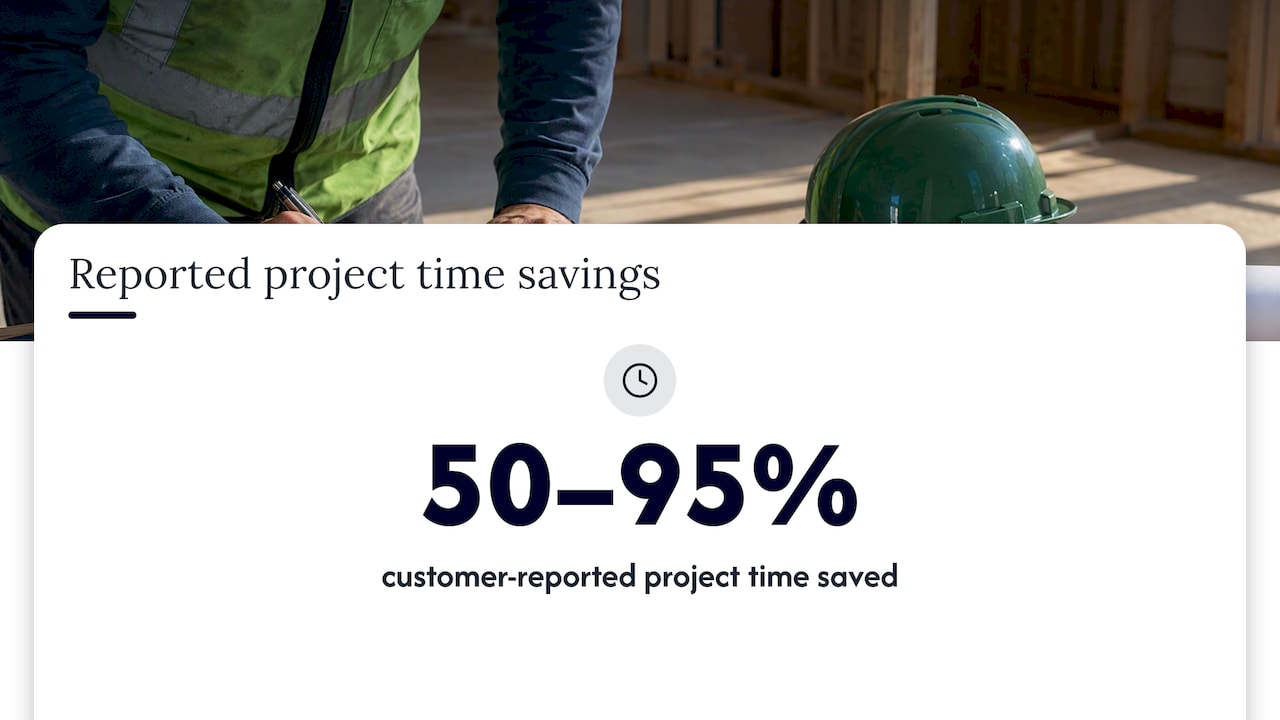
Customers report saving 50 to 95 percent of the time on projects, and higher quality as well, because errors that human reviewers missed get caught. We treat those as customer-reported results, not guarantees, and they depend on the task and on the workflow around it. Teams at companies such as AFRY, NRC Group and Netel use Yesper across their organizations, which suggests the value is not confined to one specialist role.

What we do not claim is that this ends the shortage. It does not. It lets the people who are there do more of the work that only they can do.

Putting this to work with Yesper

For contractors, consultancies and infrastructure owners that want AI in daily operations, Yesper offers document search, compliance checks, multi-step workflow automation, quantity takeoff from BIM and drawings, deliverable creation and customizable agents for different project roles, with integrations to the tools teams already use. To see how it fits a specific workflow, start at yesper.ai, or read what an AI civil engineer is and what actually works in AI for civil engineering first.

Can AI solve the construction labor shortage?

Not by itself. The shortage comes from retirements, competition for skilled workers and hiring friction, and AI does none of the physical work. It can reduce the administrative and engineering-office load so that existing staff handle more projects with the same headcount.

Which construction tasks benefit most from AI?

High-volume, document-heavy ones. Contractors surveyed by AGC point to estimating and bidding, document review and scheduling as where AI could matter most. Quantity takeoff, tender comparison and compliance checking follow the same pattern.

Will AI take over construction jobs?

The current evidence describes a shortage of workers, not a surplus, and the research on employment effects is still developing. The more likely near-term change is in task mix: less manual document handling, more review and judgment. Roles that depend on physical presence and trade skill are not what current AI tools target.

What should a firm check before adopting AI?

Check data quality, name a human reviewer for every deliverable, and confirm the tool shows its assumptions and sources. Plan training alongside the rollout, since culture and inertia are cited as bigger barriers than technical skill.

This post was written with AI assistance and published by Yesper. General information, not professional advice: requirements vary by project and jurisdiction, and the professional responsible for the project decides what applies. Spotted an error? Write to benjamin@yesper.ai.

Benjamin Glaser Co-founder at Yesper. Writes about AI and the industry that builds the world. benjamin@yesper.ai

Yesper is the AI civil engineer for construction and infrastructure. AFRY, COWI, NRC Group and other Nordic firms use it to halve the time on a study, rerun calculations in minutes, and catch errors that would otherwise slip through. Get in touch if you'd like to see what it can do for you.

Book demo