Project teams: Pilot construction risk AI with workflow and governance

Construction risk AI can reliably speed up hazard detection and document review, but it stays advisory, not autonomous. The strongest deployments pair computer vision and natural language processing with a human reviewer who signs off on every finding, and they keep a traceable record back to the source document or image. The NIST AI Risk Management Framework and a recent systematic review of 87 studies back that posture. What follows covers the methods, the realistic limits, the governance rules, and how to pilot without exposing your project to a false sense of security.

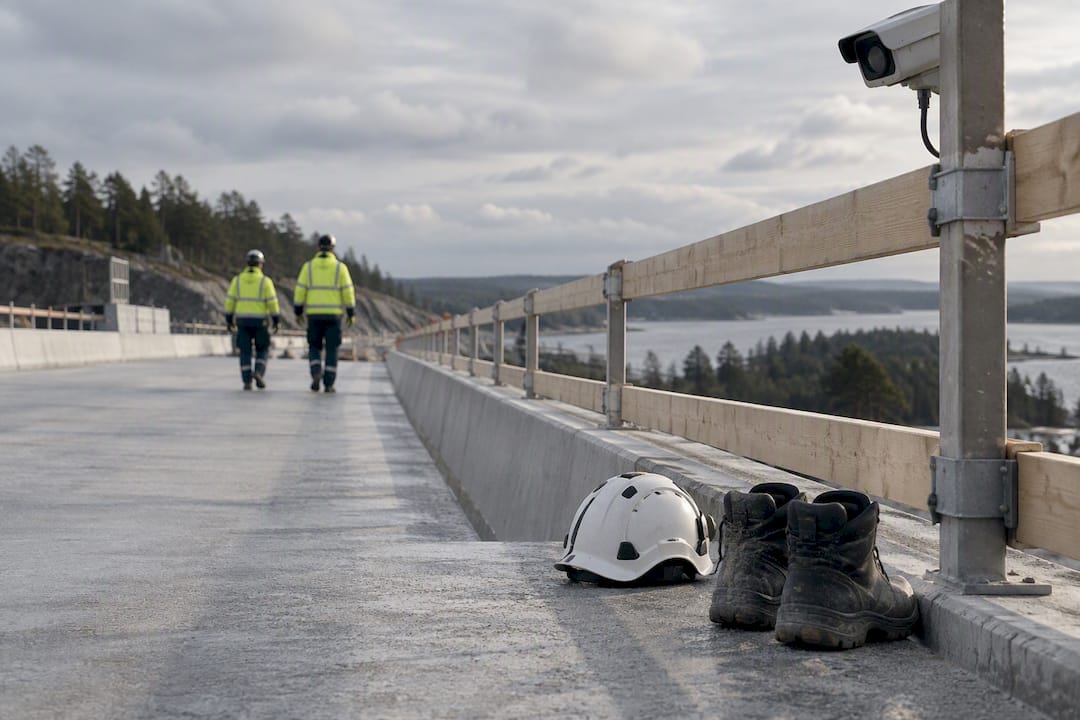
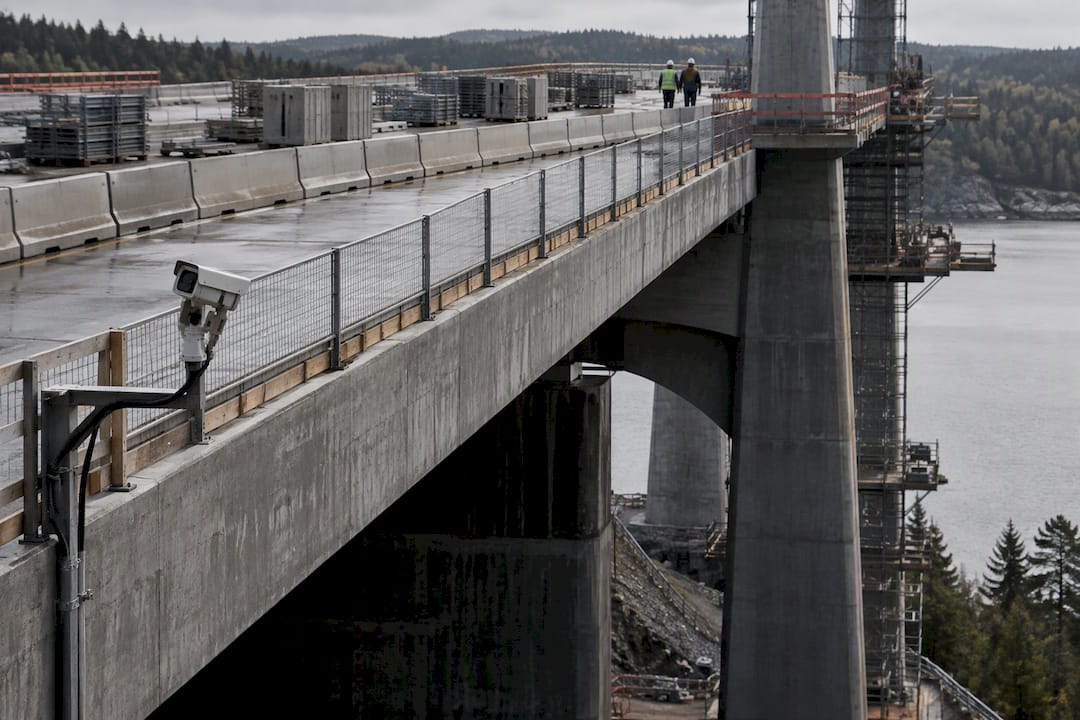
Bridge construction site with controlled safety zones
  • Computer vision performs reliably for PPE detection and hazard monitoring but is limited by camera placement, lighting, and occlusion issues in site conditions.
  • Natural language processing and knowledge graphs help extract contract obligations and detect document conflicts, facilitating compliance efforts.
  • Effective AI deployment requires strict governance, including logging, human approval, and safe-state thresholds, to prevent overreliance and legal risks.
  • Pilot projects should focus on a single, verifiable workflow with clear KPIs, traceability, and a fallback plan to manual processes if AI underperforms.
  • Construction risk AI is most mature in safety scenarios, with less developed applications in environmental risk, and adoption success depends heavily on organizational integration and trust building.

What does AI actually do across the risk lifecycle?

Risk management runs through four phases: identify, assess, respond, monitor. Construction risk AI slots into each one differently, and knowing which method belongs where keeps you from expecting a single tool to do everything.

Computer vision handles the identify phase on site: cameras flag missing hardhats, workers in fall zones, or equipment operating too close to a trench. Machine learning models take those flagged events plus historical incident data and score which hazards are most likely to escalate, feeding the assess phase. Natural language processing and knowledge-based reasoning work the document side, pulling obligations out of contracts and specs so a project team can respond with assigned actions rather than a buried PDF. Optimization algorithms help weigh trade-offs, such as which schedule slip creates the least downstream exposure.

The 2025 systematic review covering 87 studies from 2014 to 2024 confirms this division of labor: computer vision and machine learning dominate prediction and visual work, while NLP and knowledge-based reasoning carry the compliance side. It also flags that implementation across the industry remains fragmented, with socio-organizational resistance as common as any technical barrier.

What a well-built system hands back to you in practice:

  • Flagged hazards tied to a timestamped image or video clip, not just a text alert.
  • Prioritized risk lists cross-referenced against the actual project schedule.
  • A traceable risk register where every entry links back to its source document.
  • Suggested mitigation actions routed to a named reviewer for approval before anything changes on site.

None of that removes the human from safety-critical calls. AI surfaces the pattern; a supervisor or engineer still decides what happens next.

Which AI methods actually move the needle?

Four approaches account for most of the real progress in this space, and each fits a different kind of risk work.

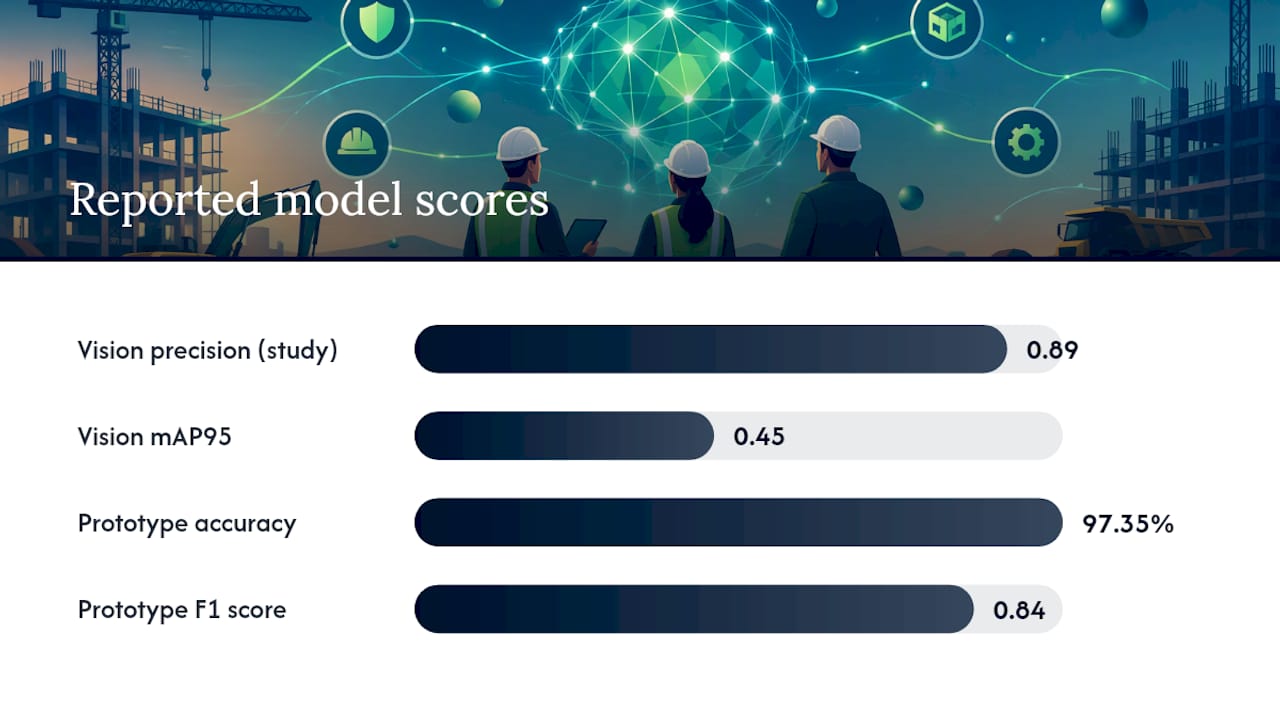
Computer vision is the most mature. It handles PPE detection, activity recognition, and scene-level violation spotting from site cameras. A 2025 study built on an OSHA-driven dataset of 55,594 images across 28 safety categories and reported a precision of 0.89 and a mAP95 of 0.45.

That 0.89 precision figure is study-specific, tied to one dataset and one model configuration. Treat it as a benchmark for what is achievable under controlled conditions, not a guarantee for your own site cameras and lighting.

NLP and document AI work the paper trail. They search contracts and specifications, detect where two clauses conflict, and extract obligations into an editable register that links back to the original page.

Multimodal agent frameworks are the newest layer, combining perception models with structured knowledge and language reasoning. One research prototype paired a fine-tuned vision model (YOLOv10 with CLIP LoRA) with a construction safety knowledge graph and retrieval-augmented generation, and reported 97.35% accuracy on activity recognition and an F1 score of 0.84 for PPE detection. The retrieval step matters: it lets the system explain why it flagged something, citing a rule or precedent instead of returning a black-box score.

Which AI Methods Actually Move the Needle? — overview diagram

Large language models earn their place in training simulations, post-accident analysis, and checklist generation, where errors get caught before consequences. They struggle with hallucination and stale context, so keep them out of live, safety-critical judgment calls without a verification step.

Key use cases worth piloting first:

  • PPE and activity monitoring on active sites.
  • Contract and spec conflict detection before a bid goes out.
  • Post-incident pattern analysis across past projects.
  • Explainable hazard reasoning that cites its source rather than just a score.

What are the real benefits and the limits nobody advertises?

The upside is concrete: faster document reviews, hazards caught earlier than a walk-through would catch them, and an audit trail that holds up when a claims dispute lands on your desk. Teams running document-heavy workflows through NLP tools report catching contract conflicts that would otherwise surface mid-project, when they are expensive to fix.

The limits are just as concrete, and they matter more the closer you get to safety-critical use.

  1. Model bias. A system trained mostly on daytime, unobstructed camera footage will underperform on night shifts or partially occluded angles.
  2. Camera placement and occlusion. Computer vision only sees what the lens sees; a hazard behind a stack of rebar goes unflagged regardless of model quality.
  3. Dataset representativeness. A benchmark built on one region’s site conditions, like the 55,594-image OSHA dataset, may not transfer cleanly to a different climate, crew size, or equipment mix.
  4. Model drift. Accuracy degrades over time as site conditions, crews, and equipment change without retraining.
  5. Latency in operational technology settings. A model that takes ten seconds to flag a hazard is functionally useless if the hazard window is five seconds.

The operational risk that catches teams off guard isn’t the model’s accuracy. It’s treating an AI flag as a finished assessment instead of a lead that still needs a qualified reviewer, and skipping the traceability step that would let anyone check the finding later.

Pro Tip: Build a rule into your workflow that no AI-flagged hazard closes as “resolved” without a named reviewer’s sign-off and a linked timestamp. That one habit prevents more disputes than any model upgrade.

What governance do you need before deployment?

Deploying construction risk AI without a governance policy is how a useful tool becomes a liability. The NIST Generative AI Profile, published in July 2024, and CISA’s joint guidance on AI in operational technology environments both converge on the same core practices.

Policy essentials to write down before go-live:

  • What data the system can access, and how long it retains it.
  • Which actions require human approval before execution.
  • A logged audit trail for every input and output the model produces.
  • An escalation path for incidents where the AI flags something urgent.
  • An explicit list of actions the AI is never allowed to take autonomously.

NIST’s framework calls for inventorying every AI component in use, logging inputs and outputs, and defining safe-state thresholds, the point at which a system defers to a human rather than acting on its own. CISA’s OT guidance echoes this for anything touching physical operations: human-in-the-loop for critical decisions is not optional.

Testing matters as much as policy. Set a baseline for false-alert rate and review time before rollout, then track both. Schedule periodic red-teaming and re-evaluation, since a model that performed well at launch can drift as site conditions change.

Governance element What it covers
Component inventory Every AI tool in use, its version, and its scope
Input/output logging Full audit trail for every AI-generated finding
Human approval gates Which actions need sign-off before execution
Safe-state thresholds When the system defers instead of acting
Re-evaluation schedule Periodic testing against fresh baselines

How should you design a pilot that actually proves value?

Start narrow. A pilot trying to cover every risk category at once produces noise, not evidence. Pick one high-frequency, document-verifiable workflow instead.

  1. Choose the workflow. Document extraction from method statements, PPE detection on a single site, or inspection follow-up tracking all work well because their outputs are easy to check against a source.
  2. Set baselines before you start. Measure current review time, the rate of overdue follow-up actions, and how often flagged items turn out to be false alerts.
  3. Define your KPIs. Track review time reduction, false-alert rate, and closure quality, meaning whether flagged issues actually got fixed, not just marked closed.
  4. Build in traceability from day one. Every AI finding should record the source passage or image, the document version, a timestamp, the model version used, the assumptions made, the reviewer’s name, and any follow-up evidence.
  5. Plan your rollback and scale criteria. Decide in advance what result triggers expansion to a second workflow, and what result means you pause and retune.

Prototype work on expert-in-the-loop dashboards for fall-risk assessment has shown that continuous retraining and attention to reviewer experience matter as much as model accuracy for getting practitioners to actually trust the output. A tool nobody trusts gets ignored, no matter how good its precision score looks on paper.

Pro Tip: Run your pilot on a workflow you could still do manually as a fallback. If the AI underperforms, you need a way to keep the project moving without it.

For teams weighing whether a domain-built platform beats a general-purpose model for this kind of work, Yesper’s overview of civil engineering AI walks through where the gap actually shows up in document-heavy tasks.

Where does a domain-specific platform like Yesper fit?

Generalist AI models struggle once construction workflows get specific: a BIM model’s quantities, a dozen tenders in three currencies, a geotechnical report built from raw CPT data. Some AI platforms aim to handle document search, regulatory compliance checks, deliverable creation, and quantity takeoff inside one workflow, with assumptions written down for review. That domain focus matters because it removes the friction of re-explaining project context every time, and it keeps a traceable link back to source documents. When evaluating any vendor claim in this space, look for the same three proof points: real enterprise adoption, measurable time savings, and audit logs you can actually inspect. More detail on what an AI civil engineer does is worth a look before you commit to a category.

What types of construction risk can AI actually address?

Construction risk isn’t one thing, and AI’s usefulness varies sharply by category.

Safety risk is where computer vision does its clearest work: PPE compliance, fall-zone monitoring, and equipment proximity alerts. This is also the category with the most published benchmarks, including the 55,594-image OSHA dataset study referenced earlier.

Construction safety gear beside marked fall zone

Financial risk shows up in cost overruns and contract disputes. NLP-driven contract review catches conflicting clauses and unbudgeted obligations before they become change orders, and tender review workflows built around document AI can compare multiple bids for consistency far faster than a manual line-by-line check.

Scheduling risk benefits from machine learning models trained on historical project data, flagging which delays tend to cascade and which stay contained. This is where optimization algorithms earn their keep, weighing trade-offs between crew reallocation and material delivery timing.

Environmental risk, covering weather exposure, site runoff, and permit compliance, is the least mature category for AI adoption. Most current tools here lean on rule-based compliance checking rather than predictive modeling, since environmental data varies too much by region and regulation for a general model to generalize well.

None of these categories run on the same model or the same data pipeline. A platform that claims to cover all four with one generic tool should raise questions about how deep any single capability actually goes.

What do real deployments look like so far?

Published case evidence in this space skews toward research prototypes rather than large-scale commercial rollouts, and that gap is worth naming plainly rather than papering over.

The clearest example comes from the multimodal agent framework combining a fine-tuned vision model with a safety knowledge graph and retrieval-augmented reasoning. In testing, it reached 97.35% accuracy on activity recognition and an F1 score of 0.84 for PPE detection, while also producing explainable output that cited the specific safety rule behind each flag. That explainability piece is what separates a research prototype worth scaling from a black-box classifier.

A second example comes from prototype work on expert-in-the-loop dashboards for fall-risk assessment, where researchers built human feedback directly into the retraining loop. The finding that mattered most wasn’t a raw accuracy number. It was that practitioner acceptance depended on interface design and retraining cadence as much as on model performance.

The systematic review of 87 studies puts a useful frame around both examples: implementation across the industry remains fragmented, and socio-organizational resistance, not technical failure, is the most common reason a promising pilot never scales. The lesson from the published case work isn’t that AI underperforms. It’s that adoption strategy determines outcomes as much as model quality does.

What data privacy and security risks should you plan for?

Construction risk AI systems touch sensitive material: site camera footage with identifiable workers, financial terms buried in contracts, and sometimes regulatory filings tied to specific projects. Treat that data with the same seriousness as any other business-critical system.

CISA’s joint guidance on integrating AI into operational technology environments recommends inventorying every AI component that touches your systems and logging its inputs and outputs. That inventory step matters for security as much as governance: you can’t secure a tool you haven’t cataloged.

A few specific considerations worth building into any vendor evaluation:

  • Where footage and documents are stored, and for how long, since retention policies vary widely between vendors.
  • Whether the vendor’s model training uses your project data, and under what terms that data can be shared or reused.
  • Access controls for who can view flagged safety incidents, given that this data can carry legal exposure in a dispute.
  • Encryption standards for data in transit between site cameras or document systems and the AI platform.

None of this is exotic security practice. It’s the same due diligence you’d apply to any cloud vendor handling contracts or personnel data, just applied to a category of tool that’s newer to most construction teams. Ask vendors directly how they handle these questions rather than assuming a security posture from marketing copy.

What’s next for AI in construction risk management?

The near-term direction is toward tighter integration between perception and reasoning, rather than standalone tools that only flag or only summarize. The multimodal agent frameworks combining vision models, knowledge graphs, and retrieval-augmented reasoning represent an early version of this convergence, and expect more platforms to follow that pattern rather than shipping vision-only or text-only tools.

Retrieval-augmented generation itself is likely to become standard for any system that produces a risk finding, since it’s the mechanism that lets a model cite the specific rule or document behind its output instead of returning an unexplained score. That explainability layer is what turns a flagged hazard into something a safety officer can actually defend in an audit.

Expect governance frameworks to formalize further too. NIST’s Generative AI Profile and CISA’s OT guidance are still relatively new, both landing within the past two years, and industry-specific adaptations of these frameworks for construction are likely as more organizations move from pilot to scaled deployment.

The harder, less discussed trend is organizational: the systematic review’s finding that socio-organizational resistance outpaces technical barriers suggests the next wave of progress depends less on model architecture and more on workflow design, training, and trust-building with the people expected to act on AI output. Tools that integrate findings directly into existing schedules and documents, rather than adding a separate dashboard to check, tend to build that trust fastest.

Author perspective: A pragmatic adoption stance

The evidence supports one clear posture: pilot narrow, measure honestly, keep a named human accountable for every safety-critical call, and never let a finding stand without a traceable link back to its source. Anything more ambitious, right now, outruns what the research actually backs.

How Yesper helps teams move from one workflow to scale

Some platforms provide a unified solution for the document-heavy side of risk work: searching project documents, running compliance checks, pulling quantities from BIM models and drawings, and generating deliverables like reports and tenders end-to-end. Outputs with documented assumptions allow reviewers to check results thoroughly. Traceability is as important as automation itself, reflecting principles discussed in the governance section above.

None of that replaces the governance work covered earlier in this piece. Any deployment, from Yesper or any other platform, still needs human approval gates, logged inputs and outputs, and a defined safe-state threshold for critical decisions. What it changes is how much manual document work your team has to do before a human ever gets to review it. If you want the fuller picture of what the platform covers, Yesper’s company page is the place to start.

Can ChatGPT do construction takeoffs?

General-purpose language models can assist with rough estimates or summarize a document, but they aren’t built to extract precise quantities from BIM models or drawings with the accuracy a takeoff requires. Purpose-built platforms designed for construction document work, including domain-specific tools like Yesper, handle that task with traceability back to the source model.

What are the top safety risks in construction that AI can help monitor?

Falls, struck-by incidents, PPE non-compliance, and proximity to heavy equipment rank among the most common site hazards, and computer vision systems are increasingly used to flag these in real time. A 2025 study using a 55,594-image dataset across 28 safety categories reported strong detection performance, though results remain study-specific rather than guaranteed across every site.

Will AI ever replace construction workers?

Current evidence points toward augmentation, not replacement. The research on AI’s role in construction safety frames the technology as helping teams see complete, current information earlier, while experienced judgment still drives the actual decisions on site.

Is there an AI built specifically for construction risk?

Yes. Purpose-built platforms exist specifically for construction and infrastructure risk work, as opposed to general-purpose AI adapted after the fact. Yesper is one example, built around document search, compliance checks, and deliverable creation tailored to how construction projects actually run.

How do I know if my AI risk findings are trustworthy?

Trustworthy AI risk output should link back to its source document, image, or dataset, show its assumptions, and route to a named human reviewer before any action closes. The NIST AI Risk Management Framework recommends logging every input and output for exactly this reason: so any finding can be checked and defended later.
This post was written with AI assistance and published by Yesper. General information, not professional advice: requirements vary by project and jurisdiction, and the professional responsible for the project decides what applies. Spotted an error? Write to benjamin@yesper.ai.

Benjamin Glaser Co-founder at Yesper. Writes about AI and the industry that builds the world. benjamin@yesper.ai

Yesper is the AI civil engineer for construction and infrastructure. AFRY, COWI, NRC Group and other Nordic firms use it to halve the time on a study, rerun calculations in minutes, and catch errors that would otherwise slip through. Get in touch if you'd like to see what it can do for you.

Book demo