Pilot to production: Regulatory compliance automation for construction
Automated regulatory compliance checks can handle most routine project-level code verifications and produce audit-ready deliverables, provided the tool is validated and human checkpoints stay in place. Systems like ARCHER show that deterministic, auditable pipelines can approach frontier accuracy without surrendering traceability, and a systematic review of automated compliance checking confirms the field has matured well past simple keyword matching. What automation cannot do is replace the engineer or architect of record, who still signs the drawing and carries the liability.
Benjamin Glaser
17 September 2026 · 12 min read
In short
Automation greatly reduces repetitive compliance checks, with estimates showing 60 to 80 percent of manual work can be automated across pipeline stages.
The most accurate and reliable systems separate extraction from rule evaluation, using deterministic verification to avoid hallucination and ensure audit trail integrity.
Deploying compliance automation should start with one project type, validated through shadow testing against known outcomes, before scaling to live use.
Validation relies on ongoing comparison with human-reviewed completed projects, tracking disagreement rates, and maintaining current jurisdictional rule sets to prevent errors.
Liability remains with the engineer or architect who signs off, as automation acts as a supplement, not a replacement, for professional judgment and oversight.
01
What regulatory compliance automation actually does for a project
Manual code review on a mid-size project routinely eats hundreds of hours: cross-referencing setback tables, checking egress widths against occupancy loads, confirming fire ratings against assembly types, then doing it again after every revision. That repetitive labor is exactly where regulatory compliance automation earns its keep. Industry summaries describe compliance workflows absorbing 60 to 80% of repetitive checks once a pipeline is running, with the remaining edge cases routed to a human reviewer.
That pipeline runs in four stages:
Data extraction pulls dimensions, materials, and annotations from PDFs, DWGs, or BIM/IFC models.
Rule mapping matches extracted parameters to the applicable code provisions for the project’s jurisdiction.
Rule evaluation runs the actual pass/fail logic against those provisions.
Reporting generates a documented, timestamped output with an audit trail back to the source drawing.
AI-based extraction handles messy 2D PDFs and legacy DWGs reasonably well, but accuracy climbs sharply once a project has a real BIM/IFC model to check against, because the geometry and metadata are already structured. Every flagged item needs a citation back to the specific jurisdiction, code edition, and section, not a vague “may not comply” note. Without that citation trail, the report is closer to a guess than a compliance record.
02
How the technical architecture actually holds together
The safest architectures never let a language model answer a compliance question directly from a prompt. They separate extraction from evaluation, and they verify evaluation deterministically.
Inputs vary in quality. PDFs and DWGs require heavier extraction work and produce more ambiguity than IFC/BIM models, which already carry structured geometry and object metadata.
Rule formalization matters more than most teams assume. Ontology-based approaches, like the SHACL-driven method described in the OntoBPR framework, turn regulatory text into machine-interpretable rules that apply consistently across IFC models and survive code revisions without a full rebuild.
Deterministic verification stops hallucination before it reaches a report. The ARCHER approach synthesizes auditable, executable checkers from regulatory text rather than asking a model to reason its way to an answer each time, and its self-hosted configurations reached 97.8% of frontier-API accuracy at a fraction of the cost, which matters for firms that need data-sovereign deployments.
Reporting has to be immutable. Logs should tie every finding to a drawing revision, record who reviewed it, and capture any override with a reason attached.
Pro Tip:Ask any vendor whether their checker was synthesized and tested against known rule sets, or whether it is a language model answering cold. The difference shows up the first time a jurisdiction issues an amendment.
03
How do you roll out compliance automation without breaking a live project?
Deploying regulatory compliance automation works best as a staged rollout, not a switch flip. Here’s the sequence that keeps risk contained while you build confidence in the tool.
Pick one repeatable project type. Choose a project category your firm handles often (mid-rise multifamily, highway resurfacing, substation upgrades) and inventory every code check that category typically requires.
Build a ground-truth test set. Run the tool in shadow mode against two or three completed projects where the real compliance outcome is already known, and measure how often the tool’s findings disagree with the human record.
Define human checkpoints up front. Decide which categories of finding require sign-off before they leave draft status, and document the override policy so a reviewer’s reason for overruling the tool is recorded, not just the override itself.
Phase the rollout. Move from pilot to parallel shadow runs, then to limited live use on low-stakes checks, and only shift to primary reliance once your acceptance metrics are consistently met.
Connect the integration points. Line up BIM/IFC connectors, and if the project falls under a funded infrastructure program, link procurement and payroll data so the audit trail satisfies IIJA-style reporting requirements rather than needing a separate manual process.
Schedule jurisdiction corpus updates. Assign ownership for keeping the rule set current as local amendments land, because a stale corpus is worse than no automation at all.
Most teams that follow this sequence reach limited live use within a single quarter and full operational reliance on the pilot project type within two to three quarters, assuming the shadow-mode disagreement rate stays low and stable across that ground-truth set.
Pro Tip:Run your shadow-mode validation on the project that gave your team the most compliance headaches last year. If the tool handles that one cleanly, it will handle your average project without much drama.
04
How do you know the tool is actually reliable?
Validation is not optional, and it is not a one-time event. A defensible benchmark uses known-answer tests against completed, previously audited projects, and tracks the disagreement rate between the tool’s findings and the documented human outcome on each one. A study on shadow-mode validation supports running this comparison across several historical projects before trusting a tool on live work, because a small sample can hide systematic failures like mislabeled door hardware or missed local exceptions.
An audit-ready deliverable needs specific components, not a generic summary:
A timestamped report tied to a specific drawing or model revision.
The exact code citation used for each finding, including jurisdiction and edition.
A log of which items a human reviewer confirmed, rejected, or overrode, with the reasoning attached.
A record of when the underlying rule corpus was last updated for that jurisdiction.
Jurisdictional amendments are the quiet failure point in most automated systems. A rule set that was accurate in January can be wrong by June if a local authority adopts an amendment and nobody updates the corpus. Treat code-edition tracking as an ongoing maintenance task with an owner, not a one-time setup step.
05
Who is actually liable when automation misses something?
Liability does not move to the software. The engineer or architect of record still signs the deliverable, and that signature still means what it always meant: automation supplements judgment, it does not replace it.
Good governance keeps that boundary clear:
Documented QA on every automated finding before it becomes part of a submittal.
Role-based approval so only qualified reviewers can clear a flagged item.
A change log tracking when the regulatory corpus was updated and by whom.
A fixed cadence for reviewing jurisdiction amendments rather than waiting for a permit rejection to reveal a gap.
Most implementation failures trace back to the same handful of mistakes: skipping shadow-mode validation because the pilot felt urgent, ignoring local amendments that differ from the base code, treating an automated report as a certification instead of a screening tool, and bolting a checker onto existing workflows without connecting it to the BIM model or procurement data that actually drives the project. Each of those is avoidable, and each one shows up repeatedly across firms that rush deployment.
06
Keeping project data secure inside automated workflows
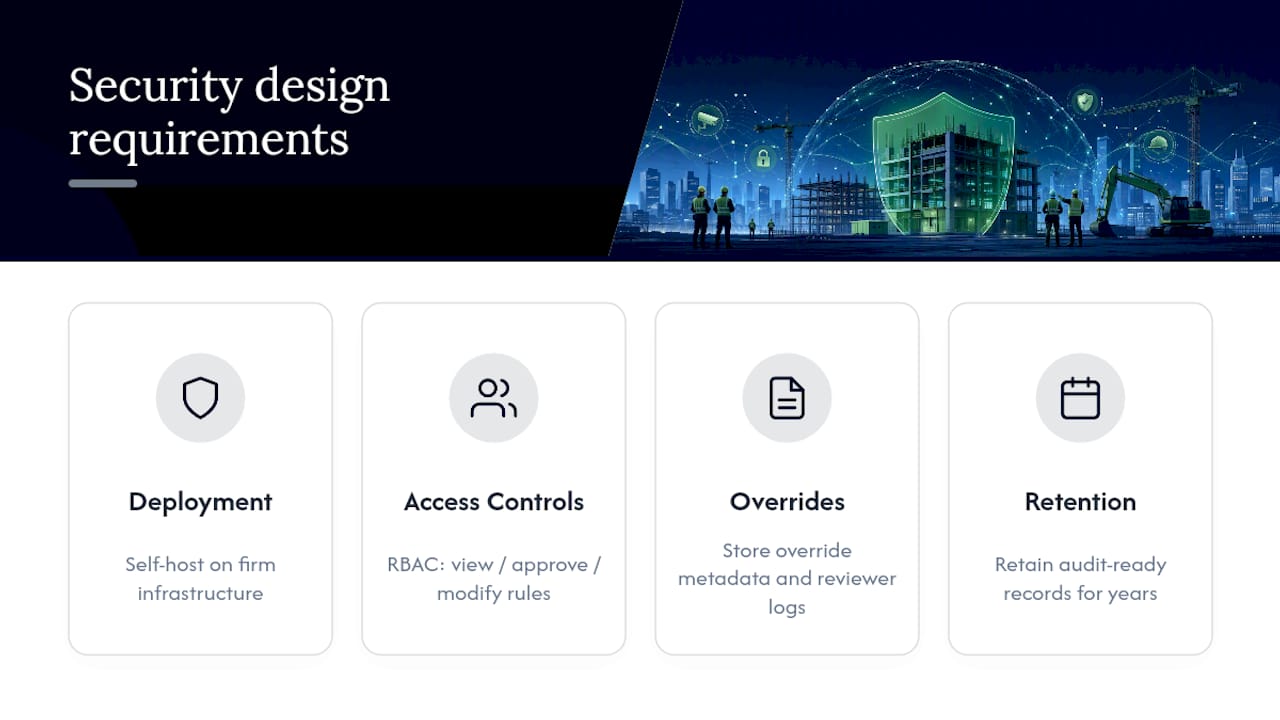
Compliance automation touches sensitive material: unreleased drawings, client contract terms, sometimes personnel data tied to certified payroll on public projects. Treat that exposure the same way you would treat any other sensitive project system, not as an afterthought bolted on after deployment.
Data-sovereign deployment options matter here. Self-hosted configurations of harnesses like ARCHER can reach accuracy close to frontier cloud APIs while keeping project data on infrastructure your firm controls, which matters for public-sector work where data residency requirements are often contractual, not optional. Ask any vendor directly whether extracted drawing data, BIM models, and generated reports stay within your environment or pass through third-party infrastructure you cannot audit.
Access controls need the same rigor as your document management system. Role-based permissions should govern who can view flagged findings, who can approve an override, and who can modify the rule corpus itself. A junior reviewer overriding a life-safety finding without a senior sign-off is a governance failure, not a software bug, and the access control system should make that override impossible rather than just discouraged.
Retention policy deserves explicit attention too. Audit-ready records, including override metadata and reviewer logs, often need to persist for years after project handover to satisfy warranty periods or public-records requests. Build retention into the system design from the start rather than discovering during an audit that logs were purged on a default schedule nobody reviewed.
07
Training staff to use and oversee automated compliance checks
The reviewers who oversee automated findings need training that looks different from a typical software onboarding session. They are not learning where buttons live. They are learning to spot when a tool’s output looks confident but is wrong, which is a harder skill than most firms budget time for.
Start training with the disagreement cases from shadow-mode validation, not with clean successes. Walking a reviewer through the specific instances where the tool missed a local amendment or misread an annotation teaches more about the tool’s actual failure modes than a week of feature demonstrations. Reviewers who only see the tool succeed tend to over-trust it once it goes live.
Assign a small group of champions, not the whole team at once. A handful of reviewers who understand both the code requirements and the tool’s extraction logic can catch systemic issues faster than a wide rollout where everyone has shallow familiarity. Those champions should also own the override log, reviewing patterns in what gets overridden and why, since a spike in overrides on a specific check type usually signals a rule mapping problem, not a run of unusual projects.
Refresh training every time the jurisdiction corpus updates. A reviewer trained on last year’s code edition will not automatically know that a setback requirement changed, and the tool’s own citation trail should be the first thing new training walks through, not the last.
08
What successful automation deployments actually look like
The clearest pattern in successful rollouts is narrow scope first. Firms that try to automate every compliance check across every project type at once tend to stall during validation, because the disagreement rate on a broad, heterogeneous project set is nearly impossible to interpret. Firms that pick one repeatable project type, like a standard multifamily building type or a recurring highway resurfacing scope, get to a stable benchmark far faster.
Safety compliance automation offers a useful parallel case. Practice guides on construction safety workflows describe firms building automated OSHA recordkeeping and certification expiry alerts into their systems, generating inspection-ready packages ahead of scheduled audits rather than scrambling when an inspector arrives. That same discipline, building the audit package continuously rather than reconstructing it after the fact, applies just as well to code compliance reporting on funded infrastructure work.
The firms that stumble tend to share a pattern too: they treat the automated report as the finish line instead of a screening step. A compliance report that flags twelve items is not a passed inspection, it is a worklist for a human reviewer. Projects that ran into trouble usually skipped the shadow-mode validation phase entirely, deploying straight to live use because a deadline was close, only to discover weeks later that the rule corpus had missed a local amendment the whole time.
09
What I would prioritize first
Start with one project type, run shadow-mode validation against two or three completed jobs, and insist on a disagreement rate you can actually defend to an auditor before going live. Pilot narrow, validate hard, then integrate with your BIM and procurement systems once the numbers hold up. That order matters more than which vendor you pick.
10
Where Yesper fits into this workflow
Yesper is built specifically for construction and infrastructure work, which is why it handles the messy middle of this workflow, pulling quantities from a BIM model, checking a drawing set against local code, assembling an audit trail, rather than treating construction as a generic document category. It runs project document search, regulatory compliance checks, and multi-step deliverable creation inside the same environment your team already works in, writing down its assumptions the way a colleague would explain a judgment call.
Teams at firms like AFRY, NRC Group, and Netel already run Yesper across thousands of seats, and customers report 50 to 95 percent time saved on project tasks, with fewer errors slipping through than manual review alone caught. If your firm is looking at pulling quantities directly from an IFC model or wants a partner for the deployment sequence described above, the services team handles discovery, integration, and adoption from pilot through full rollout. Visit Yesper to see the platform or request a pilot on your next project.
How accurate is automated compliance checking compared to manual review?
Accuracy depends heavily on architecture. Deterministic, auditable systems like ARCHER show self-hosted configurations reaching 97.8% of frontier-API accuracy, while naive language-model prompting without verification performs far less reliably on edge cases.
Who is liable if automated compliance software misses a violation?
The engineer or architect of record remains liable, since automation supplements professional judgment rather than replacing the sign-off. Governance controls like documented QA and role-based approvals exist precisely to keep that responsibility clear.
Can regulatory compliance automation handle BIM models and 2D drawings equally well?
Not equally. BIM/IFC models generally produce more accurate results because the geometry and metadata are already structured, while 2D PDFs and DWGs require heavier extraction work and carry more risk of misread annotations.
How long does it take to trust an automated compliance tool on live projects?
Most teams reach limited live use within a quarter and full reliance on a pilot project type within two to three quarters, assuming shadow-mode disagreement rates stay low across several ground-truth projects. That timeline shortens when the rule corpus for the jurisdiction is already mature.
Does Yesper handle regulatory compliance checks directly?
Yes, Yesper runs project-level regulatory compliance checks alongside document search, quantity takeoff, and deliverable creation inside one platform. Current pricing is available directly on the Yesper site, since plans are scoped to each firm’s deployment.
Benjamin GlaserCo-founder at Yesper. Writes about AI and the industry that builds the world.benjamin@yesper.ai
Get news and articles in your inbox.
Unsubscribe anytime.
Yesper is the AI civil engineer for construction and infrastructure. AFRY, COWI, NRC Group and other Nordic firms use it to halve the time on a study, rerun calculations in minutes, and catch errors that would otherwise slip through. Get in touch if you'd like to see what it can do for you.