Prove AI ROI in 5–9 months for construction CFOs


In short
Yes, and the evidence is no longer anecdotal. Document automation, estimating, progress monitoring, and project controls routinely produce measurable returns, with conservative benchmarks showing payback in 5 to 8 months on an $80 million project. The catch is that most firms haven’t gotten there yet: 45% report no AI implementation at all. The next move for decision-makers is simple: baseline your current cycle times and pick one high-confidence pilot before writing a bigger check.
02
The gap between intention and execution has rarely been this wide in construction technology. Industry research shows 56% of surveyed investors plan to increase AI funding, yet very few firms report AI fully embedded across their organization. Nearly half report no implementation whatsoever. That gap is not a failure of technology. It’s a failure of sequencing, measurement, and nerve.
Three forces are converging to make this the year the gap closes. Skilled labor remains scarce across estimating, scheduling, and document control roles, exactly the functions where document-heavy, repetitive cognitive work eats up senior staff time. Project documentation volume keeps climbing, with RFIs, submittals, and change orders multiplying on every job as contracts grow more complex. Margins, meanwhile, stay thin enough that a single missed change order or a scheduling error can wipe out a project’s profit. AI attacks all three problems at once, but only when it’s pointed at the right task.
Here’s what most ROI conversations get backward: they focus entirely on tactical automation, cutting hours out of takeoff or document review, and ignore where the biggest structural value actually sits. Projects with strong early-stage alignment on design and scope deliver cost performance roughly 6.5% below budget, compared to misaligned projects that run over budget and behind schedule. That’s a strategic use case, not a tactical one. Design optioneering, using AI to rapidly compare structural, mechanical, or site-layout alternatives before ground is broken, changes the economics of a project before a single subcontractor is mobilized.
That distinction between tactical and strategic value matters for how you sequence adoption:
The commercial case, then, isn’t “should we adopt AI.” It’s “which use case earns trust fastest, and how do we prove it earned that trust.” That second question is where most ROI conversations should actually start, and it’s the subject of the next section.
03
Not every AI application pays back at the same speed, and treating them as interchangeable is how pilots stall. A systematic literature review of construction project management found that mainstream applications cluster tightly around three areas: cost estimation, scheduling and delay prediction, and safety monitoring using vision and sensor data. That clustering isn’t accidental. Those are the domains with the most structured data and the clearest before-and-after metrics.
Here’s how the highest-impact use cases stack up, ordered roughly by how fast and reliably they pay back.
Document and change-order processing. This is the most repeatable, highest-confidence pilot available to most firms, precisely because the inputs (contracts, RFIs, submittals) are already structured and the outcomes are directly attributable. When AI flags contract discrepancies and accelerates change-order turnaround, conservative contractor benchmarks show payback in 5 to 8 months on an $80 million project, with net recoveries in the hundreds of thousands of dollars under conservative assumptions. Implementation shape: a supervised AI agent that ingests contract documents and flags variance against baseline terms, reviewed by a project engineer before anything goes final.
Statistic Callout: Document and change-order automation is one of the few AI use cases with a documented, conservative payback window under 8 months on a large project, according to contractor benchmarking data. That makes it the natural first pilot for most organizations still building internal trust in AI outputs.
AI-driven estimating and quantity takeoff. Pulling quantities out of a BIM model or a stack of drawings manually is slow and error-prone, and it’s one of the tasks where domain-specific AI shows the clearest separation from general-purpose tools. Industry benchmark compilations report estimation and progress monitoring often showing ROI in the several-hundred-percent range in case examples, though these figures vary widely by project complexity and should be treated as directional rather than guaranteed. Implementation shape: AI extracts quantities from drawings or models, cross-references specifications, and hands estimators a structured takeoff to review rather than build from scratch.
Progress monitoring. Comparing photos, drone footage, or sensor data against the schedule baseline to flag drift early gives project controls teams a head start on corrective action instead of discovering slippage at the monthly report. This falls squarely within the application areas the MDPI systematic review identifies as mainstream and well-evidenced. Implementation shape: automated visual comparison against the four-week look-ahead, with exceptions routed to the superintendent.
Scheduling and project controls. Delay prediction models that flag at-risk activities before they cascade into the critical path let schedulers intervene while options still exist. This is one of the three core application clusters the systematic review found dominates the published research, meaning the evidence base here is deeper than in newer categories like generative design.
Safety analytics. Vision-based monitoring for PPE compliance, fall hazards, and near-misses shows lower headline ROI percentages than estimating or document processing, but the value shows up in insurance premiums and incident-cost avoidance rather than pure labor-hour savings. Treat this as a value-protection use case, not a value-creation one, when building your business case.
Design optioneering. As covered above, this is where the largest structural value sits, but it’s also the hardest to pilot quickly because the feedback loop (did this design decision actually save money) can take months or years to close. Save this for after you’ve built internal measurement discipline on faster-cycle use cases.
Choosing your first use case comes down to three questions: which task has the most structured inputs already, which team is most willing to have its work checked by a machine, and which outcome can you measure within one reporting cycle. Document processing usually wins on all three, which is why it shows up as the recommended starting point in Yesper’s own guidance on rolling out AI in engineering firms.
04
ROI measurement fails most often not because the AI underperforms, but because nobody defined what counted as a benefit before the pilot started. Fix that first, and the math takes care of itself.
Start by separating direct benefits from indirect ones. Direct benefits are dollar-denominated and traceable: hours saved on document review, reduction in change-order variance, fewer rework hours, tighter schedule variance, faster working-capital cycles from quicker invoice and change-order approval. Indirect benefits are real but harder to isolate: improved forecasting accuracy, better staff retention because senior engineers spend less time on repetitive review, and stronger client satisfaction from faster turnaround on deliverables. Industry guidance on AI’s financial impact recommends tracking both categories across three phases: 0 to 6 months, 6 to 12 months, and 12 to 24-plus months, since direct labor savings tend to show up first and organizational benefits compound later.
Here is a repeatable model for building your first business case:
A worked example makes this concrete. Take a mid-size general contractor running a multi-million-dollar project with document controllers spending time weekly on change-order review and contract cross-referencing. At a fully loaded rate of $85 an hour, that’s about $66,000 a year in labor tied to a single workflow. Against typical integration and training costs for a single workflow deployment, payback usually falls inside the 6-to-9-month range this analysis recommends.
Attribution discipline is what separates a credible business case from a vendor pitch. Never claim the full theoretical time savings a tool advertises. Always isolate the specific workflow the AI touches from adjacent work a human still does by hand. And always report a range, not a point estimate, since project complexity swings the outcome more than the tool itself does. For a deeper walkthrough of building this model against your own KPIs, Yesper’s guide to evaluating engineering AI ROI covers the KPI-to-dollar conversion in more detail.
05
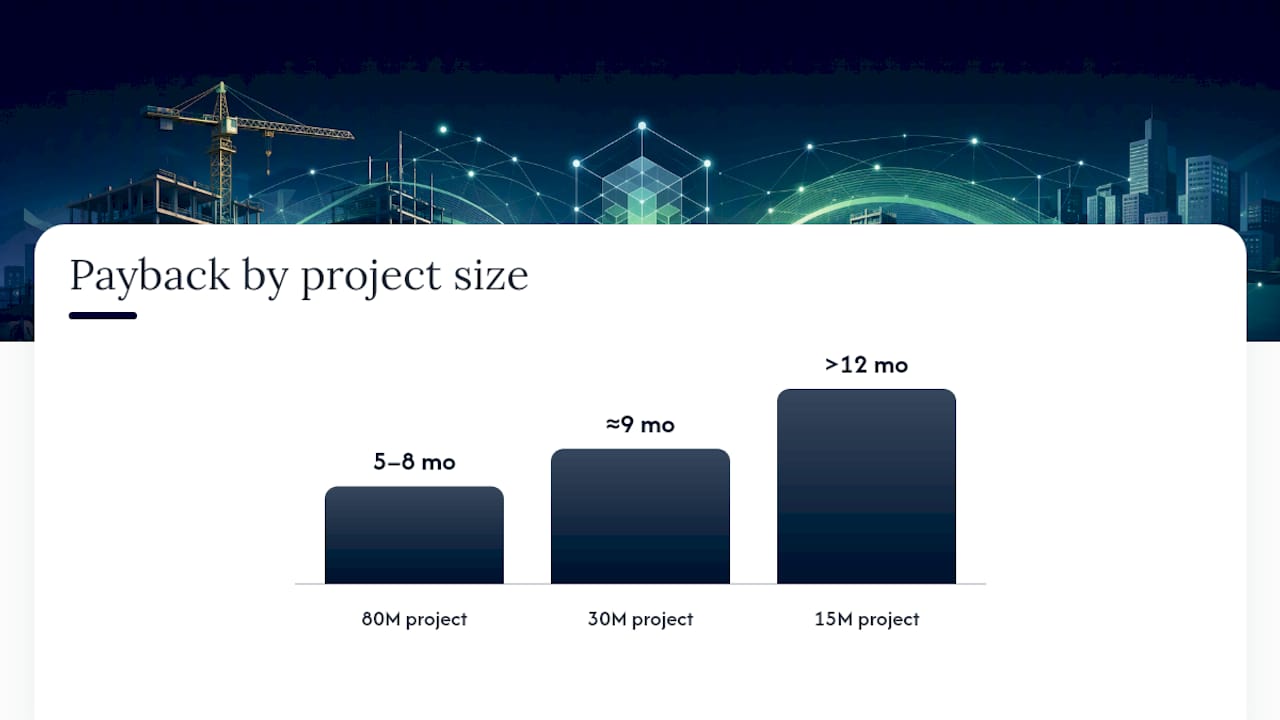
The honest answer is that cost scales with project size faster than benefit does, which is exactly why payback timelines vary so much between an $80 million infrastructure job and a $15 million tenant fit-out.
Implementation cost has four line items that vendors rarely bundle into a single number. Integration hours cover connecting the AI tool to your existing document management or BIM environment, and this is usually the largest variable cost since every firm’s tech stack looks different. Licensing is the recurring subscription fee, typically scaled by seat count or project volume. Training time covers getting project engineers and document controllers comfortable reviewing AI output rather than generating it from scratch, which takes longer than most schedules allow for. Supervised tuning is the ongoing cost of correcting the tool’s assumptions on your specific document formats and regional code requirements during the first few months.
On large projects, that fixed integration cost gets amortized fast. A single $50 million to $80 million project can absorb the setup cost and still show payback within the timelines documented above, because the labor base being automated is large enough to generate meaningful hourly savings even at conservative realization rates. Below roughly $30 million, the math gets tighter. A $30 million project might have one document controller working part-time on the target workflow, which shrinks the addressable labor cost and stretches payback toward the high end of the range, or beyond it.
Statistic Callout: Conservative benchmarking on an $80 million project shows document automation recovering net savings in the hundreds of thousands of dollars within a 5 to 8 month window. Scale matters more than sophistication here. The same tool on a $15 million project won’t hit that window without pooling.
The practical guidance for CFOs and procurement teams evaluating a business case: don’t approve a single-project pilot below $20 to $30 million in contract value unless it’s explicitly structured as a multi-project pooled deployment from day one. Marginal ROI at small scale isn’t a sign the technology doesn’t work. It’s a sign the cost structure needs to be shared.
06
The barriers holding back AI adoption in construction are almost never about the AI itself. Systematic reviews of adoption patterns consistently point to stakeholder resistance, skill shortages, and poor data integration as the dominant obstacles, not model accuracy or output quality.
Data fragmentation is usually the first wall firms hit. Drawings live in one system, contracts in another, and field photos in a third, with no consistent naming convention tying them together. The fix isn’t a massive data cleanup project before you start. It’s a minimal viable dataset: pick the one workflow you’re piloting, define a simple data contract for what “clean input” looks like for that workflow specifically, and leave the rest of your document sprawl alone for now.
Skill shortages show up differently than most firms expect. It’s rarely a shortage of people who can operate the software. It’s a shortage of people who know how to review AI output critically, the same way a senior engineer reviews a junior engineer’s work rather than either blindly trusting it or re-doing it from scratch. Targeted upskilling on review discipline, not tool operation, is where training budget should go first. Vendor partnerships that include structured onboarding tend to compress this learning curve faster than generic software training does.
Governance concerns, explainability and data security chief among them, are legitimate and shouldn’t be waved away. The mitigation is process, not policy documents: require the AI tool to show its assumptions and source references on every deliverable, the same way you’d expect a junior colleague to cite where a number came from. That single practice does more to build institutional trust than any governance committee.
Pro Tip: Run your first pilot on a workflow where a human already reviews the output today. If document controllers already check every change order before it’s filed, adding AI as a first pass doesn’t change your risk exposure, it just changes who does the first read.
Change management is where most pilots quietly die. A tool that works in a four-week trial but never gets folded into the standard weekly workflow isn’t a failed pilot, it’s an unfinished one. Build the AI step into the actual process documentation, not a side tool people forget to open.
07
Scaling AI in construction works best as a stage-gated process, where each stage has to earn its way to the next one rather than getting approved on enthusiasm alone.
Minimal telemetry needed at each gate stays lean: hours logged before and after, a variance count on the specific error type the tool addresses, and a simple pass or fail on whether the human reviewer accepted the AI’s output without major correction. You don’t need a data science team to track this. A shared spreadsheet updated weekly is enough for the first two stages.
Governance requires three roles, not a committee. A data owner is responsible for the quality of inputs feeding the tool. A platform owner manages the vendor relationship and technical integration. A domain subject matter expert, usually a senior project engineer, is accountable for reviewing and signing off on outputs during the supervised period. Skipping the domain SME role is the single most common reason pilots that looked promising in testing fail to earn trust once rolled out broadly. For a longer treatment of avoiding stalled rollouts, Yesper’s operational guide to engineering AI adoption walks through the governance checklist stage by stage.
08
Proof points from firms already running AI in production tell a more grounded story than vendor projections do.
That range matters because it reflects task variance, not inconsistency. A quantity takeoff pulled directly from a BIM model saves more time than a geotechnical report requiring judgment calls on soil classification. What ties both together is domain specialization: a tool built specifically for construction workflows understands regulatory context and document structure in ways a general-purpose model doesn’t, which is why the performance gap between domain-specific and general AI widens sharply as task complexity increases.
The practical takeaway for readers piloting their own AI adoption:
09
Document and change-order processing remains the pilot I’d point every skeptical CFO toward first. It has the shortest measurement cycle, the most structured data, and the clearest attribution path of any use case covered here. Estimating and progress monitoring come next, once your organization has built the muscle of reviewing AI output critically rather than either rubber-stamping it or dismissing it outright.
On buy versus build: build is almost never the right call for a mid-size contractor. The cost of maintaining a model that understands regional building codes, contract structures, and BIM standards is a full-time engineering problem, not a side project for your IT team. Buy from a vendor with construction-specific domain knowledge, and size your first pilot to one workflow, one project, one reporting cycle. Resist the urge to pilot three use cases simultaneously just because budget got approved.
My closing recommendation is unglamorous but it’s the whole game: the firms that win with AI in construction aren’t the ones with the flashiest tool. They’re the ones disciplined enough to measure a baseline before they start and honest enough to report a conservative number when the pilot ends.
10
Yesper is built specifically for the document processing, quantity takeoff, and deliverable creation work covered throughout this guide, not adapted from a general-purpose model after the fact. It reads project documents, drawings, and BIM models the way a specialized colleague would, then writes down its assumptions on every output so a project engineer can review it the same way they’d review a junior team member’s work rather than taking it on faith. That traceability is what lets a pilot survive procurement scrutiny instead of stalling on a governance objection.
If you’re building the business case outlined above, the fastest way to get real numbers instead of vendor estimates is to run a scoped pilot on one workflow. Yesper works with construction and infrastructure teams including AFRY, NRC Group, and Netel on exactly this kind of deployment, from document automation to takeoff to end-to-end deliverable drafting. Visit Yesper’s platform page to see how the integration and review workflow fits your existing systems, or head to Yesper to request a demo and start baselining your own numbers before your next budget cycle.
Sources
FAQ
Yes. Conservative contractor benchmarking shows document and change-order automation paying back in 5 to 8 months on an $80 million project, with net savings in the hundreds of thousands under cautious assumptions. Estimating and progress monitoring show similarly strong results in industry case compilations, though ranges vary widely by project complexity.
Definitions of this rule vary across industries and sources, and no version of it appears in construction-specific research reviewed here. Rather than force a fit, focus on the phased approach construction financial guidance actually recommends: expect direct labor savings in the first 6 months, with organizational benefits compounding over 6 to 24 months.
No. AI in construction currently automates specific tasks within workflows, document review, takeoff, progress comparison, not entire jobs or trades. The clustering of proven applications around cost estimation, scheduling, and safety monitoring shows AI acting as a review and acceleration layer, with human judgment still governing final decisions on complex engineering deliverables.
ROI combines direct, dollar-denominated benefits (hours saved, reduced change-order variance, faster approval cycles) with indirect benefits like improved forecasting and staff retention. The most credible business cases apply a conservative realization rate of 50 to 70% of theoretical time savings rather than a vendor’s best-case projection.
On large projects ($50 million to $80 million), payback typically lands within 5 to 9 months for document-heavy workflows. Smaller projects under $20 to $30 million often need pooled deployment across multiple jobs to reach a comparable payback window, since a single small project rarely generates enough labor-hour savings to cover integration costs alone.
Get news and articles in your inbox.
Yesper is the AI civil engineer for construction and infrastructure. AFRY, COWI, NRC Group and other Nordic firms use it to halve the time on a study, rerun calculations in minutes, and catch errors that would otherwise slip through. Get in touch if you'd like to see what it can do for you.
Book demo