Construction document control is the discipline of managing who creates, reviews, approves, and distributes project documents, with a verifiable trail for every version. The single most important move a project team can make is sequencing it correctly: define your document workflows first, then configure a Common Data Environment governed by ISO 19650 metadata and version rules around those workflows, not the other way around. Get that order right and you cut rework, produce an audit trail that survives a dispute, and speed up approvals across the board.
In short
01
Documents are where construction risk actually lives. A superseded drawing issued to a subcontractor, an approval that never got logged, a spec revision that sat in someone’s inbox for two weeks. These are not paperwork failures. They are the mechanism through which schedule slippage and cost overruns actually happen on site.

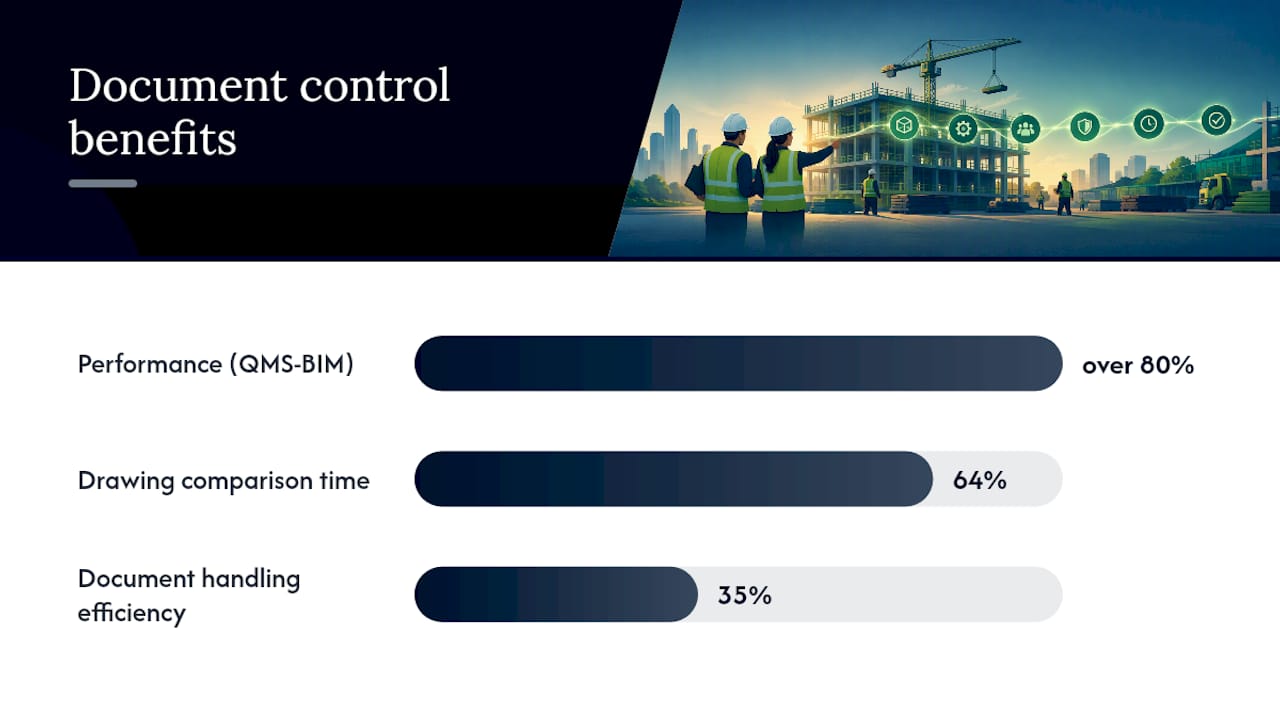
The evidence for treating this as a controls discipline rather than clerical work is direct. A JCEM study published by ASCE found that integrating quality documentation into Building Information Modeling, an approach researchers label QMS-BIM, delivered over 80% better performance than conventional systems in a tested field scenario, largely by catching inspection issues before they became reactive rework. Separately, a pilot of an AI-enhanced centralized digital workflow documented in the IJRISS journal cut drawing-comparison time by 64% and lifted document handling efficiency by 35% against manual, email-and-shared-drive processes.
The operational payoff shows up in a few concrete places:
02
Every construction project document moves through the same basic sequence, whether the team realizes it or not. Making that sequence explicit, and assigning ownership at each stage, is what separates functioning document control from chaos with a folder structure on top of it.
Milestone gates deserve special attention. At each major project milestone, someone with real authority, not just the document controller, needs to formally accept the current document set before the project moves forward. Skipping that checkpoint is how outdated drawings quietly survive into construction.
Pro Tip: Log the information state, WIP or published, as metadata on the file itself, not in a separate spreadsheet. A spreadsheet gets out of sync within a week; metadata that travels with the container does not.
03
Most document control failures trace back to a handful of preventable habits, not a lack of software. Fix these and the rest tends to fall into place.
| Practice area | Core rule | Common failure it prevents |
|---|---|---|
| Naming convention | One project-wide, ISO 19650 aligned ID scheme | Duplicate or ambiguous file names across disciplines |
| Versioning | Fixed notation for WIP vs. issued revisions | Field teams building from a superseded drawing |
| Distribution | Role-based access, logged transmittals | Unauthorized parties seeing commercially sensitive content |
| Closeout | Handover checklist defined at kickoff | Incomplete as-built package at project end |
The Fieldwire guide to construction document control walks through similar territory from a field-operations angle, and it is worth reading if your gaps are more about site adoption than system design.
04
A Common Data Environment is not a piece of software. It is workflows plus a technical platform, and the workflows come first. That framing comes straight from the UK BIM Framework’s guidance on CDE workflows, which stresses that selecting a technical solution before agreeing on the underlying process is one of the most common causes of CDE failure.
Under ISO 19650, the appointing party is accountable for the project CDE existing and functioning before information exchange begins in earnest. Waiting until design starts to sort out the CDE is already too late.
When you configure or accept a CDE, insist on these metadata fields for every container:
One practical headache: when different delivery teams run different CDE platforms, metadata does not always transfer cleanly between systems. Agree in advance how metadata will be preserved or manually reconciled during any handoff, and never let folder structures substitute for the metadata itself. A folder name is not a status code.
05
Document control breaks down most often at the boundary between roles, when everyone assumes someone else logged the approval. ISO 19650 draws clear lines that projects ignore at their own risk.
Governance sits on top of these roles as a set of checkpoints, not paperwork for its own sake. Someone with real authority signs off at each milestone. Non-compliant documents get flagged and corrected before they propagate. And a short lessons-learned review after each phase catches process gaps before they repeat on the next project.
06
Buy the workflow, not the demo. Map your Exchange Information Requirements and BIM Execution Plan first, then evaluate software against that map, because a beautifully designed platform that does not match how your teams actually approve documents will get bypassed within a month.
Features that separate genuine document control platforms from glorified file storage:
Ask any vendor how metadata survives an export to another system, and ask for a live demonstration of drawing comparison on a real revision set, not a scripted one.
Pro Tip: Run a two-week pilot using your own messiest live project, not a clean sample dataset. Software that looks great on tidy demo data often falls apart on the naming inconsistencies your actual projects have accumulated.
07
Building competency does not require hiring a specialist for every project, but it does require deliberate practice. Short, ISO 19650 aligned courses, such as the BRE Academy’s course on delivering information management in practice, give project staff a working grasp of CDE structure and status codes in a matter of days.
08
Most document control breakdowns repeat the same three patterns: fragmented systems where teams save files in personal drives instead of the CDE, naming ambiguity that makes two revisions look identical, and distribution delays that leave field crews working from outdated information.
Escalate to project governance the moment a non-compliant document reaches the field, rather than waiting to see if it causes a problem.
09
Document control has quietly moved from clerical task to a genuine project-controls function, on par with cost and schedule management. Strong governance here reduces litigation exposure and produces a handover package an owner can actually trust. Treat your CDE and workflows as assets that outlive the project.
10
Document control demands workflows and metadata discipline first. Software second. Yesper is built around that same principle: it works inside your existing project structure, understanding construction-specific regulations and document workflows rather than forcing your team into a generic file-sharing tool. It produces deliverables end-to-end, writes down its assumptions for review, and connects with the systems your teams already use, which matters when metadata needs to survive a handoff between platforms rather than get lost in translation.
Some customers report significant time savings on document-heavy tasks and catching errors that human reviewers missed. If your team is drowning in review cycles and version confusion, book a demo to see how it fits into a document control setup.
FAQ
Construction document control is the governance process that manages creation, review, approval, distribution, and archiving of project documents, with a verifiable audit trail for each step. It differs from basic document management, which is just storage and retrieval, because control adds accountability: who approved what, and when.
There is no single best CRM for construction because the right tool depends on whether you need client relationship tracking, project document control, or both combined. Many construction firms pair a standard CRM for sales and client contact with a dedicated document control or Common Data Environment system for project records, since the two solve different problems.
Document control can be demanding during active project phases, particularly at approval milestones and handover, when volume and deadline pressure both spike. Clear workflows, defined naming conventions, and defined roles reduce that pressure significantly, since most of the stress in the role comes from ambiguity rather than the workload itself.
Effective document control needs a documented naming convention, defined revision and status codes, role-based distribution rules, an audit trail of approvals, and a closeout process for handover. It also needs clear ownership among the appointing party, lead appointed party, and document controller, so no document falls into an accountability gap.

This post was written with AI assistance and published by Yesper. General information, not professional advice: requirements vary by project and jurisdiction, and the professional responsible for the project decides what applies. Spotted an error? Write to benjamin@yesper.ai.
Get news and articles in your inbox.
Yesper is the AI civil engineer for construction and infrastructure. AFRY, COWI, NRC Group and other Nordic firms use it to halve the time on a study, rerun calculations in minutes, and catch errors that would otherwise slip through. Get in touch if you'd like to see what it can do for you.
Book demo