Construction is fragmented on purpose

In March 2015 Sweden's Supreme Court ruled that thirty-four houses outside Malmö had defective facades. Nine months later, three days before Christmas, the same court decided a different question in the same case: whose defect it was. Two rulings, because the built world runs on two separate questions. Most technology ever sold to this industry has only understood the first one.

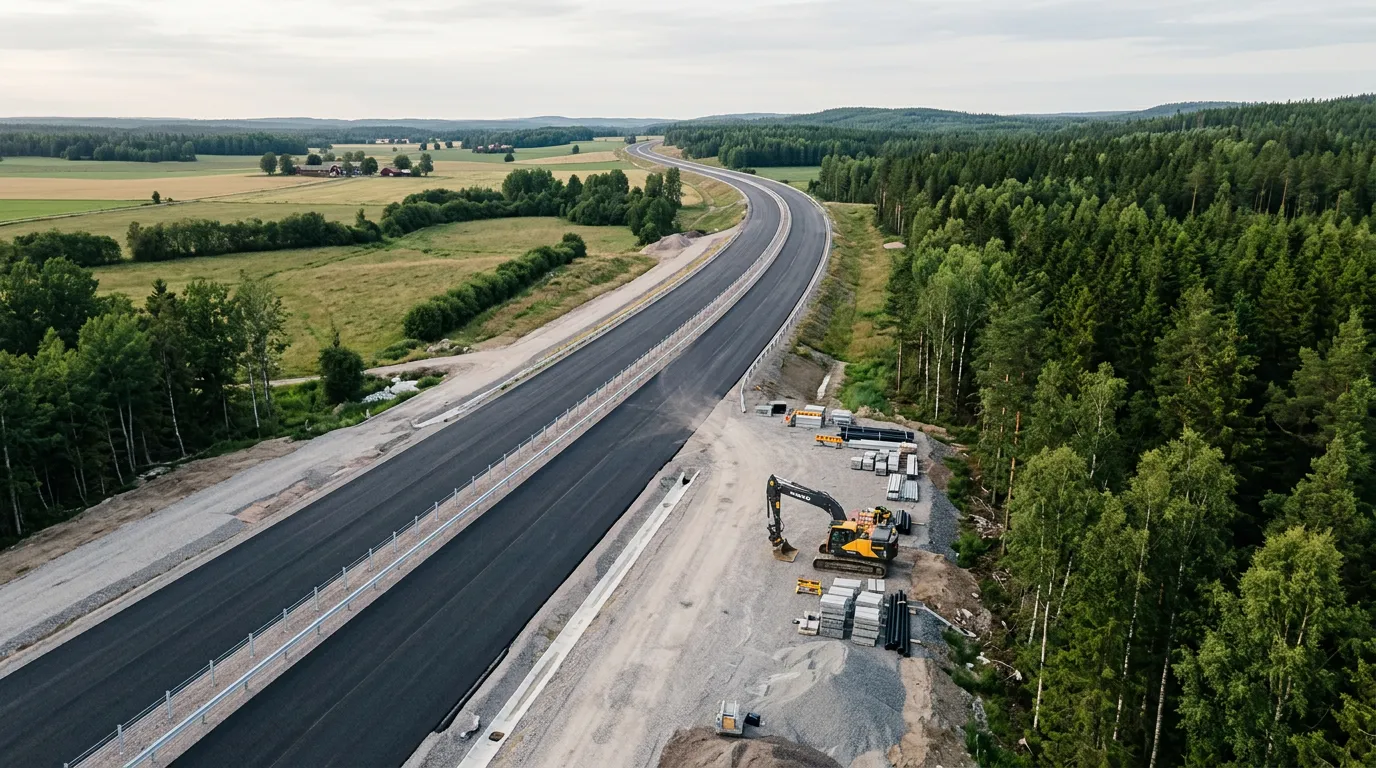
Newly paved road curving through forest, with a construction staging area at its edge

First that it was wrong, then whose it was

Between 1999 and 2003 Myresjöhus, one of Sweden's largest house builders, put up thirty-four catalogue homes in Erlandsdal, a quiet grid of streets in Svedala south of Malmö. The facades were rendered in a single step: plaster straight onto the insulation, no air gap, no drainage path. The method was cheap and in use across the country. It also, as the residents gradually discovered, let moisture in.

The Supreme Court needed two judgments to dispose of the case. In March 2015 it held that the construction involved such risks of mould, rot and bad smells that the houses were defective; the question of fault was left open. That answer came in December: Myresjöhus had adopted the method without any real investigation of its soundness, so the uncertainty, in the court's words, would fall on the company. "This is a relief," Patrik Bredberg, one of the owners, told SVT. "We have waited eight years for this." The company's group counsel, Pär Krohn, drew a different moral: the construction had been type-approved by a public authority, and the judgment gave that no weight at all. The following summer the parties settled, and thirty-two households chose between a rebuilt two-stage facade, priced by the consumer authority at 300,000 to 500,000 kronor per house, and financial compensation.

Note what the eight years were spent on. Whether the walls were wet could be measured. The years went to deciding where, among the builder who chose the method, the authority that approved it and the families who bought the houses, the mistake would finally come to rest.

A risk map redrawn every decade

The liability rules that decided the case sit in no statute book; they are negotiated. The national engineering society adopted its first general conditions for building contracts in 1906. The first edition covering both buildings and civil works arrived in 1936, the next in 1954 with eight industry organisations behind it, then 1965, 1972, 1992, 2004. After the 1972 round the negotiators made themselves permanent as the Construction Contracts Committee, BKK, a standing body of clients, contractors and consultants whose declared aim, to this day, is an optimal allocation of risk between the parties. The rulebook that decides who owes what on a Swedish site is a treaty, redrawn about once a decade, by the parties themselves.

Allocation of risk is also what the documents spend their pages on. The standard works contract, AB 04, makes each party responsible for the accuracy of the information it supplies, and the other side's approval moves nothing. The ÄTA rules, governing alterations and additions, exist to decide in real time whose wallet each gap between the documents and the ground lands in. The choice between Sweden's two main procurement forms, one where the client owns the design and one where the contractor does, is a decision about who will own the design errors, taken before a single technical solution exists. The consultants' standard contract, ABK 09, caps a firm's liability at 120 price base amounts, roughly seven million kronor, and requires insurance against precisely that liability for ten years after the assignment ends. The insurance follows the firm, never the project; a firm that winds down is expected to buy run-off cover, so that its address outlives it.

From the outside, an industry of temporary coalitions, hundreds of firms assembling around a project and dispersing when it opens, looks like a market that failed to consolidate. From inside the contracts it looks like the point. "That's what fragmentation buys: the division of liability," writes Irénée, the author of the newsletter Walking Distance, in a July essay on why forty years of software left the industry's economics untouched. "The boundaries between stakeholders are not just organizational, they're legal firewalls." A set of drawings, she notes, is a record of what its author is willing to stand behind. The industry is not fragmented because nobody managed to unite it. It is fragmented so that every mistake has an address.
Two billion dollars against the seams

The clearest way to test whether the seams are load-bearing is to price the attempts to remove them. Katerra, founded in 2015 by the former Flextronics chief executive Michael Marks, set out to be factory, architect and contractor in a single company, with a 53,000-square-metre manufacturing plant in Tracy, California, an in-house architecture firm, and SoftBank capital behind it: more than two billion dollars raised, a valuation approaching four billion at its peak. It filed for bankruptcy in June 2021. The post-mortems in the American trade press kept arriving at the same organ. Developers stayed with their "very sticky relationships with their own engineers, own suppliers and their own construction relationships", as one investor put it. The factory in Tracy was bought and restarted within months. The idea of replacing the coalition with a corporation was not.

Software aimed at the seams has done little better. Researchers who spent a year inside BIM-coordinated commercial projects found them "tightly coupled technologically, but divided organizationally": the shared model made the dependencies between firms visible without making the firms one organisation, because every participant still answered to its own scope, its own project and its own company. Britain mandated shared building models on central government projects in 2016; two years on, fewer than a fifth of surveyed professionals thought the industry was delivering on the mandate. The exception proves the rule with some precision. Getting one British project, a college building in Dudley, insured as a single project rather than as a stack of separate firms took a Cabinet Office pilot programme and a purpose-built insurance product, and the model has not spread since.

When a mistake has no address

None of this is a defence of the machinery as it stands, and the reason has a place name. Grenfell Tower burned in the early hours of 14 June 2017, from a kitchen fire that broke out at 00.54; 72 people died in a building whose concrete frame was, in the inquiry's words, structurally impervious to fire. Seven years of public inquiry then put the industry's accountability machinery on display. Rydon, the main refurbishment contractor, "did not understand where responsibility for individual decisions lay", the final report found. Richard Millett, counsel to the inquiry, had opened by inviting the parties not to indulge in a merry-go-round of buck-passing, and stood up on day 312 of the second phase to note that the merry-go-round was turning still: with a single exception, no participant had made one unqualified admission against its own interest.

The failure mode on display was mistakes falling where no address reached, decisions nobody understood themselves to own; the trouble was never the number of addresses but the territory left uncovered between them. The inquiry's remedy pointed the same way. It did not propose merging the industry's parties; it proposed unifying who watches them, calling the fragmentation of regulatory responsibility "a recipe for inefficiency and an obstacle to effective regulation". The architecture's own justification is that blame can be found, and where it cannot, the system has failed on the only terms it ever claimed for itself.

The question every new tool gets asked

The reason to understand all this in 2026 is that a new class of tools has begun to produce engineering documents rather than store them, and every one of them will be asked the industry's entry question: who answers for your mistakes? A tool that works across the seams, reading one firm's model in order to write into another firm's deliverable, has no good answer; there is no party in the AB family of contracts called the platform. A tool that works inside one firm, producing drafts that travel the firm's own review ladder toward the firm's own stamp, inherits an answer that has existed since 1906. The deliverable acquires its address at the moment someone approves it, exactly as it did when every line was drawn by hand. Nothing in the liability architecture has to move: not the coalition, not the contracts, not the ten-year insurance, not the negotiated treaty underneath them all.

That is also where the leverage sits. The firms whose names already stand in the corner of the drawings, the consultancies and the contractors, can put machine-produced work under signatures they already own, while anything that requires the industry to move together is asking the industry for the one thing it is built not to do. The Swedish standard for construction documents specifies what that corner box must contain: the handling's status, the date, and the name of the person who approved it. The box has never asked how the drawing was made.

  1. Högsta domstolen, NJA 2015 s. 110 (judgment 19 March 2015, case T 916-13) and NJA 2015 s. 1040 (judgment 22 December 2015).
  2. SVT Nyheter, "Ny dom om fuktskadade husfasader", 22 December 2015.
  3. Byggkoll (Svensk Byggtjänst), "Myresjöhus och villaägare i miljonförlikning", August 2016.
  4. Per Samuelsson, "Den svenska entreprenadrättens framväxt inom bygg- och anläggningssektorerna", Svensk Juristtidning 2017 p. 173.
  5. Byggandets Kontraktskommitté, foreningenbkk.se.
  6. Innovationsföretagen, "Frågor och svar vid förhandling av avtal – ABK 09" (liability cap, insurance duty, ten-year liability period).
  7. Irénée, "AEC 101", Walking Distance (Substack), 9 July 2026.
  8. TechCrunch, on Katerra's shutdown, 1 June 2021, and Construction Dive, "What does Katerra's demise mean for the contech and modular industries?", June 2021.
  9. Carrie Sturts Dossick & Gina Neff, "Organizational Divisions in BIM-Enabled Commercial Construction", Journal of Construction Engineering and Management 136(4), 2010.
  10. NBS, National BIM Report 2016, and Construction Manager, on the 2018 BIM survey.
  11. Constructing Excellence, "Integrated Project Insurance case study: Dudley College".
  12. Grenfell Tower Inquiry, Phase 2 Report, 4 September 2024, and Construction Management, on Richard Millett's opening address, January 2020.
  13. Stockholms stad, Teknisk handbok, Del 1: Informationshantering och klassificering (title block requirements, review statuses), rev. 2025.
Benjamin Glaser Co-founder at Yesper. Writes about AI and the industry that builds the world. benjamin@yesper.ai

Yesper is the AI civil engineer for construction and infrastructure. AFRY, COWI, NRC Group and other Nordic firms use it to halve the time on a study, rerun calculations in minutes, and catch errors that would otherwise slip through. Get in touch if you'd like to see what it can do for you.

Book demo