Optimize the process before you automate it, design every automated step so its failure can be seen, and keep a named person accountable for verifying the output. Start by mapping the workflow, run a short pilot on a high-value task, and add an independent checking mechanism from day one. The DWP Digital robotic process automation case shows what a disciplined pilot can return.
In short
01
The most consistent lesson is sequence. Automating an inefficient process multiplies waste and reduces long-term value, so the manual process gets fixed before it gets digitized. Teams that skip this step end up with a fast version of a bad workflow.
The second lesson is that automation works best as a partnership. The Defra digital team describes human-automation teaming as automation taking repetitive tasks while people apply higher-level skills, with humans involved in testing and verification to build trust.
The third is that people over-trust machines. A systematic review of automation bias found that bias and complacency are reduced by training, accountability, adaptive design, visible confidence levels, and presenting information rather than commands.
What this means in practice:
DWP Digital reported an automation pilot implemented in 12 weeks that cleared a 30,000-claim backlog in 2 weeks, with a 15:1 return on investment. The point is not the headline ratio. A narrow, well-understood workflow produced measurable value fast.
Pro Tip: Treat the checking mechanism as part of the automation scope, not an afterthought, so detection is budgeted from the first sprint.

02
Resilience comes from decisions made before the first line of configuration. The order below keeps value and recoverability together.
Field teams often discover their real exceptions only during mapping. The mobile-first rollout from Dirt Champ is a practical example of digitizing site paperwork in a way that supervisors actually use. For structural and BIM work, Xponexus describes AI and BIM automation approaches aimed at engineering practice.
Pro Tip: Write the acceptance criteria before the pilot starts, so nobody redefines success after seeing the results.
03
Measurement is where many automation programs lose their sponsors. Pick a small set of indicators before the pilot begins and report them in plain business terms.
Keep pilots narrow. Staffordshire County Council’s RPA examples emphasize a clear vision, in-house expertise, collaboration and change management, and report notable hours saved and measurable short-term benefits.
The DWP pilot took 12 weeks to implement, against a historical 40 weeks, which makes it a useful benchmark for time to value. Use it as a yardstick for your own timeline, not a promise.
When you report, favor a one-page dashboard and a short summary tied to a business outcome, such as a cleared backlog or faster invoicing. For finance audiences, our guidance on proving AI ROI for construction CFOs covers how to frame it.
04
Most damage appears after deployment, when attention moves on. Several failure modes recur, and each has a direct counter.
The review of automation error management frames the human task as detection, explanation and correction, and notes that reliability, feedback and training shape how well people recover. Build each of those three steps into the design rather than hoping they emerge.
Pro Tip: Run failure drills in which a reviewer must find a deliberately planted error. If nobody finds it, the checks are decorative.
05
Automation holds its value only when the people around it stay capable. Training and governance are how you keep them so.
For regulated engineering checks, our notes on compliance checks that keep audit proof show how governance and automation fit together.
06
Leaders tend to over-invest in tooling and under-invest in clarity. Process clarity, visible checks, documentation and training can help a pilot scale. A small pilot on a well-understood workflow can be easier to assess than an ambitious program on a murky one. Every flow needs a point where a person can see what happened and say no. Documentation and training can help people understand the system and recover from failures.
07
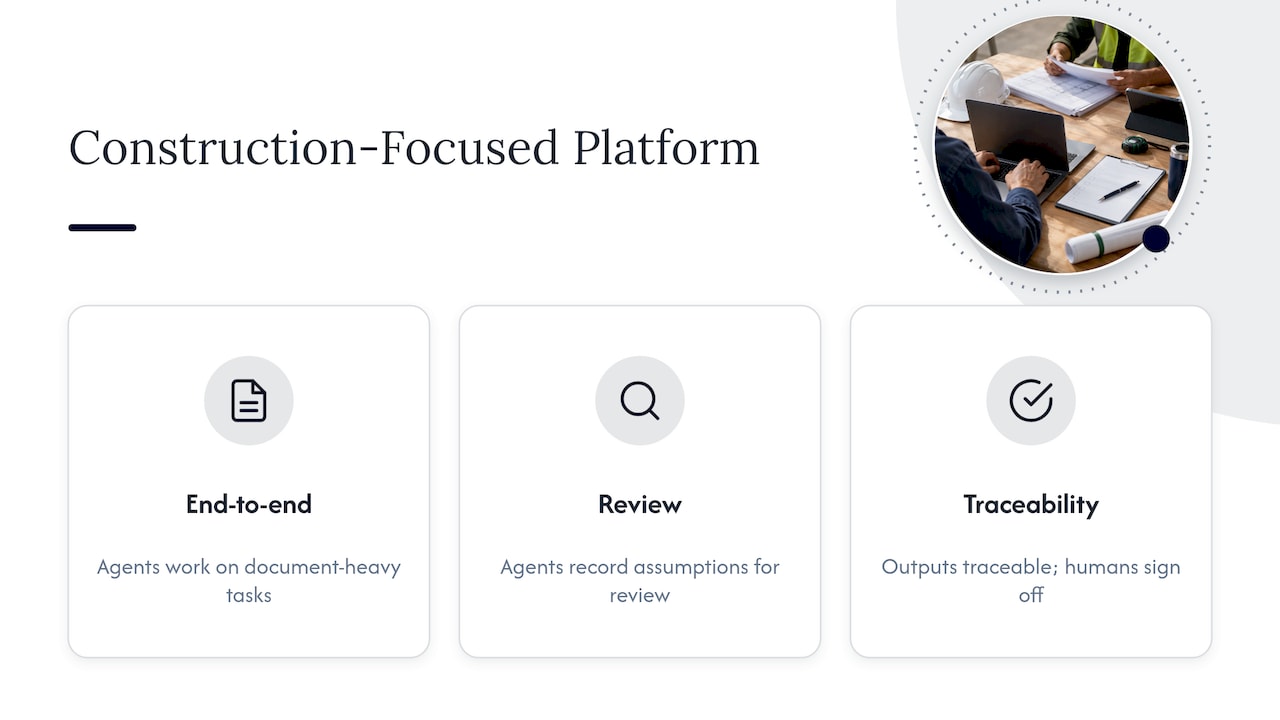
Generic tools leave your team to supply domain knowledge, regulations and document formats. We built Yesper as an AI civil engineer for construction and infrastructure, so our agents work end-to-end on document-heavy tasks, record their assumptions for review, and keep outputs traceable to sources, with humans signing off. That focus shortens the road from the first workflow to usable results. To see how it works, book a demo.

FAQ
A common classification lists fixed (hard) automation, programmable automation, flexible automation and, in many textbooks, integrated automation. Definitions vary by field, so check which taxonomy your organization uses before comparing vendors.
Automating an inefficient process multiplies its waste and reduces long-term value. Mapping and simplifying the manual steps first gives you a clean baseline to measure against.
Show confidence levels, present information rather than commands, and make verification someone’s accountable duty. A systematic review found that training, accountability and adaptive design mitigate bias and complacency.
Give reviewers an independent, simple way to check outputs. In experiments, voluntary checking tools improved failure detection, although intervention could still be slower than in manual work.
This post was written with AI assistance and published by Yesper. General information, not professional advice: requirements vary by project and jurisdiction, and the professional responsible for the project decides what applies. Spotted an error? Write to benjamin@yesper.ai.
Get news and articles in your inbox.
Yesper is the AI civil engineer for construction and infrastructure. AFRY, COWI, NRC Group and other Nordic firms use it to halve the time on a study, rerun calculations in minutes, and catch errors that would otherwise slip through. Get in touch if you'd like to see what it can do for you.
Book demo