Engineering compliance checks: BIM and AI without losing audit proof

An engineering compliance check confirms that inputs are correct, verifies that a design or facility meets applicable codes and standards, and produces an auditable record of findings and corrective actions. In practice, that means confirming your input list and risk-assessment scope before any review begins, the way EGBC’s documented checks guidance and ISO’s auditing guidance both prescribe, with automation from tools that assist in compliance once that scope is fixed.

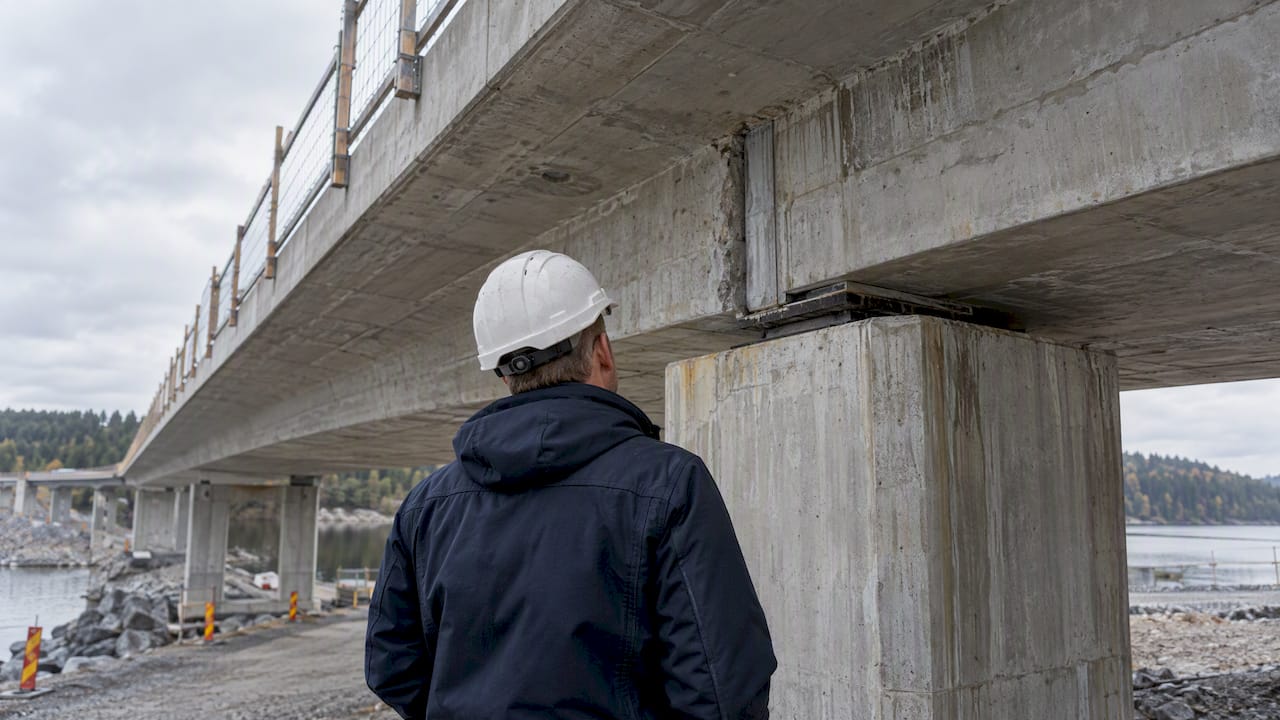
Engineer inspecting a concrete bridge joint
  • Set review depth through a documented risk assessment, and assign a qualified, sufficiently independent checker rather than asking designers to approve their own work.
  • Keep each record tied to the exact drawing or input revision, with the checker, date, scope, findings, corrective actions, and supporting evidence captured for later audits.
  • Use automation for repetitive checks, but require an engineer to review ambiguous findings and link every automated result to the model or drawing revision.
  • Restart a scoped review when codes change, a facility changes use, a retrofit occurs, or field conditions depart from the design basis.
  • Schedule checks as project milestones, and route manual and automated findings through one corrective action log so unresolved issues block dependent work.

What engineering compliance checks cover and why they matter

A compliance check is rarely one review. It is a sequence that touches input data, calculations, drawings, specifications, test records, and field inspections, each with its own failure mode and its own evidence trail. Input data errors propagate: a wrong soil bearing value or an outdated load case travels through every downstream calculation unless someone catches it at the source.

Checks exist for reasons that are easy to state and expensive to ignore. Safety sits at the top: a missed code clause in a structural or fire-protection design is not an abstract risk once the building is occupied. Legal exposure follows close behind, since a signed-and-sealed deliverable that fails to meet a referenced standard can trigger liability regardless of intent. Beyond the legal floor, there is the deliverable quality that clients and authorities having jurisdiction expect as a baseline, not a bonus, and the plain economics of rework: fixing a clash or a miscalculation before issue is a fraction of the cost of fixing it after fabrication or pour.

It helps to separate two questions that checks often blur together. Verification asks whether a design meets the stated input requirements, loads, codes, and specifications it was supposed to satisfy. Validation asks the harder question of whether the design actually suits its intended use once those requirements are met. A beam can pass every calculation check and still be the wrong beam for how the building will actually be used.

Which standards and audit expectations should you reference?

Engineers and Geoscientists BC publishes one of the clearer operational standards in this space. Its guide to documented checks requires a systematic review of input data and the retention of records that name who checked the work, the date it was checked, what was reviewed, what issues turned up, and what corrective action followed. The standard ties the intensity of that review to project risk level rather than applying one procedure to every job, and it expects the resulting records to survive an audit years later.

ISO’s technical committee on quality management takes a parallel but distinct angle. Its design and development auditing guidance frames compliance checking as an assessment of whether an organization actually considered its context, its risks, and its stakeholders, not merely whether boxes got ticked. Auditors under this guidance look specifically at design reviews, verification and validation activities, and change controls, and they expect records showing that validation happened and that any deviation was addressed rather than quietly dropped.

Both frameworks sit inside a longer-term shift that NIST’s forward-looking codes and standards report describes: a move away from purely prescriptive checklists toward adaptive, performance-based approaches, driven by gaps between current codes and evolving, nonstationary hazards. A related NIST technical note on resilience in codes and standards reinforces this by tracing technical gaps across infrastructure sectors and recommending clearer traceability back to referenced standards such as ASCE 7, NFPA, and ICC codes. Underneath all of this sits the plan-do-check-act cycle in ISO 9001, which gives documented checking a repeatable structure rather than a one-off event.

A step-by-step compliance check workflow you can run

A documented check works best as a sequence, not a single gate. The steps below move from pre-design confirmation through construction and into the retention work that makes the whole process auditable later.

  1. Confirm input requirements. Lock down loads, site data, codes in force, and client-specific criteria before any calculation starts.
  2. Perform a documented risk assessment. Set the depth of checking to match the consequence of failure, following the risk-based approach EGBC’s standard requires.
  3. Assign a qualified, sufficiently independent checker. The reviewer should have the competence to catch errors the original author is least likely to see in their own work.
  4. Review calculations and modeling assumptions. Confirm that the math matches the stated inputs and that any simplifying assumption is written down, not implied.
  5. Run cross-discipline coordination checks. Structural, mechanical, and electrical scopes need to agree on penetrations, loads, and clearances before issue, and specification conflicts between them should be logged as they are found.
  6. Verify through simulation or testing where applicable. Some claims, particularly around thermal, seismic, or fire performance, need analysis beyond hand calculation.
  7. Conduct field inspections against the issued design. Confirm installed conditions match what was approved, not what was originally drawn.
  8. Log test evidence and nonconformances as they occur. A nonconformance that is not written down at the time tends to get forgotten or disputed later.
  9. Track corrective actions to closure. Every finding needs an owner, a fix, and a sign-off, not just a note in a meeting.
  10. Carry out commissioning and operations and maintenance handover checks. Confirm the as-built condition matches the operating documentation.
  11. Set triggers for re-checks over the asset’s life. A code update, a change in use, or a retrofit should restart a scoped version of this sequence.
  12. Retain the full record set. Approvals, corrective actions, and supporting evidence need to be stored somewhere an auditor or future engineer can actually find them.

Each step produces its own piece of evidence, and the value of the workflow comes from how those pieces connect, not from any single step in isolation.

How do BIM and AI fit into compliance checking?

Automation in this space falls into a few distinct categories, and conflating them leads to disappointment. Inspection and checklist apps digitize the field walk but still depend on a human filling in the answers. BIM rule-checkers compare a model against coded rule sets and flag geometric or parametric violations. Model extractors pull quantities, clash reports, or schedules out of a BIM model without requiring manual takeoff. AI-assisted document search and triage tools scan specifications, drawings, and correspondence to surface the clauses relevant to a given question, cutting the time spent hunting through a project’s document set.

  • Inspection and checklist apps standardize field data capture and timestamp entries automatically.
  • BIM rule-checkers compare models against coded rule sets to flag geometric or clash violations.
  • Model extractors generate quantities and schedules directly from a coordinated model, as the fundamentals of building information modeling describe.
  • AI-assisted document search surfaces the specification clauses and prior correspondence relevant to a specific compliance question.

The realistic gain from these tools is speed, consistency, and earlier error detection, not a replacement for professional judgment. Where a code clause is ambiguous or where a design condition falls outside a prescriptive rule, a reviewing engineer still has to interpret it and write down the reasoning. NIST’s forward-looking codes work makes a related point: as codes shift toward performance-based criteria, implicit gaps become more common, and documenting the judgment used to resolve them matters more, not less.

The practical integration work is less glamorous than the tools themselves. Tool outputs need to feed into document control, issue trackers, and commissioning logs rather than live in a separate silo, and every automated finding needs a version reference back to the model or drawing revision that produced it. Our guidance on drawing revision control covers how to keep that traceability intact as drawings move through revisions.

Pro Tip: Route every automated finding through the same corrective-action log as manual findings, so an auditor sees one record set instead of two competing ones.

Documenting checks: What records do you need to keep?

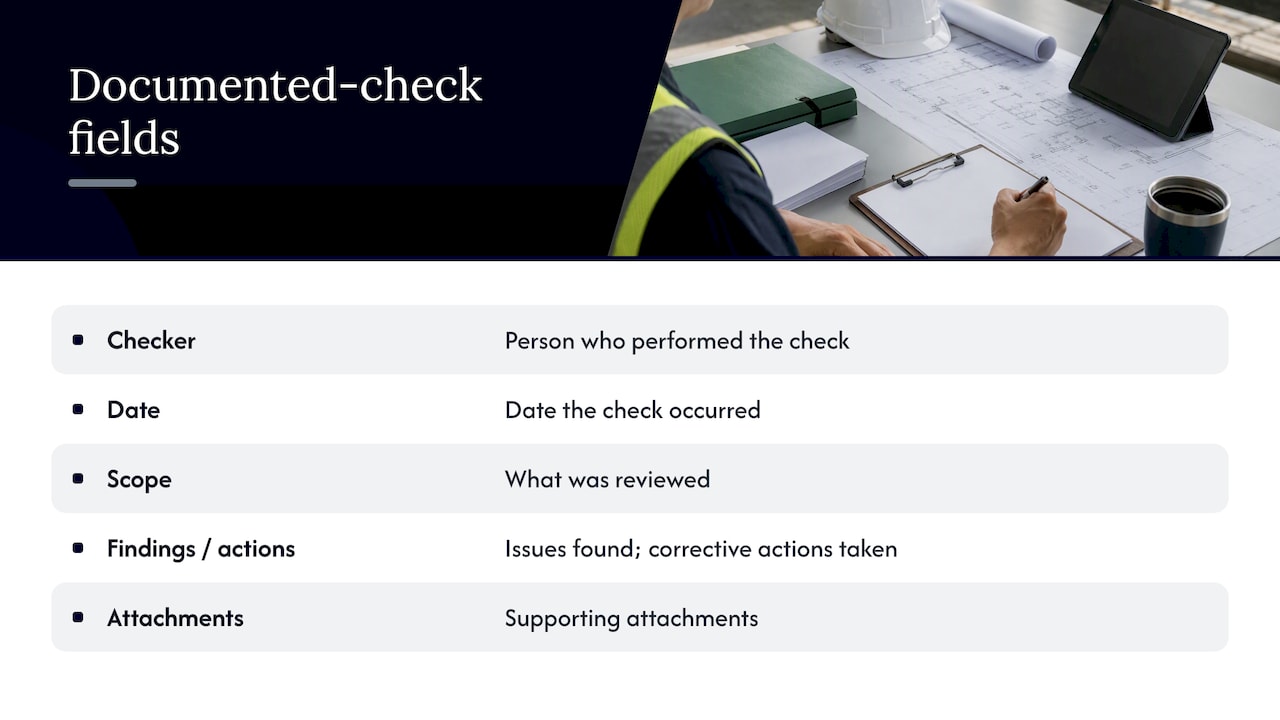
An audit-ready record is only as good as its weakest field. At minimum, each documented check needs to capture who performed it, the date it occurred, the scope of what was reviewed, the findings, the corrective actions taken, and the supporting attachments, exactly the fields EGBC’s standard specifies for documented engineering checks. A record missing any one of these fields is harder to defend later, even if the underlying work was sound.

Six fields in an audit-ready check record

Version control matters as much as the content of the record. Each check needs to trace back to the specific input requirement, drawing revision, or specification clause it addressed, so a reviewer years later can reconstruct why a decision was made. Retention timelines should align with your broader quality management practices rather than being set ad hoc per project, since a record that outlives its project file is often the one an insurer or regulator eventually asks for.

Templates help, but only when they link into the systems that already track QA/QC and commissioning. Our guidance on aligning QA/QC automation with ISO frameworks covers how to structure that linkage so the compliance record and the quality system are not two separate paper trails.

How do teams fold an AI assistant into compliance checks?

The highest-value AI-assisted tasks in this workflow tend to be the repetitive ones: searching a document set for the clause that applies to a specific condition, triaging which rules are even relevant to a given discipline, running the same checklist item across dozens of similar components, and extracting quantities from a BIM model rather than counting manually.

None of that removes the need for professional responsibility. The pattern that preserves it is human-in-the-loop review: an engineer examines what the assistant produced, the assistant’s assumptions are written down rather than hidden, and every output carries a version reference tied back into the documented check record. Our case material on automating design review workflows shows what that looks like in a design-review context specifically.

A sensible adoption path starts narrow. Pick one scope, such as input-data checks on a single discipline, define what counts as an acceptable output before you start, and only then fold that output into the same record set your documented checks already use.

Common challenges and pitfalls in compliance checks

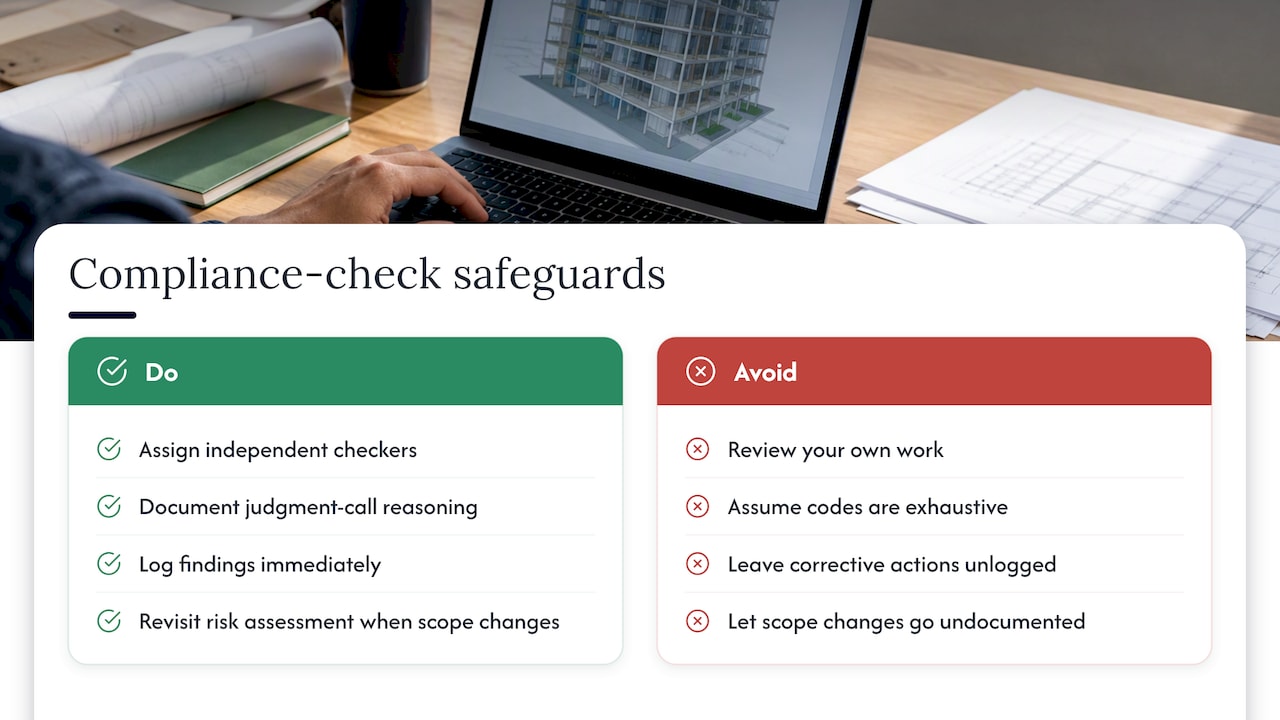
The most common failure mode is not a missed calculation. It is a documented check that exists on paper but was never actually independent, because the reviewer was the same person under time pressure to sign off their own work. A second common pitfall is treating a code as exhaustive text: standards often leave gaps, and teams that assume silence means no requirement tend to miss the judgment calls that NIST’s codes research flags as a growing issue in performance-based frameworks.

Record-keeping gaps cause their own problems. A corrective action that was fixed but never logged looks, to an auditor, identical to one that was never fixed at all. Scope creep is another recurring issue: a check defined for one risk level quietly expands or contracts as a project proceeds, without anyone updating the documented risk assessment that set its original depth.

Coordination gaps between disciplines surface late and expensively, often at the point where a mechanical penetration conflicts with a structural member that was checked independently and never cross-referenced. The fix in each case is procedural rather than technical: assign genuine independence to checkers, write down the reasoning behind judgment calls, log every finding at the moment it occurs, and revisit the risk assessment whenever scope changes rather than treating it as a one-time document.

Common Challenges and Pitfalls in Compliance Checks — overview diagram

How do compliance checks fit into project management and QA?

A compliance check that lives outside the project schedule tends to get skipped under deadline pressure. The more durable approach treats each check as a scheduled milestone with its own owner, due date, and dependency, the same way a concrete pour or a steel delivery would appear on a project plan.

Quality assurance systems and compliance checks should share one record set rather than running as parallel processes. When a nonconformance surfaces during a documented check, it should land in the same issue tracker that QA/QC uses for everything else, with the same escalation path and the same sign-off requirement. Our overview of document control through handover describes how that single-record approach carries through to project closeout, where disconnected systems cause the most retrieval problems.

Scheduling the checks themselves inside the project management tool, rather than in a separate compliance binder, also makes the dependency visible: a structural check that has not closed should visibly block the pour it gates, not sit in a spreadsheet nobody checks before mobilizing a crew.

Who performs compliance checks and how do teams collaborate?

Responsibility usually splits across a few roles. The original designer produces the calculation or drawing and is the least suited to catching its own errors. A qualified checker, with sufficient independence and competence in the relevant discipline, performs the documented review that EGBC’s standard calls for. A discipline lead or project engineer resolves cross-discipline conflicts the checker surfaces, and a quality manager or compliance officer owns the record-keeping system that ties everything together.

On larger projects, an authority having jurisdiction or a third-party reviewer adds an external layer, and their expectations, documented risk assessment, traceable records, evidence of verification and validation, tend to mirror the ISO TC176 auditing criteria closely enough that designing your internal process around those criteria saves a second round of rework later.

Collaboration works best when each role has a clear handoff point rather than overlapping responsibility for the same finding. A checker who flags an issue should know exactly who owns the fix and by when, and that handoff should appear in the same record the original check produced, not in a separate email thread that disappears from the audit trail.

Compliance checklists by engineering discipline

A generic checklist misses the failure modes specific to each discipline, so most engineering teams keep discipline-specific lists that share a common structure, input verification, calculation review, drawing coordination, and field confirmation, but differ in what they emphasize.

Civil checklists tend to focus on site data, grading, drainage, and geotechnical inputs, since errors here propagate into every other discipline’s assumptions. Structural checklists emphasize load path verification, connection design, and code-specific seismic or wind criteria, areas where ASCE’s referenced standards carry particular weight. Mechanical checklists concentrate on equipment sizing, ventilation code compliance, and coordination with structural penetrations. Electrical checklists prioritize load calculations, panel schedules, and code clearances, often cross-referencing NFPA and ICC provisions.

The discipline split matters most at the coordination boundary. A mechanical duct run and a structural beam can each pass their own discipline’s checklist independently and still conflict physically, which is why cross-discipline coordination needs its own checklist item rather than being assumed to fall out of the individual disciplines automatically.

Maintaining compliance as standards and conditions change

A compliance check performed at design issue does not stay valid forever. Codes get updated, project conditions change during construction, and the building or infrastructure asset itself ages and gets modified long after handover, each of which can quietly invalidate an earlier check.

The practical response is to define re-check triggers in advance rather than relying on someone noticing a change. A code update that affects a referenced standard, a change of use for a facility, a significant retrofit, or a discovered field condition that differs from the design basis should each restart a scoped version of the original documented check, not a full re-review of the entire project.

This lifecycle view aligns with where NIST’s forward-looking codes research is pushing the industry: toward performance-based standards that assume conditions will shift over an asset’s life rather than static prescriptive rules fixed at the design date. Building that assumption into your compliance program now, with clear triggers and a retained record of what was checked when, saves a scramble later when a code update or an incident forces the question.

Pragmatic priorities for teams implementing routine checks

Teams adopting documented checks for the first time tend to overbuild the system before getting the basics right. Input verification and a documented risk assessment come first, before any discussion of tools, because a well-automated check against the wrong inputs is still wrong.

Automation earns its place on the low-risk, high-repetition items: the same checklist run across a hundred similar connections, not the judgment call on an unusual load case. Measuring the effect matters more than adopting the tool itself, specifically whether requests for information and rework actually drop once automation takes over the repetitive checks. A short list of KPIs, time per review, corrective actions closed, and findings at audit, tells you more about whether a compliance program is working than any tool’s feature list.

How an integrated AI assistant speeds up audit-ready compliance work

An AI civil engineer fits naturally into the workflow this article describes: searching project documents for the clause that applies to a given check, triaging rules across a discipline, and producing traceable records with assumptions written down for review, the same way you would review a colleague’s work. Teams use AI assistants across engineering, procurement, and project roles rather than as single-purpose tools.

A reasonable starting scope includes workflows such as input-data checks on a defined discipline, a drawing review pass, or assembling commissioning evidence into a single traceable record. Our overview of the platform describes how it fits into construction and infrastructure teams in more detail, and our technical architecture page covers how outputs stay traceable back to source documents.

What is meant by a compliance check?

A compliance check is a documented review confirming that a design, facility, or piece of work meets the applicable codes, standards, and specified requirements. It produces a record showing who checked it, what was reviewed, what was found, and what corrective action followed, as EGBC’s documented checks standard specifies.

What are the big four disciplines of engineering?

Civil, structural, mechanical, and electrical are commonly treated as the core disciplines in building and infrastructure compliance work. Each discipline maintains its own checklist focus, from geotechnical and drainage inputs in civil work to load path and connection design in structural work, while still requiring cross-discipline coordination checks.

What is engineering inspection?

Engineering inspection is the field-based verification that installed or constructed conditions match the issued, approved design. It typically generates test evidence and nonconformance logs that feed directly into the same documented check record used for design-stage reviews.

What does compliance mean in mechanical engineering?

In mechanical engineering, compliance means a design meets the applicable equipment, ventilation, and safety codes along with project-specific specifications, verified through calculation review and, where needed, testing. It also requires coordination checks confirming mechanical elements do not conflict with structural or electrical scope.

This post was written with AI assistance and published by Yesper. General information, not professional advice: requirements vary by project and jurisdiction, and the professional responsible for the project decides what applies. Spotted an error? Write to benjamin@yesper.ai.

Benjamin Glaser Co-founder at Yesper. Writes about AI and the industry that builds the world. benjamin@yesper.ai

Yesper is the AI civil engineer for construction and infrastructure. AFRY, COWI, NRC Group and other Nordic firms use it to halve the time on a study, rerun calculations in minutes, and catch errors that would otherwise slip through. Get in touch if you'd like to see what it can do for you.

Book demo