Design review automation, at its most useful, is a human-supervised system that catches repeatable, standards-based errors before they reach fabrication, builds an auditable evidence chain, and frees engineers to spend their time on judgment calls rather than checklist items. It reduces manual review hours and rework cycles. It does not replace the reviewer. The human gate stays in place for every decision that requires engineering judgment.
In short
01
The useful scope is narrower than the marketing language around it suggests, and that narrowness is the point. Deterministic, rule-based checks are where automation earns trust, because the outcome is verifiable against a known standard rather than inferred by a language model.
In practice, the checks that hold up under scrutiny include:
A taxonomy along these lines, covering standards compliance, internal rules, geometric consistency, data integrity, manufacturability, and recurrence of past failures, is a reasonable starting checklist for scoping a pilot.
The architecture that supports this work tends to split into three tiers: perception, where CAD files, drawings, and documents are extracted into structured data; cognition, where a deterministic rule engine checks that data against a standards knowledge graph; and collaboration, where findings are routed into a review workspace and uncertain or judgment-level items go to a human. Automation connects into this chain through PLM and PDM systems and issue trackers, with an export or acceptance gate sitting between the cognition tier and anything that leaves the system as a final deliverable.
02
Piloting automation well is mostly a data and governance problem before it is a tooling problem. A practical sequence looks like this:
Pro Tip: Pilot on a single part family or drawing set first; a narrow, well-instrumented pilot surfaces integration gaps faster than a broad rollout ever will.
The DUCTILE paper’s central recommendation is worth carrying into any implementation plan: let generative orchestration decide what to check and in what order, but let verified, deterministic tools perform the calculations and hard-rule enforcement. That separation is what keeps an automated review defensible months later, when someone asks why a part passed.
03
Automation built on large language models inherits their weaknesses, and the DUCTILE research is direct about where that leads: over-reliance on generative AI without deterministic guardrails is a recurring pitfall, and calculations or hard-rule checks should run on validated tools rather than on model inference.
Teams that have deployed these systems tend to run into a short list of recurring issues:
04
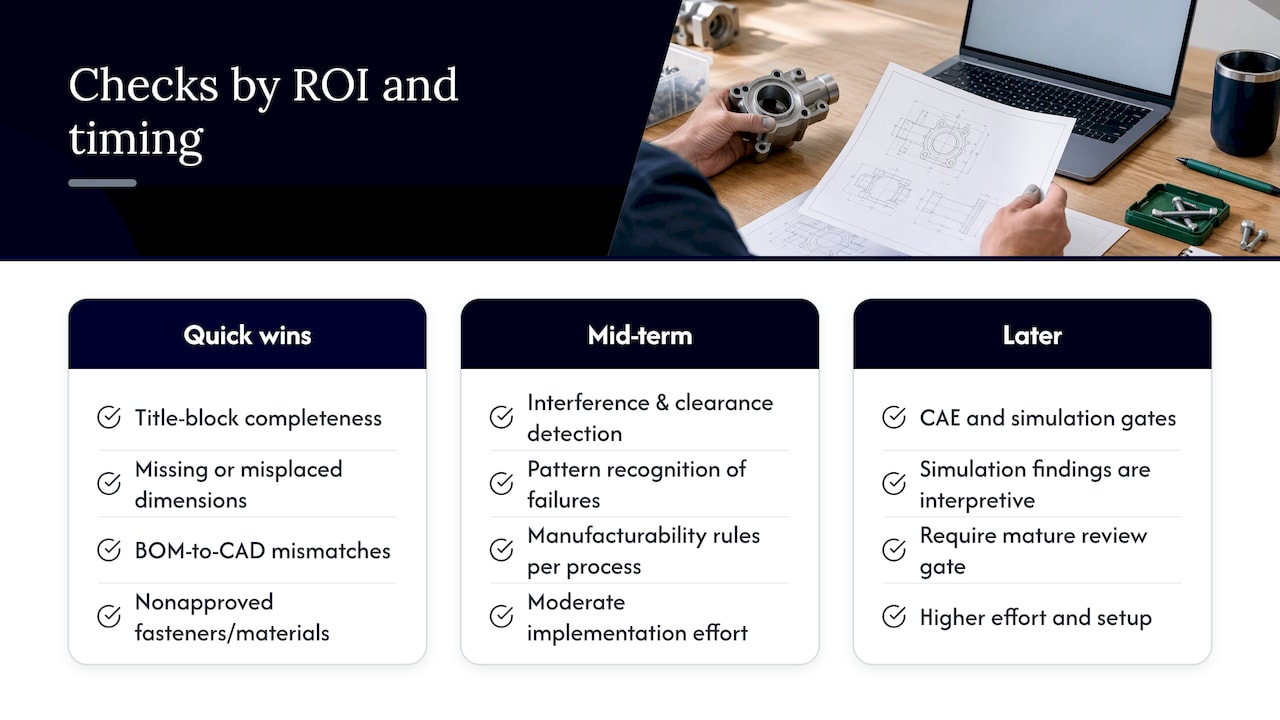
The fastest wins are the checks with the least ambiguity and the most repetition: title-block completeness, missing or misplaced dimensions, BOM-to-CAD mismatches, and flags for nonapproved fasteners or materials. These are low-effort to implement and catch the errors that cause the most avoidable rework.
Mid-term scope extends to interference and clearance detection, pattern recognition across recurring failure types, and manufacturability rules tied to specific processes. CAE and simulation gates belong later in the sequence, once the deterministic layer is stable, because simulation findings carry more interpretive weight and need a more mature review gate around them.
One illustration of what this impact can look like: Yesper reports that customers see 50 to 95 percent time saved on related document and takeoff work, with fewer errors reaching later project stages, a brand-stated figure worth treating as a directional benchmark rather than a guarantee for any specific project.
Measuring ROI is straightforward once a pilot runs: track review hours before and after, count rework cycles avoided, and check whether findings carry enough traceable rationale to survive an audit.

05
General-purpose AI models struggle as engineering complexity increases, because standards, document formats, and approval chains in construction and infrastructure work are domain-specific in ways a generic assistant was never built to track. A platform purpose-built for that domain ties standards checks, document control, and multi-step agent workflows together into outputs that carry their own evidence trail for structural engineering.
Yesper reports that its customers achieve 50 to 95 percent time savings on project work, alongside higher-quality outputs, a claim worth reading as the company’s own stated outcome rather than an independent finding. A domain-specialized platform tends to matter most where regulation is dense, where multiple file types and disciplines have to reconcile, and where BIM or BOM integration is central to the deliverable, conditions under which a general model’s gaps widen fastest.
06
The role shift worth paying attention to is not automation replacing engineers, it is engineers supervising agents and verifying rationale instead of manually checking trivial, repeatable issues. That is a different skill than the one most review processes were built around.
Teams adopting this well tend to start with deterministic checks only, require a written rationale for every rejection or edit of an automated finding, and keep an audit trail that outlasts any single project. The cultural shift that matters most: automation generates evidence for a decision, it does not make the decision. Treat it that way and the review gate stays meaningful instead of becoming a rubber stamp.
07
We built Yesper around the reality that construction and infrastructure review work is document-heavy, regulation-dense, and spread across disciplines that rarely share a single file format. Our platform combines project document search, compliance checks against regulatory frameworks, and customizable agent workflows into outputs that keep their reasoning attached, so a finding can be traced back to its source rather than taken on faith.
Teams use this for regulatory compliance checks across jurisdictions, document control across large project sets, and auditable quantity takeoffs that sit behind a review gate rather than going straight to a deliverable. If that scope matches a problem you are working through, our company page covers how we approach it in more detail.
FAQ
Design review automation refers to software that performs first-pass checks on drawings, models, and documents, such as GD&T syntax, BOM-to-model consistency, and standards compliance, before a human engineer signs off. It works best as a supervised system, with a human review gate retained for judgment decisions.
No. Research on agentic engineering workflows, including the DUCTILE study, recommends keeping deterministic tools responsible for calculations and rule enforcement while a human reviewer verifies rationale and evidence. Full automation without a review gate increases the risk of undetected errors reaching production.
The highest-return starting points are title-block completeness, missing or misplaced dimensions, BOM-to-CAD mismatches, and flags for nonapproved materials or fasteners, since these checks are low-effort and catch repeatable, preventable errors. Interference detection and manufacturability rules are reasonable mid-term additions once the basics are validated.
Teams typically run representative test cases through repeated trials, an approach described as pass-k testing in the DUCTILE paper, and log every automated decision for later audit. This builds confidence in the system before it touches live project deliverables.
Yesper provides compliance checks, document search, and agent-based workflows built for construction and infrastructure projects, tying outputs to their source documents for traceability. Details on scope and fit are available on the Yesper company page.

This post was written with AI assistance and published by Yesper. General information, not professional advice: requirements vary by project and jurisdiction, and the professional responsible for the project decides what applies. Spotted an error? Write to benjamin@yesper.ai.
Get news and articles in your inbox.
Yesper is the AI civil engineer for construction and infrastructure. AFRY, COWI, NRC Group and other Nordic firms use it to halve the time on a study, rerun calculations in minutes, and catch errors that would otherwise slip through. Get in touch if you'd like to see what it can do for you.
Book demo