One current revision: Drawing revision control for engineers with ASME

Drawing revision control is the discipline of identifying, approving, and tracking every change made to a drawing so that only one current version is ever in use at a given moment. The single rule that prevents most failures is straightforward: maintain one current approved revision with a unique identifier and an unalterable audit trail. Everything else, from ASME numbering conventions to ISO 9001 clauses, exists to enforce that one rule in practice.

Engineer checking a controlled drawing revision
  • Maintaining a single current, approved revision with a unique identifier prevents errors caused by outdated drawings in the field.
  • A consistent revision numbering scheme, following ASME guidelines and avoiding confusing letters, is essential for clarity over long project timelines.
  • Formal approval workflows, including documented change orders with roles and signatures, secure revision integrity and accountability.
  • Digital systems should enforce automatic obsolescence of superseded revisions and provide an unalterable audit trail for all changes.
  • Regular verification, including spot checks and controlled distribution, minimizes the risk of outdated or uncontrolled copies on site.

Scope and definitions: Revision, version, and the controlled copy

The terms “revision” and “version” get used interchangeably on site, which creates confusion that persists into audits. A revision is a formally approved, released change to a drawing, tracked with a letter or number and tied to an approval record. A version, by contrast, often refers to an in-progress draft that has not yet cleared review, useful internally but not something a contractor should ever build from.

Revision control operates at two levels. Drawing-level revision treats the whole sheet set as one unit, bumping the revision identifier whenever any sheet changes, which suits smaller packages. Sheet-level revision tracks each sheet independently, appropriate for large multi-sheet sets where only one sheet changes and reissuing the whole package would be wasteful.

A few terms worth fixing before going further:

  • Revision block: the table on a drawing recording revision letter, description, date, and approval.
  • Controlled copy: a distributed copy tracked against a master list, as opposed to an uncontrolled print.
  • Design activity: the organization responsible for the drawing’s technical content and, critically, for authorizing its revisions; this responsibility can transfer between organizations but must be documented when it does.

Why revision control matters: The cost of getting it wrong

A crew working from a superseded drawing does not know it is wrong until the installed work fails inspection or clashes with another trade. The resulting rework, change order, and schedule slip trace back, almost always, to the same root cause: more than one “current” copy existed at the point of use.

ISO 9001:2015’s document control clause exists largely because this failure mode is so common across industries. The standard requires documented information to be identified, approved before use, and available where the work happens, with obsolete revisions actively kept out of circulation rather than merely superseded on paper. Auditors assessing conformance check the master list against what is physically in use at a workstation or job site, not just what the document control system claims.

The downstream effects show up as RFIs asking which revision governs, change orders correcting field-installed work that followed an old print, and, in the worst cases, claims disputes over who approved what and when. A field-level breakdown of the change order process shows how quickly a drawing discrepancy on site becomes a contractual and financial issue rather than a paperwork one. None of this is exotic; it is the predictable result of skipping the one rule stated at the outset.

Standards to reference: ASME, EIA-649, and ISO 9001

Three bodies of standards cover nearly everything a revision control system needs to satisfy, and each addresses a different layer of the problem.

ASME Y14.35 governs the mechanics of revising a drawing itself. It defines revision methods, revision block content, and how to mark revised areas on a sheet, along with rules for adding, deleting, canceling, and reinstating sheets within a drawing set. This is the standard to consult when deciding whether a change belongs at the sheet level or the drawing level, and how to record it so a reviewer years later can reconstruct what changed and why.

EIA-649 addresses the broader configuration management function that drawing revision control sits inside. It defines five core CM functions: planning, identification, change management, status accounting, and verification and audit. These translate directly into a checklist:

  • Planning: define who owns the CM process and how it scales with project complexity.
  • Identification: assign unique, unambiguous identifiers to every drawing and revision.
  • Change management: route every change through a defined approval path before release.
  • Status accounting: maintain a master list showing the current approved revision of every document.
  • Verification and audit: periodically confirm that what is in use matches what the system records.

ISO 9001:2015 clause 7.5 is the quality management layer that most audits are actually scored against. It requires documented information to be identified, approved, available at the point of use, protected, version controlled, and retained or disposed on a defined schedule. An auditor working this clause will ask for the master list, the approval evidence for the current revision, and proof that obsolete copies are not sitting on a drafting table or clipped to a site trailer wall.

Revision identification and numbering schemes

Numbering seems trivial until a drawing set has gone through many revisions over several years and someone needs to know, instantly, which letter comes next. ASME guidance settles most of the ambiguity.

  1. Use uppercase letters in sequence starting with A, and omit the letters I, O, Q, S, X, and Z because they are easily confused with numerals or other letters on a printed or scanned drawing.
  2. When single letters are exhausted, move to double letters: AA, AB, AC, and so on through AY, then BA, following the same omission rule for each position.
  3. Cap revision letters at three alpha characters. A drawing that needs a fourth character has likely outlived its usefulness as a single document and should be superseded by a new drawing number instead.
  4. An initial issue is often marked with a dash rather than a letter, reserving “A” for the first formal revision after release.
  5. Numeric schemes work as an alternative, particularly where a project already uses numeric document IDs, with a common convention bumping the integer for a substantive change and a decimal or sub-letter for a minor one.

The choice between alpha and numeric matters less than consistency. A team that mixes schemes across a project set is rebuilding the same confusion that numbering rules were meant to eliminate.

Approval workflows: ECOs, RADs, and the state model

Every controlled drawing should move through the same four states regardless of project size: Draft, Reviewed, Approved, and Released. A defined approval workflow specifies who can author a change, who must review it technically, who holds final approval authority, and how that approval is captured. Skipping a state, or allowing informal verbal approval to substitute for a recorded one, is the single most common gap auditors find.

An Engineering Change Order or Revision Authorization Document should capture, at minimum:

  • The change description, in plain language a non-author can understand.
  • The reason for the change, whether a design error, a field condition, or a client request.
  • The affected drawings and revision identifiers, linked explicitly to the revision block entry.
  • The approval chain, with names, dates, and signatures or verified electronic equivalents.

Role clarity prevents the most frequent breakdown: an author approving their own change. A practical role matrix separates author, technical reviewer, approving authority, and document controller, with the document controller responsible for release and distribution rather than technical content. Wet or electronic signatures both work as evidence, provided the audit trail records who signed, when, and against which exact revision.

Pro Tip: Require the ECO number on the revision block itself, not just in a separate change log, so anyone looking at the drawing can trace the approval record without searching a second system.

Methods and tools: From paper logs to PLM systems

Small teams can run a credible revision control system with a master list spreadsheet, a single designated document owner, and discipline about never issuing a drawing without updating both the revision block and the master list simultaneously. This works until the team, the project count, or the number of external parties receiving drawings grows past what one person can track manually.

CAD software revision blocks and metadata fields only help if they are populated consistently. A revision block with a blank date or missing approver name is functionally useless in an audit, regardless of what the CAD file’s internal version history shows.

When evaluating an electronic document management or product lifecycle management system, insist on a short list of non-negotiables:

  • Automatic obsolescence of superseded revisions, so an old file cannot be opened and mistaken for current.
  • A complete, unalterable audit trail showing every state change, approval, and distribution event.
  • Role-based access control that enforces the approval matrix rather than relying on manual discipline.
  • Read-and-acknowledge tracking confirming that field personnel have actually opened the current revision, not just that it was emailed.

A six-stage approach to construction document control illustrates how these pieces fit together across a full project lifecycle rather than as isolated features.

Actionable best-practices checklist

Teams rebuilding a revision control process from scratch, or auditing an existing one, get the most value from working through these steps roughly in order.

  1. Assign unique document identifiers to every drawing before any revision activity begins, with no two drawings sharing an ID regardless of discipline.
  2. Make the current revision visible at the point of use, meaning the title block, not a separate index, tells a reader on site exactly which letter governs.
  3. Write a change summary for every revision, even a one-line description, rather than leaving the revision block entry blank or vague.
  4. Maintain a complete, unalterable audit trail covering every draft, review, approval, and release event tied to that revision.
  5. Enforce automatic obsolescence so a superseded revision cannot be pulled up, printed, or distributed without a visible warning.
  6. Control distribution through a defined list rather than ad hoc email, so every recipient of a controlled copy is known and traceable.
  7. Set a periodic review schedule with an escalation path when a drawing has gone unreviewed past its due date.
  8. Define retention and disposition rules up front rather than after a dispute forces the question.
  9. Train personnel on read-and-acknowledge expectations, confirming receipt of the current revision rather than assuming distribution equals awareness.

Pro Tip: Run a quarterly spot check comparing the master list against what is physically or digitally in use at three random workstations or site locations; this single habit catches most drift before an external auditor does.

These steps distill directly from ISO 9001’s document control checklist, which auditors apply almost verbatim when assessing conformance, and from EIA-649’s configuration management functions, which supply the underlying logic for why each step matters.

Distribution, controlled copies, and keeping shadow prints off site

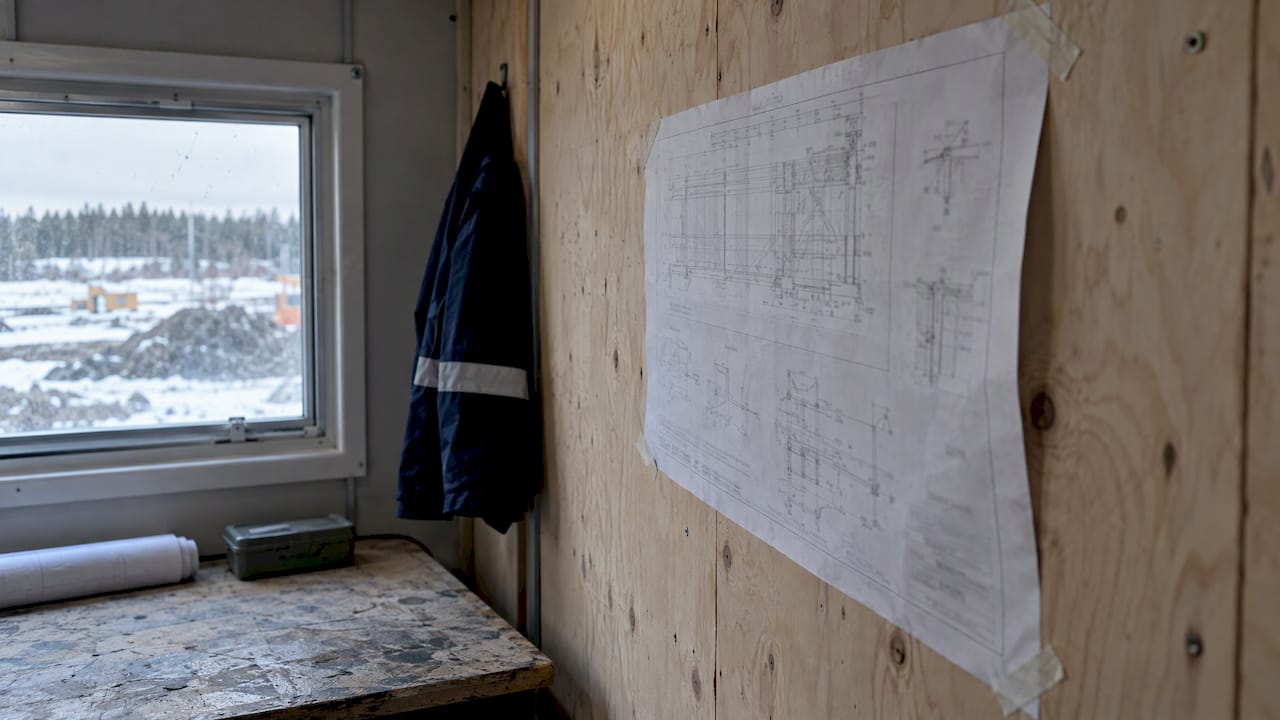
The printed drawing taped to a site trailer wall is, in practice, the most common point of failure in an otherwise well-designed revision control system. A system can be flawless on a server and still fail in the field if an outdated printed copy remains easier to reach than the current digital one.

Superseded drawing taped inside site trailer

A distribution list identifying every controlled copy, who holds it, and which revision it reflects is the baseline control. Stamping or watermarking uncontrolled prints, so anyone looking at a loose page can tell at a glance it is not an official controlled copy, closes much of the remaining gap. The more durable fix is structural: make the current approved digital revision genuinely easier to access on site than any printed alternative, whether through a tablet, a QR code on a previous controlled print pointing to the live file, or a site kiosk.

Archival and retention policy should tie directly to the same ISO 9001 clause governing document control, specifying how long superseded revisions are kept, in what form, and who has authority to dispose of them. A practical guide to document control workflows covers how distribution and controlled-copy discipline hold up specifically on active construction sites, where the conditions working against a clean system are hardest to control.

Integrating revision control with project management and collaboration tools

Revision control rarely functions well as an isolated system sitting apart from the rest of project delivery. When a project management platform tracks RFIs, submittals, and schedule milestones separately from the drawing revision history, teams end up reconciling two sources of truth manually, which is exactly the condition the earlier sections warn against.

The more resilient setup links a drawing’s revision identifier directly to the RFIs, change orders, and submittals that reference it, so a reviewer pulling up an RFI sees immediately which drawing revision it applies to rather than guessing from context or date. The same linkage matters for quantities and model-derived data: when bill of quantities figures are generated directly from a BIM model, those figures are only trustworthy if they are tied to the specific drawing or model revision they were pulled from, not a general project folder that may contain several versions.

Collaboration tools used for day-to-day coordination, whether for scheduling, field reporting, or document sharing, should reference the same revision identifiers used in the formal control system rather than inventing parallel labels. A team that names files descriptively in a shared drive while the official system uses letter-based revisions is maintaining two naming conventions that will eventually disagree with each other.

Common challenges and solutions in managing drawing revisions

A few problems recur across nearly every project regardless of size or industry. Multiple “current” copies circulating simultaneously is the most frequent, usually traced to someone saving a local copy before a formal revision cycle completes. The fix is procedural: make it a stated rule that no drawing leaves the control system until its revision block and master list entry are updated together, not sequentially.

Inconsistent revision practices across disciplines or subcontractors create a second recurring problem, where one team uses letters and another uses decimals on the same project. Resolving this requires a single project-wide numbering convention agreed before design work begins, not retrofitted after drawings are already in circulation.

A third challenge is approval bottlenecks, where a single approver becomes a chokepoint and teams start bypassing formal approval to keep schedules moving. A defined backup approver, documented in the same role matrix referenced earlier, prevents this without weakening the approval requirement itself.

Finally, orphaned or forgotten superseded copies, whether printed or saved locally, remain the hardest problem to fully solve through policy alone. Automatic obsolescence features in a digital system address this more reliably than any amount of training, which is why the tooling choice matters once a project outgrows a manual master list.

ISO 9001 document control obligations in practice

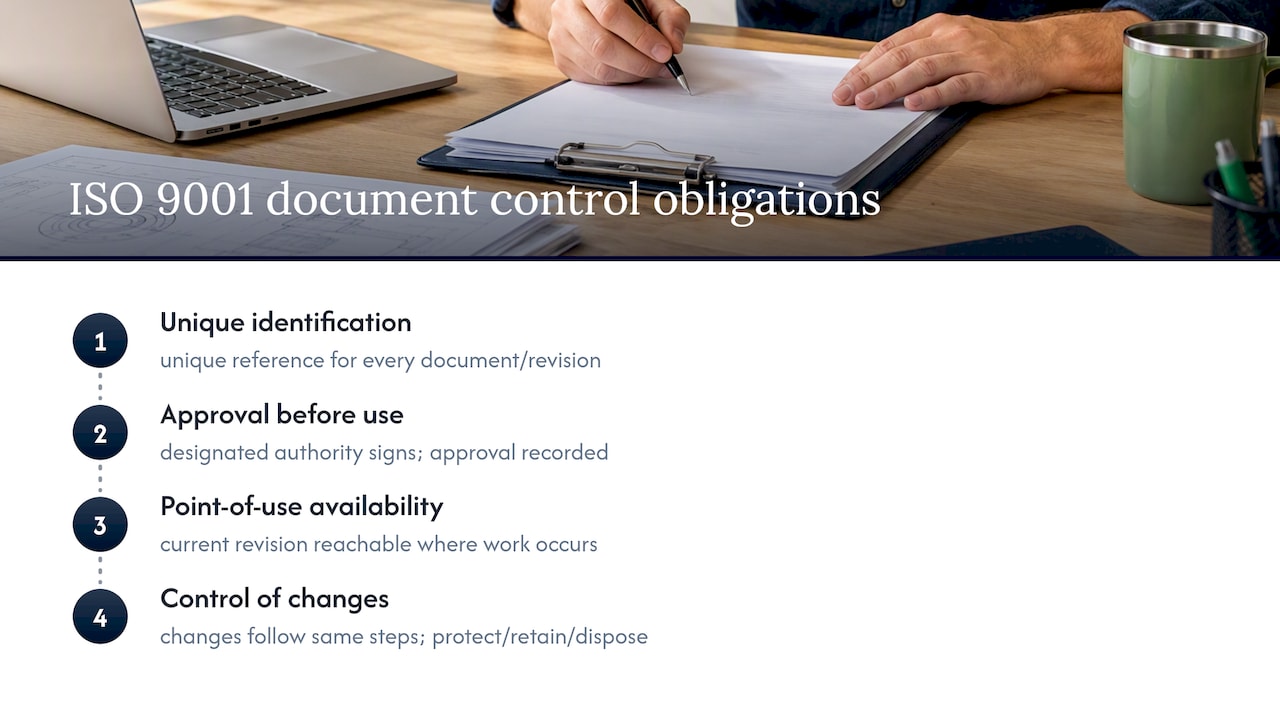
ISO 9001:2015 clause 7.5 sets out document control obligations that apply directly to engineering drawings, structured around four practical requirements. Identification means every document, including every revision of it, carries a unique reference that leaves no ambiguity about what it is or which version it represents.

Four ISO 9001 document control obligations

Approval before use requires that a drawing cannot be released for construction or manufacturing until a designated authority has signed off, with that approval recorded rather than assumed. Availability at the point of use means the current revision has to be reachable by the people doing the work, not just stored correctly in a central system that nobody on site can access.

Control of changes is the clause most directly relevant to revision practice: any change to a controlled document must go through the same identification and approval steps as the original, with the control of changes requirement also covering protection and retention or disposition once a document is superseded. An auditor reviewing conformance against this clause will typically request the master list, sample approval records, and evidence that obsolete revisions have been removed from active use, which is precisely the checklist the earlier sections build toward.

What teams should fix first

Most organizations improving a weak revision control system reach for software before fixing process, which gets the sequence backward. A master list and a single accountable document owner, even on a spreadsheet, resolve more risk in the first month than any platform migration, because the platform inherits whatever discipline, or lack of it, already exists around approvals and distribution.

Auditability and automatic obsolescence should rank above convenience features when evaluating any digital system, since the cost of a superseded drawing reaching a job site far exceeds the cost of a slower interface. Operations and site teams belong in this conversation from the start, not as an afterthought once the system is built, because distribution and field access are where revision control most often fails in practice.

Where Yesper fits for teams ready to automate document control

Building the checklist above by hand works, but scaling it across hundreds of drawings, dozens of subcontractors, and multiple active projects is where manual systems strain. We built Yesper to link drawings, revisions, and the records that reference them, surfacing the current approved version with a traceable history behind every change rather than a folder of files sorted by date. For construction and infrastructure teams weighing whether to formalize this with a dedicated platform, our AI platform for construction and infrastructure is worth a look, and our company page covers more on how we approach the problem.

What is drawing revision control?

Drawing revision control is the process of identifying, approving, and tracking changes to a drawing so only one current approved version is ever used at a given time. It relies on a unique document identifier, a visible current revision marker, and a recorded approval history, practices formalized in standards such as ASME Y14.35 and ISO 9001 clause 7.5.

What letters are skipped in drawing revisions?

Industry practice, following ASME-aligned guidance, omits the letters I, O, Q, S, X, and Z from revision sequences because they are easily confused with numerals or other letters. When single letters run out, the sequence continues with double letters such as AA and AB, following the same omission rule.

What is a drawing revision?

A drawing revision is a formally approved, released change to a drawing, recorded with a unique identifier, a description of what changed, and an approval record. It differs from an internal working draft, which has not yet completed review and should never be used for construction or fabrication.

What is the 30-60-90 design process?

It is a project delivery milestone framework rather than a revision numbering scheme, though each milestone set should still carry its own tracked revision identifiers.

How does EIA-649 relate to drawing revision control?

EIA-649 defines five configuration management functions (planning, identification, change management, status accounting, and verification and audit) that underpin effective revision control at a program level. Drawing-level practices from ASME standards operate inside this broader CM framework rather than replacing it.


This post was written with AI assistance and published by Yesper. General information, not professional advice: requirements vary by project and jurisdiction, and the professional responsible for the project decides what applies. Spotted an error? Write to benjamin@yesper.ai.

Benjamin Glaser Co-founder at Yesper. Writes about AI and the industry that builds the world. benjamin@yesper.ai

Yesper is the AI civil engineer for construction and infrastructure. AFRY, COWI, NRC Group and other Nordic firms use it to halve the time on a study, rerun calculations in minutes, and catch errors that would otherwise slip through. Get in touch if you'd like to see what it can do for you.

Book demo