The future of AI in construction is industry-wide augmentation, not replacement: better design optioneering, sharper planning, safer job sites, and measurable productivity gains, all governed by pilots, emerging standards, and unglamorous data work. RICS survey data and regulatory sandbox trials confirm the direction, even as most firms remain stuck at the pilot stage.
In short
01
Four technologies do most of the work behind the phrase “AI in construction,” and each has a distinct job. Machine learning finds patterns in historical project data, useful for predicting cost overruns or schedule slippage before they happen. Computer vision reads images and video, the basis for progress tracking from site cameras and drone footage. Natural language processing and large language models parse contracts, specifications, and regulatory text, turning unstructured documents into searchable, comparable information. Generative and multimodal models combine several data types at once, drafting design options or reasoning across drawings, point clouds, and text simultaneously.
Applied to construction tasks, the distinctions matter:
None of this works without clean inputs. A model trained on inconsistent file formats or incomplete handover data produces confident, wrong answers, which is precisely why human review of AI-generated deliverables remains a fixed requirement rather than a temporary inconvenience.
02
AI touches every phase of a construction project, though the value concentrates where documents and data are already dense.
The common thread is data density. Preconstruction and estimating tasks tend to be document-heavy and semi-structured, which is exactly where practitioner reporting says AI adoption concentrates, since document review, estimating, and reporting are easier to automate than judgment calls made in the field. Robotics and physical automation lag behind, constrained by site variability and the cost of hardware deployment rather than by algorithmic limits. Firms weighing where to start should prioritize use cases with existing digital records: BIM models, historical tender data, and site imagery, since these feed AI systems without requiring a separate data collection effort first.
03
The gains reported so far cluster around efficiency, schedule compression, and safety, though the range is wide and heavily dependent on data maturity.
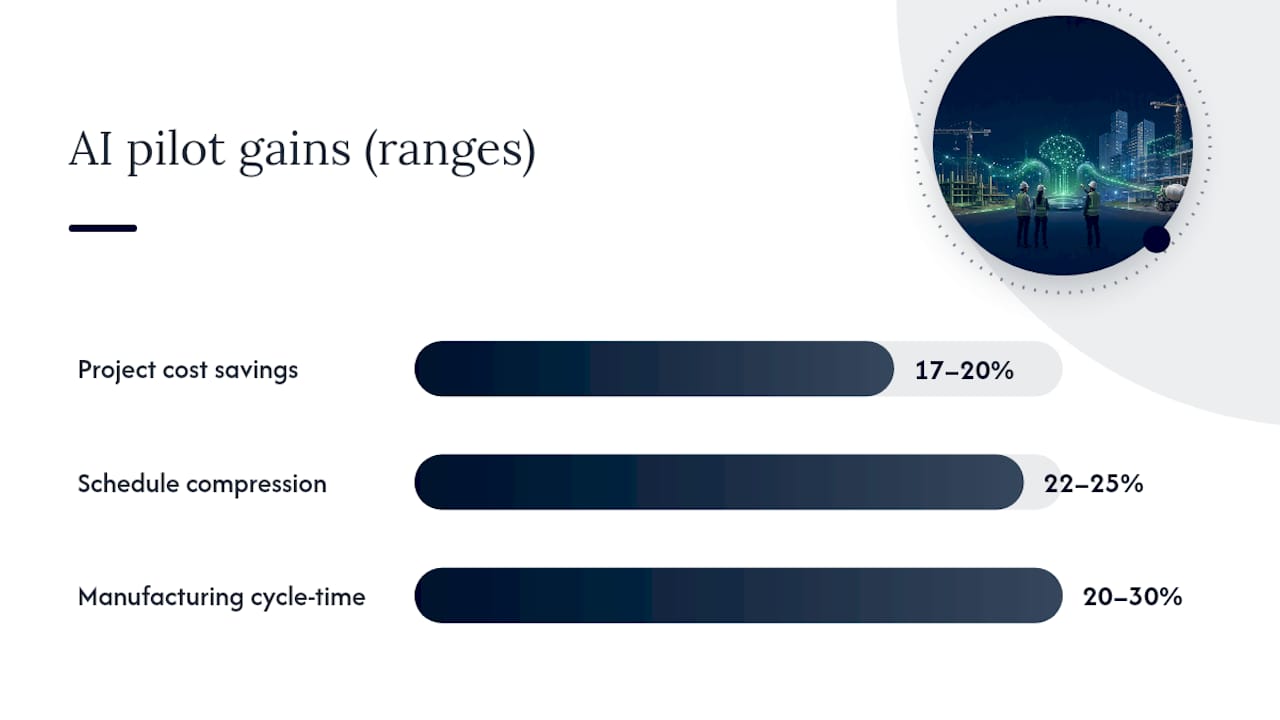
A whitepaper and roundtable synthesis from MIT and Suffolk estimates illustrative project-level savings of 17% to 20% on cost and 22% to 25% on schedule when multiple AI levers are applied together on a sample multifamily project, figures the authors frame as directional rather than guaranteed. Separately, early physical AI and robotics pilots in manufacturing have shown cycle-time gains of 20% to 30%, a result the World Economic Forum suggests points to a comparable opportunity in construction material handling, though the figure itself comes from manufacturing settings rather than job sites.

Variance is the rule, not the exception. A firm with standardized BIM workflows and a clean document repository sees faster returns than one still working from scanned PDFs and inconsistent naming conventions. Project type matters too: repetitive, high-volume builds convert AI-driven scheduling gains more reliably than one-off, highly customized projects.
Pilots worth running should track a short list of concrete metrics:
Firms building a business case around these figures can find a structured approach to proving AI ROI useful before committing budget beyond the pilot stage.
04
Most obstacles to scaling AI in construction are organizational, not technical. Data fragmentation tops the list: projects generate documents in inconsistent formats across dozens of stakeholders, and preparing that data for AI use is often the single largest cost in a deployment. Skills gaps compound the problem, since project-based firms rarely have in-house AI expertise, and change resistance runs high among teams accustomed to manual review as a quality safeguard.
Governance is the second major front. Explainability and accountability matter more in construction than in most industries, because a missed structural error or a misread compliance clause carries physical and legal consequences, not just financial ones. Monitoring technologies on site, from wearables to CCTV-linked analytics, also raise privacy questions that firms have to resolve before rollout, not after a complaint.
Pro Tip: Start data cleanup with the documents you already reuse most often, like BIM exports and tender templates, rather than trying to standardize an entire project archive at once.
05
The regulatory picture is moving faster than most firms’ internal policies. In the European Union, the AI Act’s staged implementation is already shaping how construction technology gets procured and deployed, with higher-risk applications, including some safety monitoring tools, facing stricter documentation and oversight requirements as later provisions come into force.

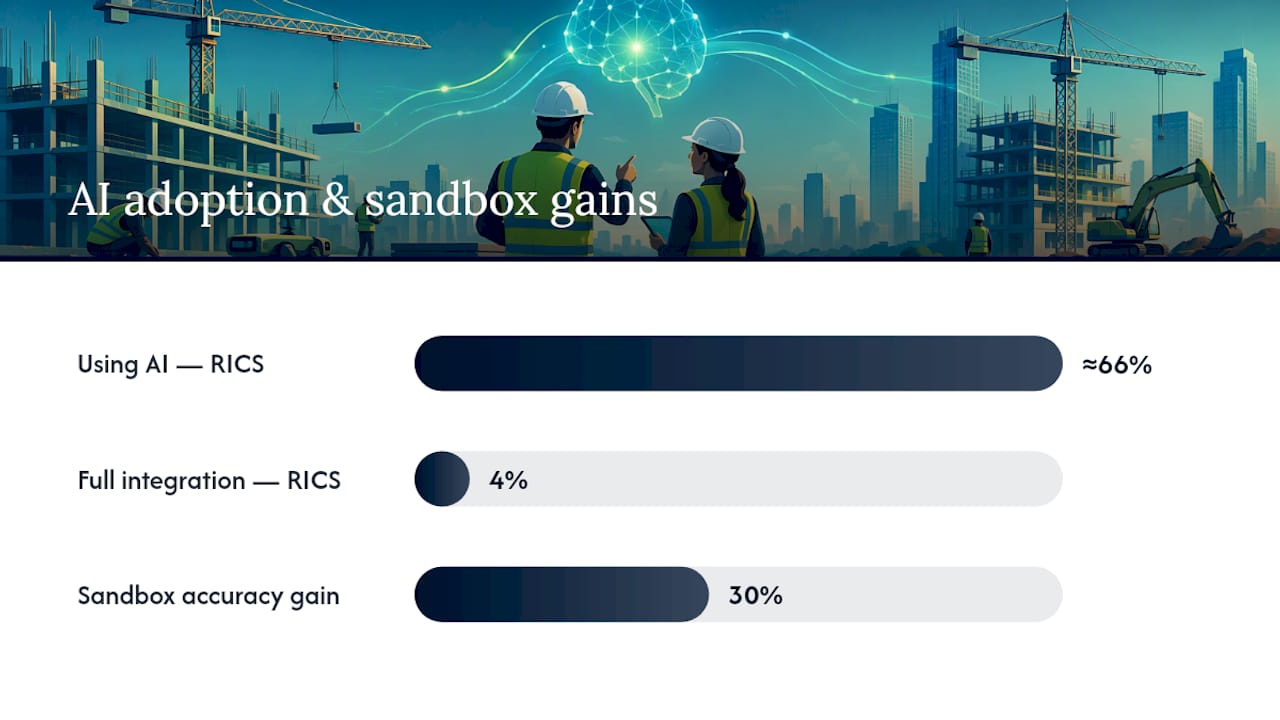
Professional bodies are filling gaps the law does not yet cover. RICS has published guidance on the responsible use of AI in the built environment, and its 2026 survey found that around two-thirds of Global Construction Monitor respondents now use AI in some part of their work, up materially from 2025, though only about 4% report full or widespread integration. RICS recommends near-term actions for 2026 and 2027 focused on governance and standards with medium-term actions through 2028 and 2029 aimed at embedding AI competence into professional qualifications.
Regulatory sandboxes offer an early look at what compliant deployment looks like in practice. The Smarter Regulatory Sandbox, run by the UK Health and Safety Executive with the Safetytech Accelerator, found that model accuracy improved by 30% once regulatory content was made machine-readable, and that combining CCTV footage with regulatory data helped flag higher-risk, non-compliant sites.
06
Moving from pilot to routine practice takes a deliberate sequence, not a single tool purchase.
Practitioner reporting backs this sequence directly. Successful pilots tend to share clear KPIs, a data ingestion plan, and a small cross-disciplinary team that includes someone who understands both the domain and the technology. Firms exploring implementation partners for this stage sometimes bring in outside AI transformation consulting to help with vendor selection and workflow redesign.
Pro Tip: Treat the first pilot as a data audit as much as a technology test. What you learn about your own document quality often matters more than the model’s output.
07
Several shifts are likely to reshape investment priorities over the next several years. Multimodal domain models will improve reasoning across drawings, regulations, and site photos simultaneously, sharpening compliance checks that today require several separate tools. Digital twins will extend further into lifecycle decisions, informing maintenance and energy strategy well past handover rather than serving only as a design-phase reference.
Physical AI is likely to mature on site as robotics and material-handling systems benefit from the same simulation-based deployment planning already showing early gains in manufacturing. Frontline AI, tools aimed at scheduling, training, and worker wellbeing rather than back-office tasks, is expected to grow as firms look for ways to support site staff directly rather than only project managers. Sustainability-linked applications, from embodied carbon optimization to energy-use forecasting, are also likely to become a standard feature of design and operations tools rather than a separate add-on.
08
General-purpose AI models struggle as construction tasks grow more complex, because they lack the domain grounding to produce a geotechnical report from raw CPT protocols or reconcile a dozen tenders across different currencies. Vertical platforms built specifically for engineering work close that gap by encoding construction-specific workflows and deliverables rather than answering generic queries.
Yesper is one example of this category in active use across organizations. Its stated function centers on a defined set of capabilities:
More detail on the platform’s approach to civil engineering tasks is available for readers evaluating vertical tools against general-purpose alternatives.
09
The ethical questions around AI in construction center on accountability, transparency, and who bears the consequences when a system gets something wrong. When an AI tool flags a structural risk incorrectly or misses one, the responsibility for that error has to sit clearly with a named party, not diffuse into “the algorithm decided.” This is why human-in-the-loop review is treated as a governance requirement rather than a nicety in professional guidance like the RICS AI standard.
Worker monitoring raises a parallel set of concerns. Wearables and site cameras that track movement, PPE compliance, or fatigue generate data that can improve safety outcomes, but the same data can be repurposed for performance surveillance if policies do not draw a clear line. Firms deploying these tools need explicit rules on what gets recorded, how long it is retained, and who can access it, decided before rollout rather than negotiated after a dispute.
There is also a fairness dimension to how AI systems get trained and validated. A model built on data from large, well-documented projects may perform poorly on smaller or unconventional builds, and firms relying on AI-generated compliance checks or cost estimates need to understand where that gap is likely to show up. None of these risks argue against adoption. They argue for governance structures, documented assumptions, and review steps built in from the first pilot rather than added retroactively once a problem surfaces.
10
AI is changing what construction roles look like more than it is eliminating them. Reporting from the World Economic Forum and the International Labour Organization on frontline and industrial work generally supports augmentation over replacement: AI tends to create new skilled roles focused on managing, validating, and interpreting AI output, rather than simply removing headcount.
In practice, this means estimators spend less time manually extracting quantities and more time judging which AI-flagged discrepancies matter. Site supervisors gain tools that flag safety risks earlier, but still make the final call on what happens next. New roles are emerging too, particularly AI technologists embedded within project teams who understand both the domain and the tooling well enough to validate outputs and troubleshoot when a model gets it wrong.
The transition is uneven. Firms with the resources to hire dedicated AI staff or retrain existing employees will see roles shift faster and with less disruption than smaller firms trying to absorb the same tools without added support. The skills gap identified earlier as a barrier to adoption is, from the workforce’s perspective, also the biggest determinant of whether AI expands job scope or narrows it. Where firms invest in training alongside deployment, workers tend to gain capability rather than lose ground.
11
The industry does not have a technology problem. It has a governance problem, dressed up as a technology decision. Firms that pair every pilot with a measurable KPI and a named accountable reviewer will convert to production faster than firms chasing the flashiest tool. Standards work, not model selection, is the real bottleneck.
12
Firms weighing whether to build AI capability in-house or adopt a domain-specialist platform face a real tradeoff between control and speed. Yesper addresses this by working inside existing project workflows rather than requiring teams to build automation from scratch, covering document search, compliance checks, deliverable creation, and quantity takeoff from BIM models and drawings.
Teams evaluating where a vertical platform fits into a broader AI roadmap can review Yesper’s company profile or visit the Yesper platform page for a closer look at how it integrates into existing project workflows.
FAQ
The future centers on augmentation rather than replacement, with AI improving design optioneering, planning, safety monitoring, and productivity across the project lifecycle. Adoption is accelerating, but RICS survey data shows only a small share of firms have moved past pilots into full integration.
No, construction work requires physical execution, on-site judgment, and accountability that current AI systems cannot provide on their own. Reporting on frontline and industrial work generally supports augmentation over replacement, with AI creating new skilled roles rather than eliminating the need for people.
The main risks are data fragmentation, unclear accountability when AI-generated outputs contain errors, and privacy concerns from worker-monitoring technologies. These are organizational and governance challenges as much as technical ones, which is why standards bodies like RICS recommend clear oversight structures before scaling adoption.
Recent developments include the UK’s Smarter Regulatory Sandbox, which improved compliance-model accuracy by 30% using machine-readable regulatory content, and RICS’s 2026 survey showing a majority of construction professionals now use AI in some part of their work. Both point to 2026 as a year of standards development and governance focus rather than broad operational maturity.

This post was written with AI assistance and published by Yesper. General information, not professional advice: requirements vary by project and jurisdiction, and the professional responsible for the project decides what applies. Spotted an error? Write to benjamin@yesper.ai.
Get news and articles in your inbox.
Yesper is the AI civil engineer for construction and infrastructure. AFRY, COWI, NRC Group and other Nordic firms use it to halve the time on a study, rerun calculations in minutes, and catch errors that would otherwise slip through. Get in touch if you'd like to see what it can do for you.
Book demo