Value engineering with AI: Where it helps and where it fails
Value engineering with AI means using language models, document retrieval and automated checks to speed up the function-first review of a design, not to cut line items faster. Used that way, it shortens the study cycle and widens the pool of alternatives. Used as a shortcut to savings, it produces proposals that nobody can defend at the review table.
Benjamin Glaser
19 October 2026 · 13 min read
The distinction matters because the term is routinely abused. Owners say “value engineering” when they mean a budget cut after bids come in high, and a model that is asked to “reduce cost” will oblige, quietly, at the expense of function. What follows sets out how the method is defined, where AI fits in its phases, what the published evidence supports, and what has to be true of the tooling before a reviewer should trust it.
02
TL;DR
Value engineering is a structured study of function versus cost, defined in US federal rules as achieving the needed functions at the lowest life-cycle cost without sacrificing safety, necessary quality or environmental attributes. It is not a discount exercise.
AI earns its place in the information, creative and evaluation phases: reading the document set, generating and screening alternatives, and checking each against requirements.
A 2025 study of an AI-facilitated framework reported a 31% shorter value engineering cycle, but the same work stresses explainability. Savings that cannot be inspected are not savings a reviewer can sign.
General-purpose chat models fail on construction specifics such as CPT protocols, BIM quantities and multi-currency tenders. Domain-built systems that write down their assumptions fare better.
Treat AI output the way you treat a junior colleague’s: reviewed, sourced, and signed off by a named engineer.
03
What value engineering actually is
The US Federal Highway Administration quotes the regulatory definition in 23 CFR Part 627.3: a systematic application of recognized techniques by a multi-disciplined team to identify the function of a product or service, establish a worth for that function, generate alternatives through creative thinking, and provide the needed functions reliably at the lowest life-cycle cost, without sacrificing safety, necessary quality or environmental attributes.
Read closely, the definition has three consequences that any AI deployment inherits.
Function comes first. The unit of analysis is what an element must do, not what it is made of. A model that compares unit prices of materials is doing procurement, not value engineering.
The horizon is the life cycle. A cheaper cladding that doubles maintenance is not a saving. Lifecycle cost analysis of the inputs, including energy and replacement cycles, belongs inside the study, not after it.
A team does it. The definition assumes multiple disciplines challenging each other. AI that replaces that friction removes the mechanism that makes the method work.
The same FHWA page distinguishes the study done during design from the Value Engineering Change Proposal, a post-award proposal that a contractor submits under a contract clause. Both are in scope for AI, and they have different risks: the first is exposed to missed alternatives, the second to unexamined side effects on a design that is already fixed.
04
Why the traditional process strains
A classic study follows a job plan. Summaries of the SAVE International standard describe six phases run in sequence within a pre-study, study and post-study structure: information, function analysis, creative, evaluation, development and presentation. In practice the weak points are mundane.
The information phase depends on someone having read all of the drawings, specifications, geotechnical data and prior correspondence. In a large project nobody has.
The creative phase is limited by the experience of the people in the room. Alternatives that sit outside their prior projects rarely surface.
The evaluation phase is compressed, because workshops are scheduled for days, not weeks, and each idea must be checked against codes, schedule and constructability.
The development phase demands quantities and cost comparisons that someone has to rebuild by hand from a model or from drawings.
The authors of a 2025 AI-driven value management framework describe the same problem in more academic terms: dependence on individual expertise, fixed processes, and separation from the data-rich environment where the project actually lives. That is the gap AI can address, and it is also where careless use does damage.
05
Where AI fits in the job plan
The table maps each phase to the work AI can reasonably take on and the check a human must keep.
Phase
What AI can do
What a human must keep
Information
Search and summarize the full document set; extract requirements, constraints and quantities
Decide which documents are authoritative; confirm extracted values against the source
Function analysis
Propose function definitions from specifications and cross-reference them with elements
Own the function statement and the worth assigned to it
Creative
Generate alternatives, including ones outside the team’s habitual solutions
Judge which ideas are buildable on this site, with this contractor
Evaluation
Screen alternatives against codes, standards and project requirements; flag conflicts
Weigh trade-offs that involve risk, safety or owner preference
Development
Recompute quantities, compare tenders, draft the proposal and its supporting calculations
Review the assumptions line by line; sign
Presentation
Assemble the report, tables and slides from the study record
Answer for the recommendation
The pattern is consistent: AI widens and accelerates the work between decisions, and people keep the decisions. That is also the position of the 2025 RICS report on AI in construction, which calls for explainability, fairness and transparency in tools that influence safety, cost or resource decisions, and treats AI as a reinforcement of professional expertise rather than a standalone solution.
Reading the project before anyone proposes anything
The information phase is the most mechanical and the most valuable to automate. Retrieval-augmented generation grounds a model’s answers in the project’s own documents. A Delphi and case study on generative AI in construction found that applying retrieval to project documentation improved baseline model performance by 5.2% in quality, 9.4% in relevance and 4.8% in reproducibility. The same paper frames the stakes: construction productivity grows about 1% a year, against 2.8% for the global economy. The gains from retrieval are modest in percentage terms, but they decide whether an answer can be traced to a clause, which is the property a value study needs.
Checking alternatives against the rules
An alternative that violates a code is not an alternative. Automated compliance is an active research area: a 2025 ontology and NLP method for regulatory documents analyzed 14 documents of roughly 242,000 words in under ten seconds each, with F1 scores up to 0.86. That is useful for screening and plainly insufficient for sign-off, since an F1 of 0.86 means errors remain.
The arXiv case study on automatic building code review points to the sound architecture. Retrieval-based reasoning helps interpret ambiguous rules, while deterministic checks, such as direct calls to established code engines, are what make an output audit-ready. Relying on a generative model alone for compliance is the risky option.
06
What the evidence supports, and what it does not
The most direct measurement is the 2025 study cited above. Integrating predictive analytics and explainable AI into a value management system produced a reported 31% reduction in value engineering cycle time, a 23% increase in decision-making consistency and an 89% improvement in stakeholder satisfaction with transparency, with an average cost optimization potential of €2.8 million per project.
Those are encouraging numbers, and they should be read with discipline.
They come from one framework evaluated empirically, not from an industry-wide audit.
“Cost optimization potential” is a modeled quantity, not realized savings on a closed project.
The figure that matters most to a skeptical reviewer is arguably the transparency one. Stakeholders accepted the process because they could see how it reached its conclusions.
A broader review of value engineering in the Industry 4.0 era reaches a compatible conclusion: the discipline is being redefined around function-driven, data-intelligent optimization, and cost reduction alone is the wrong frame. For public work, the US Department of Defense value engineering guidebook goes further and treats it as a requirement that AI-driven assumptions be inspectable, so that oversight and accountability survive in regulated procurement.
07
Why general models stall on engineering data
A general frontier model can discuss value engineering fluently. The trouble starts when it is asked to produce the work. Three tasks show the pattern:
A geotechnical report from raw CPT protocols. The model must interpret soundings, select parameters and justify them, not paraphrase a textbook.
Quantities from a BIM model. The numbers must reconcile with the model’s classification and with the drawings, and an unexplained discrepancy is an error.
One comparable set of numbers from a dozen tenders in three currencies. Scope gaps, exclusions, exchange dates and unit definitions all have to be normalized before the comparison means anything.
The UK government’s review of data analytics and AI in project delivery argues that data readiness, not model sophistication, is the bottleneck. When project artifacts are not findable and structured, a model has no relational links between them, and inconsistencies in compliance reasoning follow. In a value study this appears as a proposed alternative that contradicts a requirement buried in another document.
The remedy is not a bigger model. It is a system built around the construction workflow, in which the model’s output is constrained, sourced and accompanied by its assumptions. For tender normalization specifically, see how tender document analysis keeps a human signoff at the end, and for model-derived quantities, the 30% rule for AI on BIM and the limits of 5D BIM estimation.
08
Criteria for judging an AI tool for value engineering
Before any tool enters a value study, ask for evidence on these points.
Assumptions in writing. Does every deliverable list the assumptions and the method used, in a form a reviewer can challenge line by line?
Source traceability. Can each number or statement be followed back to a page, a clause or a model element?
Deterministic checks where it counts. Are code and quantity checks performed by rules or calculation engines rather than by a language model’s recall?
Domain coverage. Does it handle the actual inputs: CPT data, IFC models, drawings, specifications, tenders in several currencies?
Role fit. Can it be configured for the estimator, the design lead and the project manager, who need different outputs from the same record?
Governance. Who approves what, and is that approval recorded?
The first two items separate a tool from a liability. Practitioners who report large time savings, in the range of 50 to 95 percent, tend to be those who force the system to expose its reasoning and then review it as they would a colleague’s work.
09
Where AI value engineering goes wrong
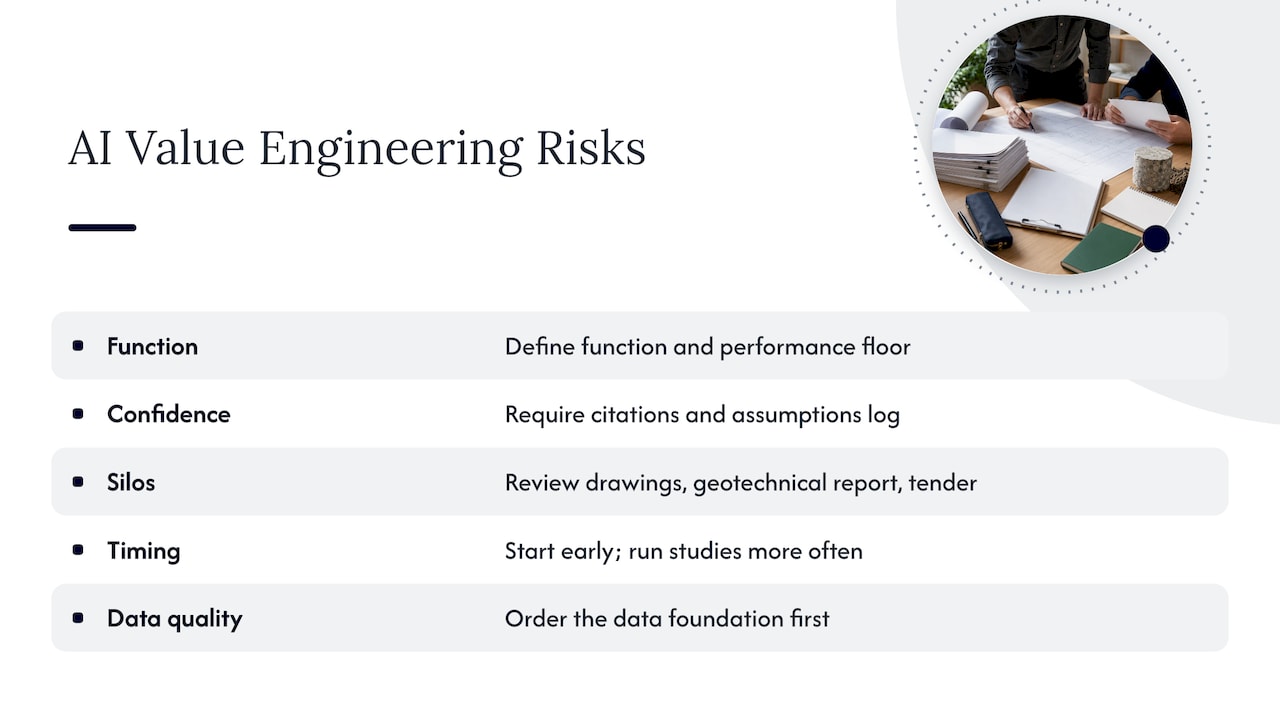
Savings without function. A model told to find 8% will find 8%, and may do it by removing redundancy that the function requires. Define the function and the performance floor first, and let the model search above it.
Unreviewed confidence. Fluent prose hides weak inputs. The cure is mandatory source citations and an assumptions log.
Silos. A study that sees only drawings misses the geotechnical report and the contractor’s tender. Value is usually found at the seams between documents.
Late use. Value engineering delivers the most when it starts early in design, when change is cheap. AI makes early studies affordable, so the sensible move is to run them more often instead of running the same late one faster.
Ignoring data quality. If the document set is inconsistent, the AI will surface the inconsistency, which is useful, or build on it, which is not. Teams should expect the first outcome only when the data foundation is in order.
10
Our perspective
We build an AI civil engineer, so we have a stake in this, and we say plainly where we think the industry misreads the problem.
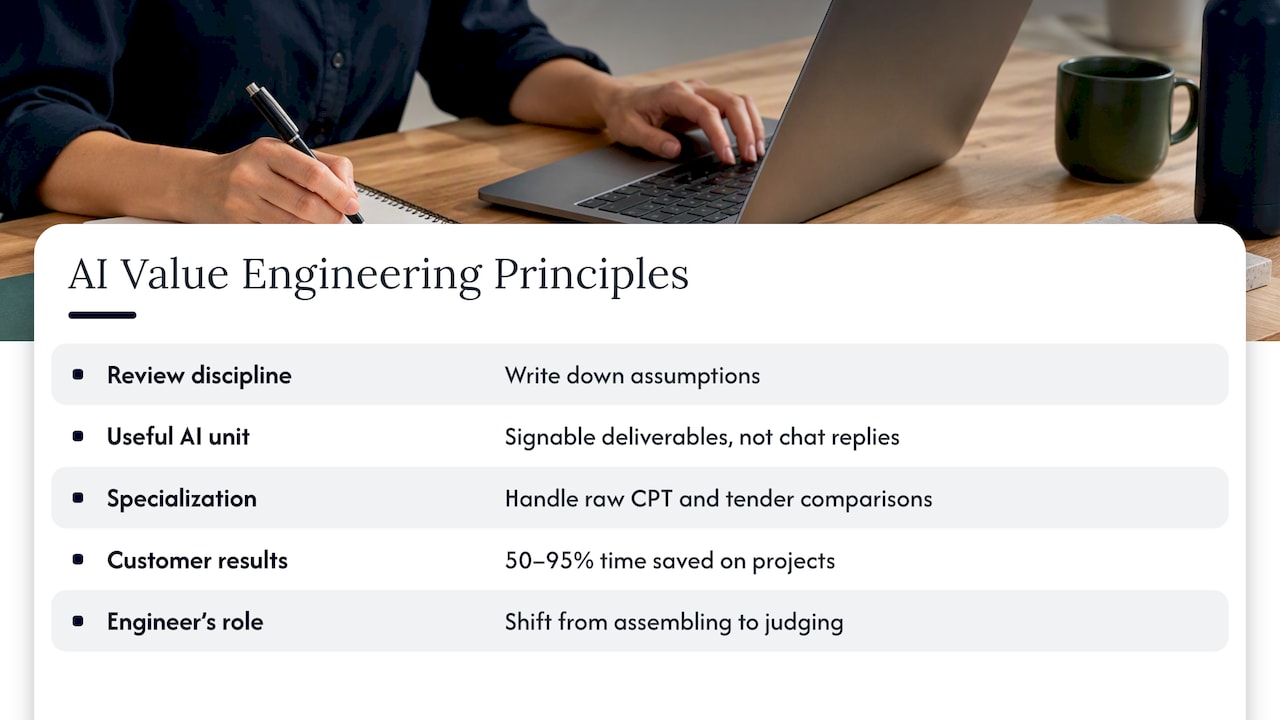
First, value engineering is a review discipline, and review needs something to review. That is why Yesper writes down its assumptions as it works. An engineer should be able to open a deliverable and challenge it in the way they would challenge a colleague’s calculation, without reverse-engineering where a figure came from. We would rather a reviewer disagree with a stated assumption than trust an unstated one.
Second, we think the useful unit of AI in construction is the deliverable, not the answer. A report, a quantity schedule or a normalized tender comparison is something a team can sign. A chat reply is something a team must re-verify. Yesper is built to produce the first kind of output end to end, and customers such as AFRY, NRC Group and Netel use it across their organizations. Customers report 50 to 95 percent of time saved on projects, along with quality gains because errors that human reviewers missed get caught.
Third, specialization matters more as complexity rises. On real engineering tasks, the gap between a general model and a system built for the discipline is not gradual. A general model cannot produce the geotechnical report from raw CPT protocols or one comparable set of numbers from a dozen tenders in three currencies. Value engineering lives exactly in that territory.
Finally, none of this removes the engineer. It moves the engineer’s time from assembling to judging, which is the part of value engineering the standard always intended.
11
How Yesper supports a value study
Yesper gives construction and infrastructure teams document search across the project record, regulatory compliance checks, quantity takeoff from BIM and drawings, error detection, and deliverable creation for reports, tenders, presentations and spreadsheets, with customizable agents for different project roles. In a value study that covers the information, evaluation and development phases, with traceability back to sources. If you are weighing how this would fit your organization’s workflow, start with the Yesper platform, or read about how it handles AI ROI for construction CFOs and turning AI adoption into measurable project gains.
12
A practical sequence for adopting it
Fix the function statements. Write down what each major element must do and the performance floor, before any AI generates alternatives.
Organize the record. Make drawings, specifications, models, geotechnical data and correspondence findable. The government review cited above treats this as the real bottleneck.
Apply AI to the information phase first. It is the lowest-risk step, and errors are easy to spot against the source.
Use deterministic checks for compliance and quantities. Let the model interpret, and let rules and calculations verify.
Review assumptions as a team. Put the assumptions log on the table in the workshop, next to the cost figures.
Record decisions. The RICS call for a joined-up strategy led by stakeholders, beyond isolated experiments, applies here: governance is part of the method.
No. The federal definition requires the needed functions to be delivered at the lowest life-cycle cost without sacrificing safety, necessary quality or environmental attributes. Cost cutting reduces price and accepts whatever function is lost. A study that cannot name the function it protects is cost cutting under another label.
Can AI do value engineering on its own?
It can do much of the reading, alternative generation, screening and drafting, but not the judgment. Trade-offs involving safety, risk and owner priorities need a named engineer’s decision. The sound arrangement is AI doing the assembly and people reviewing stated assumptions and signing off.
Which phases of the job plan benefit most?
The information, evaluation and development phases, because they are document-heavy and repetitive. Reading the full record, checking alternatives against requirements, and recomputing quantities or tender comparisons are where time is lost. The function analysis and final decision stay with the team.
How reliable are AI compliance checks?
They are good for screening and not yet enough alone. One 2025 method reached F1 scores up to 0.86 on regulatory documents, so some errors remain. Researchers recommend combining retrieval-based reasoning with deterministic checks for audit-ready results.
This post was written with AI assistance and published by Yesper. General information, not professional advice: requirements vary by project and jurisdiction, and the professional responsible for the project decides what applies. Spotted an error? Write to benjamin@yesper.ai.
Benjamin GlaserCo-founder at Yesper. Writes about AI and the industry that builds the world.benjamin@yesper.ai
Get news and articles in your inbox.
Unsubscribe anytime.
Yesper is the AI civil engineer for construction and infrastructure. AFRY, COWI, NRC Group and other Nordic firms use it to halve the time on a study, rerun calculations in minutes, and catch errors that would otherwise slip through. Get in touch if you'd like to see what it can do for you.