Engineers: How AI civil engineers fit with ASCE rules and job market

An “AI civil engineer” is not a replacement for a licensed professional but a layer of automated support that drafts, checks and flags work for human review. The Bureau of Labor Statistics projects 5% employment growth for civil engineers through 2034, hardly the trajectory of a profession being automated away. ASCE policy is explicit that engineers retain accountability for public safety regardless of which tool produced a draft, and platforms like Yesper are built around that constraint rather than against it.

Civil engineer reviewing an AI-assisted design
  • AI supports volume-based tasks like defect detection, site simulation, and document drafting, leading to significant time savings and improved error detection.
  • Engineers need basic data literacy and domain judgment skills to validate AI outputs and ensure compliance with safety and code requirements.
  • Most civil engineering roles will see task shifts, with routine drafting automated, while on-site supervision and judgment-heavy tasks remain human responsibilities.
  • Successful AI adoption requires disciplined pilots with measurable goals, clear review processes, and ongoing validation to prevent shelf-ware.
  • Firms should focus on AI platforms with construction-specific features, traceable outputs, and integration into existing BIM and project management systems.

Where AI earns its place on a project

The highest-payoff applications share one trait: they handle volume, not judgment. Computer vision models scan drone imagery to flag bridge deck cracking or corrosion patterns for an inspector’s confirmation, cutting the time spent scrolling through raw footage. Digital twins let planning teams simulate site conditions against large sensor and survey datasets instead of waiting for a physical walkthrough. Document automation tools search regulations, summarize specifications and draft tender language, work that used to consume a junior engineer’s week.

  • Inspection and condition monitoring: drone imagery plus computer vision flags defects for human sign-off.
  • Digital twins: continuous site data supports planning and operations decisions before ground is broken.
  • Document automation: regulatory search, spec summaries and draft reports move from days to hours.
  • BIM and drawing QA: automated checks catch clashes and quantity errors before they reach the field.

Some AI-powered platforms report significant time saved on projects, with error detection catching issues human reviewers missed on the same deliverables. The time savings vary widely depending on the task, reflecting how much manual document handling was previously required. Readers who want a fuller walkthrough of these categories can see practical AI use cases in construction.

Building the skills an AI-capable engineer needs

The technical bar for working alongside AI tools is lower than most engineers assume, but it is not zero. Data literacy, a working grasp of machine learning concepts and basic prompt construction now sit alongside structural analysis as useful fluencies. What matters more is domain judgment: knowing how to validate a model’s output, explain why it produced a given answer and verify it against code requirements before it reaches a stamp.

  1. Start with short, practical projects: a small retrieval-augmented or agent-based exercise builds more credibility than a certificate alone.
  2. Build a portfolio around model validation and BIM familiarity rather than theory alone.
  3. Consider a formal pathway once the fundamentals are solid. Carnegie Mellon’s MS in AI Engineering-Civil Engineering is one example of a degree built specifically at that intersection.
  4. Treat professional certificates and badges as a complement to hands-on work, not a substitute for it.

That sequence, project first, credential second, mirrors how hiring managers in the sector actually evaluate candidates.

Staying accountable when a model does the drafting

ASCE Policy Statement 573 states plainly that engineers must maintain responsibility for planning, design, construction and public safety, and that AI cannot substitute for professional judgment. NCEES guidance follows the same logic: the tool changes, the duty of care does not. A 2025 Frontiers framework for responsible AI in structural engineering organizes that duty into three domains: technical foundations, operational governance and professional responsibility, with continuous validation and explainability running through all three.

Practical guardrails follow from that framework:

  • Keep a human reviewer in the loop on anything design-affecting, not just final sign-off.
  • Document the model’s assumptions the way you would annotate a colleague’s calculation.
  • Re-validate periodically against fresh field data to catch drift before it compounds.
  • Watch for hallucination and bias the same way you would watch for a transcription error.

Pro Tip: Before submitting any AI-influenced deliverable, confirm the tool’s assumptions are written down somewhere you can audit, not just embedded in the output.

What the job market is actually telling engineers

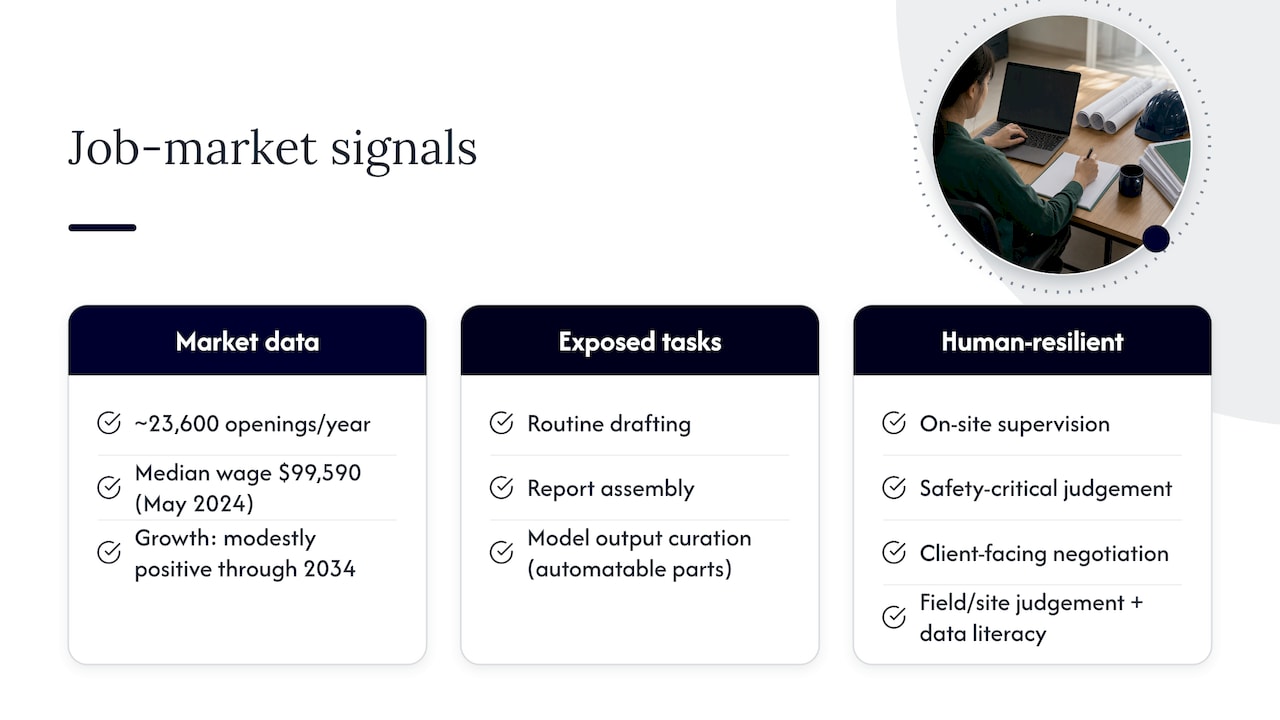
The labor-market signal contradicts the replacement narrative circulating in some trade press. The BLS projects about 23,600 annual job openings for civil engineers nationally, with a median annual wage of $99,590 as of May 2024. That growth rate through 2034 is projected to be modestly positive, indicating steady demand rather than decline, which is unusual for a field speculated to be hollowed out by automation.

What is shifting is task composition inside existing roles. Routine drafting and report assembly are the most exposed to automation; on-site supervision, safety-critical judgment calls and client-facing negotiation remain firmly human. New role variants are emerging around that split: AI-integrated design leads who manage model output quality, field engineers who pair site judgment with data literacy, and integration engineers who connect AI tools into existing BIM and project information management systems. Students building toward any of these should prioritize a portfolio over coursework alone.

What the Job Market Is Actually Telling Engineers — overview diagram

Rolling out AI without creating shelf-ware

Firms that succeed with AI tend to follow a disciplined sequence rather than a top-down mandate. Industry reporting on AEC adoption trends notes that most firms already using AI plan to expand use in 2026, but expansion without governance tends to produce exactly the shelf-ware this checklist is meant to avoid.

  1. Pick one low-risk, high-value pilot, something like regulatory document search, and set measurable acceptance criteria before starting.
  2. Define who reviews AI output at each stage and where it plugs into existing estimating and bid software or project information management systems.
  3. Track time saved and error rates against a baseline, not against intuition.
  4. Set a retraining or sunset rule so a model that drifts gets flagged, not quietly ignored.

Pro Tip: Treat the pilot’s acceptance criteria as a contract with yourself. If the tool cannot meet them in 90 days, that is useful information, not a failure. A more detailed rollout framework is available in this guide to avoiding AI shelf-ware.

What these tools look like in daily use

Benjamin writes on AI applications in civil engineering in affiliation with Yesper, a platform built for construction and infrastructure teams.

In practice, AI support in daily work looks like:

  • Automated draft reports pulled from raw site and regulatory data, reviewed before issue.
  • Regulatory compliance checks run against a project’s specific jurisdiction before submission.
  • Traceable assumptions attached to every output, so a reviewer can audit the reasoning, not just the number.

More detail on how human review fits into that process is covered in this explainer on AI civil engineers.

The discipline AI adoption actually requires

The risk in civil engineering is not that AI moves too fast. It is that firms treat adoption as a tooling decision instead of a governance decision, skipping the validation and documentation that make AI output trustworthy. The engineers who benefit most will be the ones who treat verification and traceability as part of the job, not friction added to it, and who pull data specialists and regulatory staff into that conversation early rather than after a model’s output is already in a tender.

Finding the right platform fit for your firm

When evaluating enterprise AI platforms for construction work, look for domain fit, integration with existing BIM and project systems, and traceable, source-verified outputs rather than black-box answers. Some AI platforms are built for construction and infrastructure work, handling document search, regulatory compliance checks and end-to-end deliverable creation. Readers wanting the technical detail behind that approach can review Yesper’s platform architecture or visit Yesper directly.

Can AI do civil engineering work on its own?

No. AI tools can draft reports, check documents and flag errors, but ASCE policy requires a licensed engineer to retain responsibility for design, construction and public safety decisions. AI functions as a drafting and review aid under human oversight, not an independent practitioner.

Which engineering roles are least likely to be automated?

Roles built around on-site supervision, safety-critical judgment and client negotiation remain the most protected, since these depend on contextual judgment that automated tools are not positioned to replace. Routine drafting and document assembly tasks are more exposed, which is why many engineers are shifting toward roles that pair domain judgment with AI oversight.

What does an AI engineer typically earn in civil engineering?

There is no separate published wage category for “AI civil engineer” roles. The BLS reports a median annual wage of $99,590 for civil engineers generally as of May 2024, and AI-related specializations typically sit within that same occupational classification rather than a distinct one.

Can AI replace drafting software like AutoCAD?

AI tools are increasingly used to interpret and check drawings and BIM models rather than replace drafting software outright. The tasks shifting are quality assurance and quantity extraction from existing models, while the underlying drafting platforms remain the production environment engineers work in.


This post was written with AI assistance and published by Yesper. General information, not professional advice: requirements vary by project and jurisdiction, and the professional responsible for the project decides what applies. Spotted an error? Write to benjamin@yesper.ai.

Benjamin Glaser Co-founder at Yesper. Writes about AI and the industry that builds the world. benjamin@yesper.ai

Yesper is the AI civil engineer for construction and infrastructure. AFRY, COWI, NRC Group and other Nordic firms use it to halve the time on a study, rerun calculations in minutes, and catch errors that would otherwise slip through. Get in touch if you'd like to see what it can do for you.

Book demo