Specialized AI for engineering: What sets it apart in 2026
Specialized AI for engineering is software built around the inputs, codes and review habits of a specific discipline, rather than a general chatbot asked to imitate an engineer. In construction and infrastructure that means reading raw CPT protocols, BIM models and tender packages, checking work against the governing code, and writing down every assumption so a licensed engineer can review it as they would a colleague’s calculation. The distinction matters because the tasks where engineering firms lose the most hours are precisely those where a general model degrades fastest.
Benjamin Glaser
22 October 2026 · 12 min read
01
TL;DR
Specialized engineering AI is defined by its inputs (CPT data, BIM, drawings, tenders), its grounding in verified project documents and codes, and its traceable output, not by the size of the underlying model.
The licensed engineer stays accountable. ASCE’s policy says AI cannot replace the professional judgment of a Professional Engineer, so review and sign-off must be built into the workflow.
02
What makes AI specialized rather than general
A general frontier model is a remarkable generalist. Ask it to explain consolidation settlement and it will do so fluently. Ask it to produce a geotechnical report from a folder of raw CPT protocols, and the fluency becomes a liability: it will produce something that reads like a report, with constraints that were never in the data.
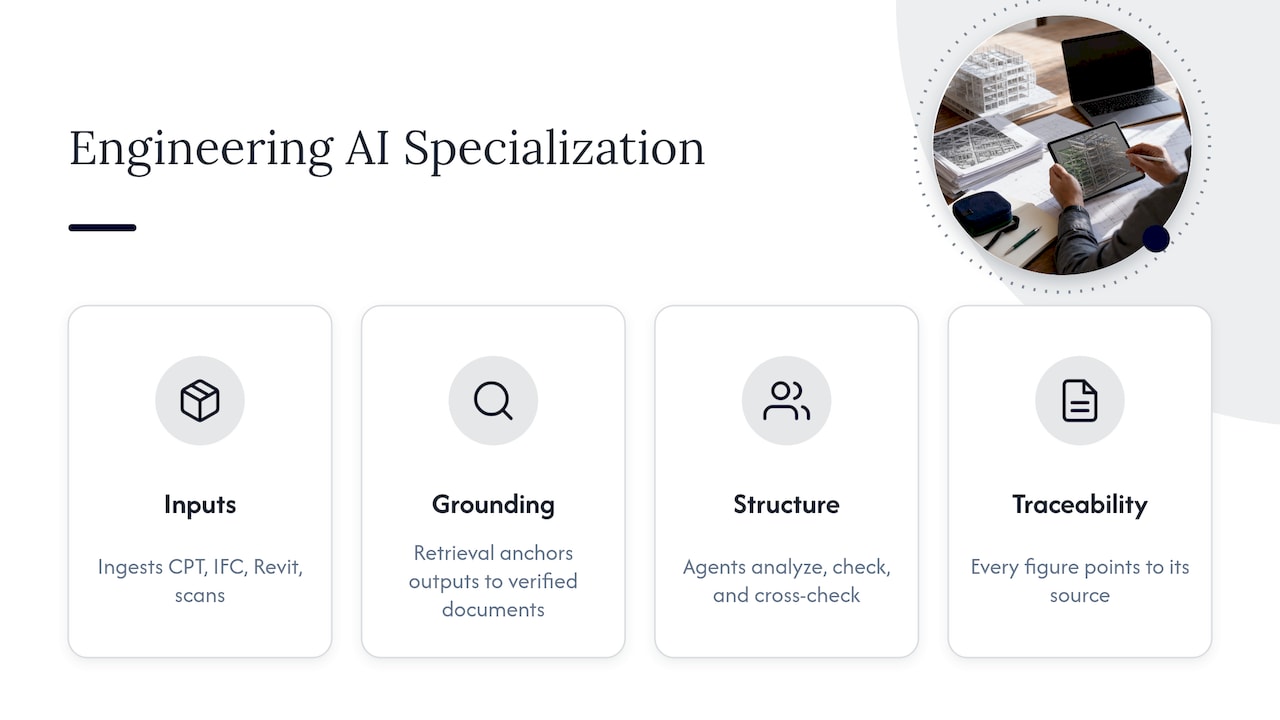
Specialization in engineering shows up in four places.
Inputs. The material engineers actually work with is rarely clean prose. It is CPT logs, IFC and Revit models, scanned drawings, spreadsheets of quantities, and a dozen tenders in three currencies with different inclusions and exclusions. A specialized system is built to ingest these formats and return one comparable set of numbers.
Grounding. Modern codes are non-linear and cross-referenced: a clause in Eurocode or the International Building Code points to a table, which points to a national annex or an amendment. Researchers at Cardiff University, writing on LLM-based automated compliance checking, frame the core engineering problem as anchoring generation to verified documentation, which is the reason retrieval-based architectures dominate serious work in this area.
Structure. The strongest published results come from systems that imitate a professional team. In the reinforced concrete study, one agent handles the structural analysis, another checks code compliance and a third performs an independent cross-check, rather than a single model producing a single answer that nobody can interrogate (Automation in Construction, 2025).
Traceability. Every assumption is written down, every figure points to its source document. Without this, the output cannot be reviewed, and an engineer who cannot review it cannot seal it.
03
General model versus specialized system, task by task
The gap is not uniform. For drafting an email or summarizing a meeting, a general model is sufficient. The difference becomes a cliff as the task gets longer, more document-heavy and more consequential.
Task
General chatbot
Specialized engineering AI
Summarize a specification section
Usually adequate
Adequate, with clause references
Geotechnical report from raw CPT protocols
Cannot process the raw data reliably; invents plausible values
Reads the protocols, derives parameters, documents assumptions
Quantities from a BIM model
Cannot interpret the model geometry at scale
Extracts quantities and keeps the link to model elements
Compare a dozen tenders in three currencies
Inconsistent normalization, no audit trail
One comparable set of numbers with sources
Check a design against a cross-referenced code
Misses clauses reached through references
Retrieves the governing clauses and flags conflicts
Reproducibility on rerun
Varies between sessions
Fixed workflow, repeatable steps
The pattern in the last column is consistent: the specialized system does the whole job from raw material to reviewable deliverable, while the general model answers questions about the job.
04
What the evidence says about performance
It is worth separating what is measured from what is promised.
The most concrete public result is the structural design study above. Customizing a model for the domain through retrieval and a multi-agent setup produced a 90% time saving, 97% design accuracy and gains of up to 9.4% in response relevance and reproducibility. It is one study on one design problem, reinforced concrete, and it should not be read as a guarantee for every discipline. It does show the direction: domain structure beats raw model size.
On the practitioner side, customers of Yesper report 50 to 95 percent time saved on projects, and higher quality, because errors that human reviewers missed get caught. That range is customer-reported, and the spread itself is informative: a routine document search saves less than the generation of a full deliverable from scratch.
For the market view, the ACEC Research Institute’s 2025 paper points to where firms see value now: progress monitoring (36%), contract and document review (30%) and resource optimization (30%). None of these is glamorous. All of them are document-heavy, repetitive and checkable, which is exactly the profile of work where specialized AI earns its place.
05
Why adoption is still early
The enthusiasm is ahead of the implementation. The RICS 2025 report on AI in construction finds that 45% of organizations globally have no AI implementation at all, 34% are confined to early pilots, and 1.5% report use across multiple processes. Meanwhile the NBS Digital Construction Report 2025 records that 42.5% of respondents already use AI tools, up from 9% in 2020. Both can be true: many professionals use AI individually, while few organizations have changed how work flows.
The reasons given are operational. In the RICS data, 46% of respondents name a lack of skilled personnel as the biggest hurdle, 37% cite integration with existing systems and 30% cite poor data quality and availability. Regulation is not the main brake. Most construction professionals expect AI to raise productivity, yet trust has to be earned through transparency.
Three implications follow for anyone buying or building specialized AI:
Integration is a requirement, not a feature. A tool that lives outside the document system, the BIM environment and the project management stack becomes one more tab.
Data quality decides the result. A specialized system can read messy inputs, but it cannot recover information that was never recorded.
Someone has to own the change. The ACEC paper stresses that adoption fails when AI is treated as plug-and-play software. Firms that do well appoint AI champions who redesign workflows around what the system does well.
06
Where specialized AI pays off in construction and infrastructure
The applications that survive scrutiny share one trait: the output can be checked against a source.
Document search and organizational knowledge
A contractor’s knowledge sits in thousands of PDFs, emails and old project folders. Search that answers with the clause, drawing or minute it came from turns that archive into something a new project manager can use in week one rather than year two.
Compliance review
Checking a design package or a submittal against code, owner requirements and project specifications is slow because the relevant text is scattered. A system that retrieves the governing clauses and flags conflicts shortens the first pass, while the engineer still decides what a flagged item means.
Quantity takeoff and BIM
Extracting quantities from models and drawings is where manual work and error rates are both high. Our guide to AI for BIM and the human sign-off it requires goes through how to keep an engineer in the loop while the takeoff itself is automated.
Tender analysis
Tenders arrive in different structures, scopes and currencies. Normalizing them into one comparable table is mechanical but unforgiving; one missed exclusion changes the ranking. See how tender document analysis works in hours rather than days with human sign-off at the end.
Deliverables from scratch
Reports, presentations, spreadsheets and tender documents can be produced end-to-end, with the assumptions listed for review. This is where the largest time savings tend to sit, because the system replaces assembly work rather than a single lookup.
No serious discussion of engineering AI avoids the question of responsibility. The American Society of Civil Engineers states in its policy statement 573 that the civil engineer must keep responsibility for planning, design, construction, operation and the protection of public health, safety and welfare, and that AI cannot replace the professional judgment of a licensed Professional Engineer.
The practical reading is not that AI should be kept away from design work. It is that the system must produce output a licensed engineer can actually review: stated assumptions, cited sources, reproducible steps. A black box that returns a number fails this test regardless of how often the number is right. For a fuller treatment of how this fits with professional rules and the labor market, see how AI civil engineers fit with ASCE rules.
The same logic answers the anxious question that dominates search results, whether AI will replace engineers. The ACEC paper describes AI as a force multiplier that lets senior staff hand off repetitive drafting and checking and concentrate on design thinking and mentorship. The Autodesk 2025 AI Jobs Report adds that AI fluency is becoming a baseline requirement, with design skills, communication and strategic judgment ranked among the most valued human competencies.
08
Trust, data protection and access control
A specialized system will hold tender prices, geotechnical data and design calculations, which is commercially sensitive material. RICS notes that firms are moving toward AI governance frameworks that emphasize data protection and intellectual property. Before any rollout, security and IT teams should settle who can see which project, which roles can export, and how permissions are removed when people leave. A practical starting point is this prioritized checklist of user access controls, written for IT and security teams and applicable to any platform that holds project data.
Two questions belong in every vendor conversation: where does the data go, and what is it used for? Ask for the answer in writing, and have the contract say it.
09
Our perspective: From answering questions to doing the work
We built Yesper on a simple observation. Most engineering hours are not spent on the decision that needs a senior engineer; they are spent on everything around it: finding the right revision, reading the right clause, reconciling the numbers, formatting the deliverable. A tool that merely answers questions leaves that work where it was.
So we designed an AI civil engineer that works inside your projects, produces deliverables from scratch and writes down its assumptions, so that review looks like reviewing a colleague’s work rather than auditing a black box. Its output is traceable to source documents, because without that, review is theater.
We also think the honest benchmark is the hard task, not the easy one. On a summary or a drafted email, a general model and a specialized one look alike. Hand both a set of raw CPT protocols, a BIM model or a dozen tenders in three currencies, and the difference stops being incremental. That is why Yesper is built for engineering work all the way down the stack, and why teams at companies such as AFRY, NRC Group and Netel use it across the organization rather than in one corner of it.
The point we would stress hardest is that the review step is the product. Time saved that is paid back in doubt is not time saved.
10
How to evaluate a specialized engineering AI
A short list of tests separates real engineering systems from general models with an engineering skin.
Give it your worst input. Use a raw CPT export, a heavy BIM model or a messy tender pack, not a clean sample. Note what it does when information is missing: a good system says so; a weak one fills the gap.
Inspect the assumptions. Can you see every assumption, and the document each came from? If not, you cannot review it.
Check the code logic. Pick a clause that depends on a cross-reference and see whether the system finds the whole chain.
Rerun it. The same inputs should give the same result, or any differences should be explained.
Test the integration. Does it connect to the tools your teams already use, or does it need a parallel process?
Define sign-off. Decide in advance who reviews which output and how that review is recorded.
Name an owner. Per the ACEC findings, adoption needs a champion who redesigns the workflow, not just an administrator who grants licenses.
Yesper is an AI civil engineer for construction and infrastructure teams. It searches project documents, checks regulatory compliance, extracts quantities from BIM and drawings, builds reports, tenders, presentations and spreadsheets, detects errors, and runs multi-step workflows with agents configured for different project roles. To see how it fits your organization, visit Yesper or book a demo.
FAQ
What is specialized AI for engineering?
It is AI built for the data, codes and review practices of an engineering discipline. It reads domain inputs such as CPT protocols and BIM models, grounds its answers in verified documents, and records its assumptions. The aim is a deliverable an engineer can review, not a plausible-sounding answer.
Can AI replace engineers?
Not under current professional rules. ASCE states that AI cannot replace the professional judgment of a licensed Professional Engineer. In practice, AI takes over repetitive drafting, searching and checking, while engineers keep design decisions and sign-off.
Why not just use a general chatbot for engineering work?
For short, low-stakes text tasks, a chatbot is fine. For work built on raw project data, cross-referenced codes or many documents, general models tend to invent constraints and lose traceability. Specialized systems add retrieval, domain workflows and independent cross-checks to address exactly that.
Which engineering tasks benefit most from AI today?
Document-heavy, checkable tasks. The ACEC findings put progress monitoring at 36% and contract or document review and resource optimization at 30% each. Quantity takeoff, compliance review and tender comparison fit the same pattern.
Why do so many AI initiatives in construction stall?
Mostly for operational reasons. RICS respondents most often cite a lack of skilled personnel (46%), then integration with existing systems (37%) and data quality (30%). Treating AI as plug-and-play software, without owners and redesigned workflows, makes stalling likely.
This post was written with AI assistance and published by Yesper. General information, not professional advice: requirements vary by project and jurisdiction, and the professional responsible for the project decides what applies. Spotted an error? Write to benjamin@yesper.ai.
Benjamin GlaserCo-founder at Yesper. Writes about AI and the industry that builds the world.benjamin@yesper.ai
Get news and articles in your inbox.
Unsubscribe anytime.
Yesper is the AI civil engineer for construction and infrastructure. AFRY, COWI, NRC Group and other Nordic firms use it to halve the time on a study, rerun calculations in minutes, and catch errors that would otherwise slip through. Get in touch if you'd like to see what it can do for you.