Owner requirements tracking is the practice of recording what the owner needs from a project, assigning each need an owner, a source and a verification method, and keeping that record current until handover. Done well, it is a living register linked to design decisions, submittals and tests. Done badly, it is a PDF written during briefing that nobody opens after the design kickoff, which is where most of the trouble starts.
This guide sets out what to track, how to structure the register, how to log deviations, and where automation changes the economics of the work.
02
03
The search results for this topic are dominated by software requirements management: Jira tickets, test cases, product backlogs. The vocabulary transfers, but construction and infrastructure add features that software teams rarely face. Requirements arrive from several directions at once: the owner’s functional and operational needs, the permitting authority’s conditions, the standards the contract incorporates, and the site itself. Each has a different author, a different approval route and a different way of being verified.
Tracking therefore has to cover three things:
A requirement without all three is a wish. It may be a legitimate wish, but nobody can say on handover day whether it was met.
04
The most common failure is what one might call the static document trap. Requirements are finalized in an early brief and never updated for site conditions, regulatory shifts or design compromises. Loughborough University research on client requirements information argues for a life-cycle approach instead, one that keeps requirements managed throughout the project rather than only in the early briefing phase. The same body of work, in a paper on an integrated requirements management system, describes the paper-based handling of client requirements and change requests as lacking efficiency and effectiveness.
The practical consequences are familiar. A mechanical engineer sizes plant against the version of the brief in their inbox. A procurement lead orders a material that meets the drawing but not the specification. A value-engineering proposal quietly trades away a performance target that the owner considered non-negotiable, and nobody records that the trade was made. Each is a small event; together they are the rework that owners later describe as inexplicable.
The remedy is not more documentation. It is documentation that is attributed, linked and changeable under control.
05
Project owners and engineering leaders frequently fail to distinguish between the Owner’s Project Requirements and the Basis of Design. The distinction is simple and the consequences of ignoring it are not.
| Owner’s Project Requirements (OPR) | Basis of Design (BOD) | |
|---|---|---|
| Answers | What the facility must do | How the design team will achieve it |
| Written by | Owner, with advisers | Design team |
| Typical content | Performance targets, sustainability goals, operational needs | Engineering solutions, assumptions, selected systems |
| Changes when | The owner’s needs change | Design develops or conditions change |
When the two are merged into one document, technical design shifts get mistaken for functional changes, and genuine functional changes get buried in design revisions. The result is unmanaged scope creep. The California State University OPR Guide is a useful starting template for the structure of an OPR, though its examples are written for typical CSU projects and need adapting to your own.
Keep the two in separate but linked repositories. Then any proposed change to the BOD can be tested against the OPR before it is authorized, which is the whole point of an impact analysis log.
06
A register entry that survives a long project carries more than the requirement text. A workable minimum:
The discipline is in the rationale and the evidence. Without them, the register is an index; with them, it is an argument that can be audited.
07
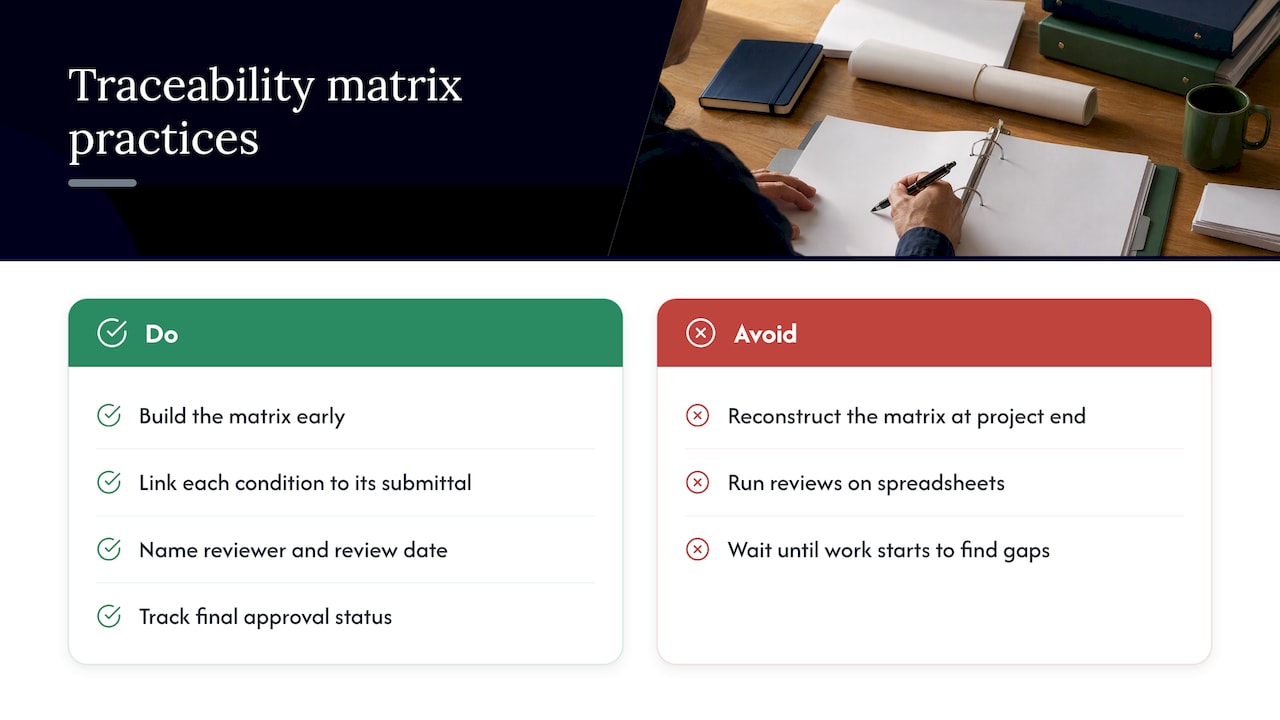
The requirements traceability matrix maps each high-level objective to the regulatory conditions, design elements, deliverables and verification activities that satisfy it. The CSU guide treats it as the essential mechanism for keeping project scope aligned with strategic intent. The common failure is not building it badly but building it late: attempting to reconstruct it retrospectively at the end is a recognized driver of cost overruns and compliance failures.

The matrix is just as much a regulatory instrument. On infrastructure projects with formal conditions, each condition needs to be linked to a unique submittal, a specific reviewer, a review date and a final approval status. The California DCBO Best Management Practices Guide requires an internet-based submittal system acting as a portal for document review. Teams that run this on spreadsheets lose the ability to run look-ahead audits. They discover that a condition is missing or unapproved only when work is physically underway, and that is when stop-work risk becomes real.
For a practical look at generating the first version of the matrix from source documents rather than typing it, see our note on a compliance matrix built straight from the tender documents.
08
Requirements will be deviated from. That is normal; an unrecorded deviation is the problem. Current best-practice guidance, including the CSU guide and the DCBO guide cited above, calls for deviations to be tracked in a formal log recording:
The fifth item is the one that fails most often in practice. Approval after the fact is not approval; it is ratification, and it leaves the owner with obligations they never assessed. Tracking requirements as addenda after the request for proposals is issued also ensures that all design team members are working from the most recent approved criteria.
The same logic applies commercially. A deviation that changes cost or time belongs in the change-order trail as well, and our overview of change order analysis and the outputs contractors and PMs need first covers how to connect the two records.
09
A requirement that is unverified is a risk, and the cleanest way to run both disciplines is to let them share data. Every requirement with an open status past its planned verification date is a candidate risk-register entry; every risk that references a performance target should point back to a requirement ID. Teams exploring risk register automation will find the same principle at work: a register that is updated by events rather than by quarterly workshops is one people trust.
On the quality side, the register feeds inspection and test plans directly. For the standards context, our piece on audit-ready QA/QC automation under ISO 19650 and ISO 9001 shows how verification evidence is kept traceable. Safety obligations follow the same pattern, covered in five audit-ready construction safety compliance steps.
10
Owners generally pick among three routes. None is universally right; each fits a different scale and risk profile.
| Approach | Strength | Weakness |
|---|---|---|
| Spreadsheet | Cheap to start, familiar | No automatic impact analysis; versions diverge; look-ahead audits become manual work |
| General requirements management software | Mature traceability, audit trails, suited to product development | Built around software and product lifecycles; construction documents still have to be read and entered by hand |
| Construction-specific AI platform | Reads the source documents, drafts the register and flags conflicts | Requires an organizational commitment to use it in daily work |
The difference that matters between specialized platforms and basic tools is live traceability. According to a 2026 industry review of requirements management tools, in one of the stronger platforms a change to a parent requirement triggers an automatic identification of every affected downstream item. The same review puts implementation of that tool at two to three months. Treat these as figures for that product category, not as a forecast for your own project.
The manual burden sits upstream of all of this. Someone must still read a 400-page specification, a stack of permit conditions and a set of owner standards, and turn them into discrete, testable records. That is precisely the step in which errors enter, and the step automation is best placed to take over.
11
Three tasks account for most of the effort in requirements tracking, and each is document-heavy:
The condition for using AI here is traceability. A tool that produces an answer without showing the clause it relied on has moved the review problem, not solved it. The reviewer should be able to inspect the assumptions and the sources the way they would review a colleague’s work. Our discussion of engineering compliance checks with BIM and AI without losing audit proof goes into this in detail, and drawing revision control addresses the related question of which revision a requirement was checked against.
12
We build Yesper as an AI civil engineer for construction and infrastructure, and requirements tracking is a good test of whether that description means anything. The work is not answering questions about a document. It is reading several documents, producing a structured deliverable, and writing down the assumptions made along the way so that an engineer can challenge them.
Two convictions shape how we approach it. First, a requirements register is only as good as its link to source: every record should lead back to the clause that created it, and every automated conclusion should show its working. Second, the value is in catching what a tired human reviewer misses, such as a permit condition with no allocated submittal, or a design change that quietly contradicts a performance target. Customers tell us that this combination, rather than raw speed, is what changes how they run projects, though results depend on the organization and the discipline of its processes.
We would add one caution of our own. No tool rescues a project whose owner has not decided what they want. The OPR still has to be written by people who understand the facility’s purpose. What automation does is keep that intent intact once the project machinery starts moving.
13
Yesper works inside your projects across the organization, reading specifications, tender documents, drawings and BIM models, building the compliance matrix and checking deliverables against it, with sources shown for every finding. Teams use it to search project documents, run regulatory compliance checks, automate multi-step workflows and produce reports and spreadsheets. You can see how the pieces fit on the Yesper platform page, or start from yesper.ai to see how it applies to your own role.
14
For an owner starting a new project, or retrofitting discipline onto one already underway, the order matters more than the tooling.
Analysts of requirements software often note that the real gain is less rework, not more activity. By centralizing information, teams remove version conflicts and fragmented email threads and move from firefighting toward quality assurance, as Capterra’s category overview suggests. That matches what the construction research says about integrated systems: fewer errors from manual, disconnected processes, and a lower chance of buying materials that fail the specification.
FAQ
Tracking records the status of each requirement over time: open, verified, deviated or closed. Traceability records the links between a requirement and its source, design elements and verification evidence. In practice you need both, and the traceability matrix is usually where they meet.
The owner owns the requirements; a named role on the owner’s side, often a project manager or commissioning authority, owns the register itself. Individual records are assigned to the party responsible for satisfying them. Splitting ownership this way keeps the owner in control of intent without making them responsible for design detail.
Whenever a requirement, design decision or regulatory condition changes, and reviewed on a fixed cycle as well. Weekly during design is common. The key point from the guidance is that the matrix is maintained throughout the project, not rebuilt at the end.
For a small project with few stakeholders, yes. As the number of requirements, reviewers and submittals grows, spreadsheets make look-ahead audits and impact analysis a manual job, and missing conditions tend to surface late. At that point a connected system pays for itself in avoided rework.

Sources
This post was written with AI assistance and published by Yesper. General information, not professional advice: requirements vary by project and jurisdiction, and the professional responsible for the project decides what applies. Spotted an error? Write to benjamin@yesper.ai.
Get news and articles in your inbox.
Yesper is the AI civil engineer for construction and infrastructure. AFRY, COWI, NRC Group and other Nordic firms use it to halve the time on a study, rerun calculations in minutes, and catch errors that would otherwise slip through. Get in touch if you'd like to see what it can do for you.
Book demo