Compliance comes down to five things: follow the standards that actually apply to your project (starting with 29 CFR 1926 in the US or CDM 2015 in the UK), run a documented hazard identification process, lock down fall protection, scaffolding, and ladder safety first, keep inspection and training records current, and inspect on a fixed schedule rather than a reactive one. Platforms leveraging AI now handle much of the document trail behind that work, but the discipline itself has not changed in decades.
In short
01
Most citations happen because a known hazard sat unaddressed, not because a rule was unknown. Fix that order of operations first.
Build a one-page evidence pack before an inspector ever arrives. A dated photo, a completed log entry, and a signed corrective action note are usually enough to satisfy an inspector that a flagged issue has already been handled.
02
The right rulebook depends entirely on where you’re building and who’s working the site.
Write that mapping down in a compliance register. Auditors spanning more than one jurisdiction will ask who owns each rule and where the evidence for it lives.
03
OSHA’s own recommended practices push contractors toward a flexible, site-specific “find and fix” model rather than a rigid, universal checklist. The practices are aimed especially at small and medium-sized contractors, and they advise starting with modest goals and building from there, since continuous improvement matters more than launching with something polished.
A defensible program documents these pieces:
Pro Tip: Treat every inspection finding as raw material for your next SWMS revision, not a one-off fix. That feedback loop is what separates a program that survives scrutiny from one that just reacts to it.
04
Five of the ten standards OSHA cited most often in fiscal year 2025 are construction standards: fall protection, scaffolding, ladders, fall protection training, and eye and face protection. None of these are obscure or hard to verify.
For every fix, capture proof the same way: a dated photo, a completed inspection checklist entry, and a retraining log if the issue involved a person rather than equipment. That three-part record is usually what closes a finding.
05
Enforcement issues on multi-contractor sites almost always trace back to one gap: nobody was clearly in charge of coordinating safety across trades. CDM 2015 addresses this directly by requiring specific appointments and documents.
06
Inspectors and internal auditors want the same things: proof that your management system actually runs day to day, not just a policy binder.
A timestamped photo folder and a centralized cloud evidence pack beat a filing cabinet every time an inspector shows up unannounced. If you build in Australia, check exactly when a SWMS is legally required for your own project type.
07
Manual compliance tracking breaks down the moment a project scales past a handful of subcontractors. Centralized digital systems answer that by embedding regulatory requirements directly into daily workflows instead of treating compliance as a separate paperwork exercise. Construction ERP vendor CMiC argues that this is what makes oversight measurable and defensible.
Automation handles the repetitive retrieval and bundling work well; the site-specific hazard judgment still belongs to a competent person on the ground. Yesper, the AI civil engineer for construction and infrastructure, builds a compliance matrix directly from the tender documents, with each requirement traced to its place in the source. AFRY, NRC Group and Netel run Yesper across thousands of seats.
Customers report substantial time savings on document-heavy project tasks, along with the added benefit of catching errors that human reviewers might miss on the first pass.
08
A predictable walk sequence keeps an inspection from turning into a scramble.
09
Compliance built after design is finished always costs more than compliance built into it. Embedding hazard planning at the front end of a schedule cuts rework that would otherwise surface mid-build.
Leadership has to visibly own this, and workers need a real channel to flag hazards, not a suggestion box nobody checks. Track near-miss rate, inspection pass rate, and time-to-close on nonconformances. Those three numbers tell you whether the program is actually working, faster than any audit will.
10
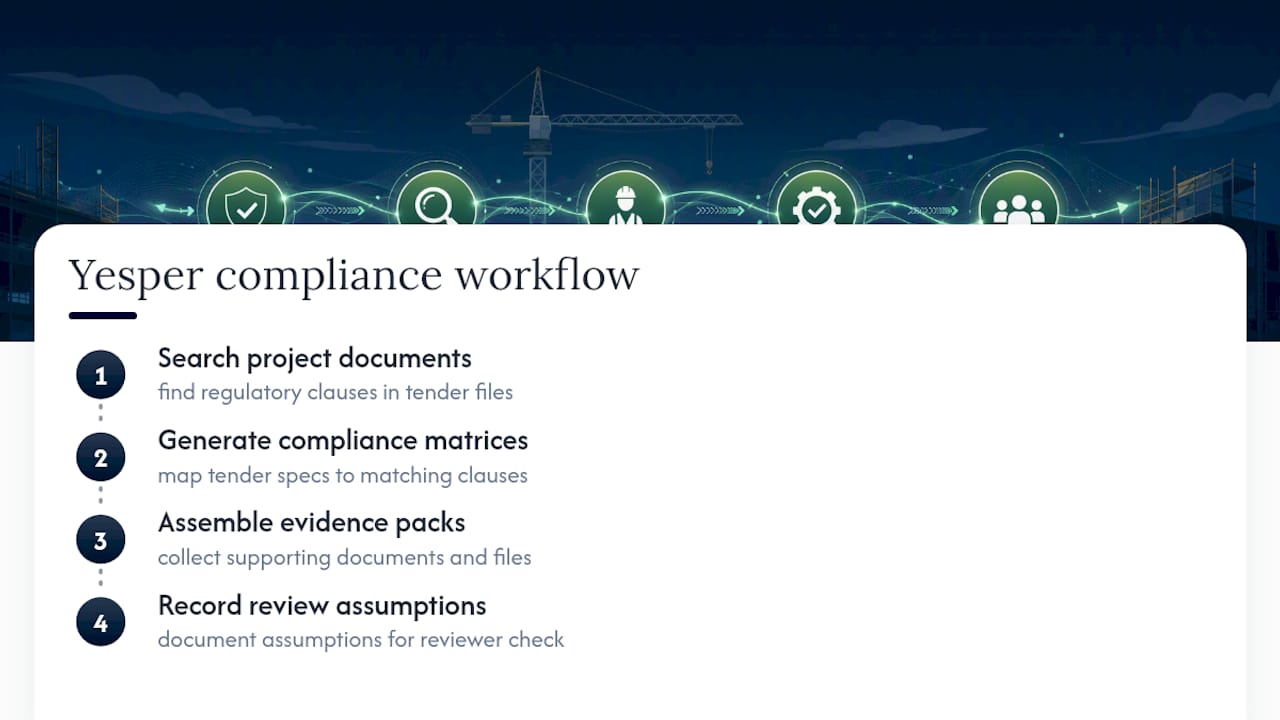
Yesper offers an alternative to building compliance paperwork by hand, project after project. Instead of a team manually cross-referencing tender documents against regulatory clauses, Yesper reads the project documents with page-level source citations, builds checklists and compliance matrices from the tender documents, and writes the supporting documents with the assumptions made written down for review, the same way you’d review a colleague’s work.

For safety officers managing multiple active sites, that means less time spent reconstructing what happened last week and more time on the hazards that actually need a human eye. See what Yesper does, or book a demo.
FAQ
The core federal standard is 29 CFR Part 1926, covering fall protection, scaffolding, excavation, cranes, and dozens of topic-specific subparts. States running their own OSHA-approved plans can add requirements beyond this federal floor.
There’s no single official list of prioritized rules, but enforcement data highlights fall protection, scaffolding, ladders, fall protection training, and eye and face protection. Those five construction standards all sit among the ten standards OSHA cited most often in fiscal year 2025.
At minimum, a site needs documented fall protection systems, scaffolds inspected by a competent person before each work shift, PPE availability, training records tied to the equipment in use, and a hazard identification process that gets updated as conditions change. A one-page evidence pack combining photos, logs, and signed corrective actions typically satisfies an inspector’s initial questions.
Definitions vary across guidance documents, but a common version covers: identify hazards before work starts, use required PPE, maintain fall protection above six feet, inspect equipment before use, keep walkways and exits clear, report incidents immediately, and complete required training before starting a new task.
Yes. Digital record systems centralize inspection and training records, and Yesper builds checklists and compliance matrices directly from tender documents, with page-level source citations, cutting the manual document work that eats into a safety officer’s week. Site-specific hazard judgment still requires a competent person on the ground.

This post was written with AI assistance and published by Yesper. General information, not professional advice: requirements vary by project and jurisdiction, and the professional responsible for the project decides what applies. Spotted an error? Write to benjamin@yesper.ai.
Get news and articles in your inbox.
Yesper is the AI civil engineer for construction and infrastructure. AFRY, COWI, NRC Group and other Nordic firms use it to halve the time on a study, rerun calculations in minutes, and catch errors that would otherwise slip through. Get in touch if you'd like to see what it can do for you.
Book demo