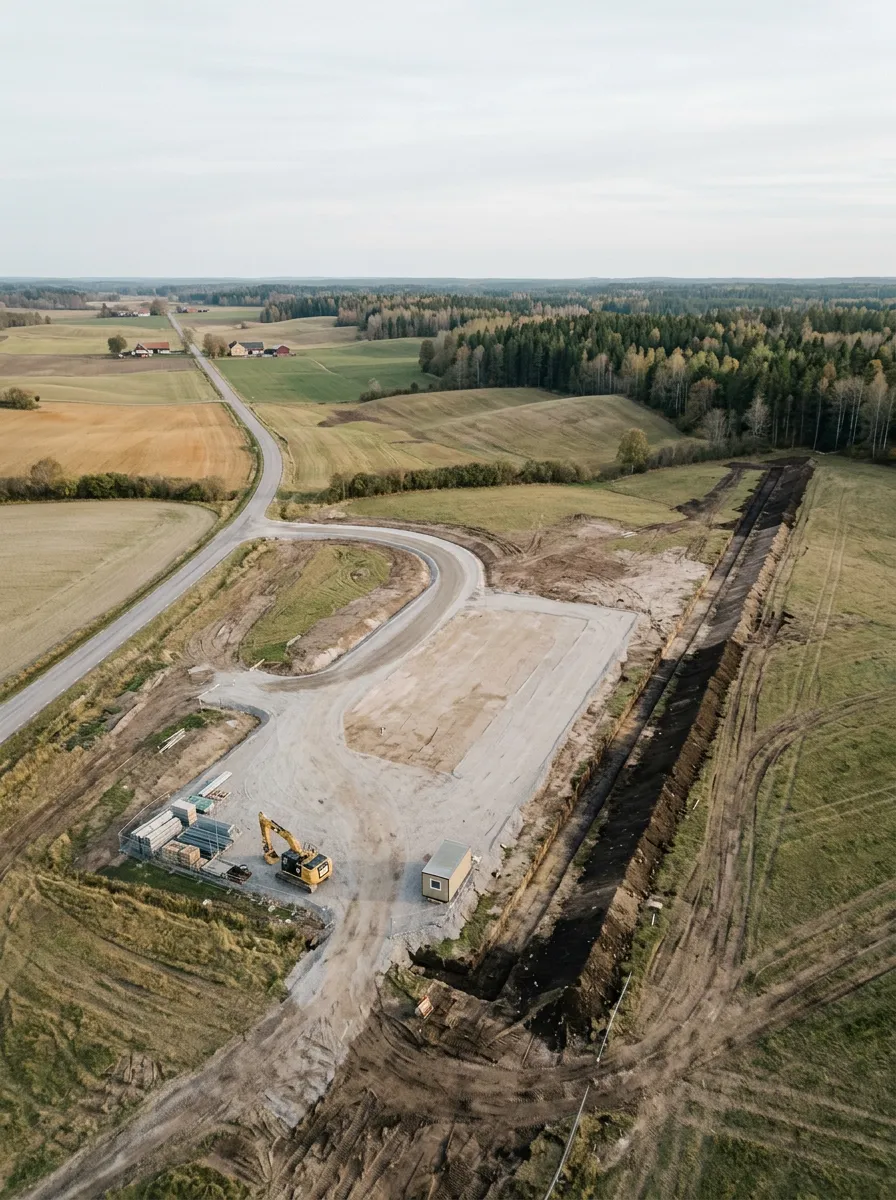
Just after ten on the morning of 13 May 2026, a JAS 39 Gripen landed on riksväg 44 at Häljestena, a stretch of highway built to double as a runway. Sweden is counting its physical readiness assets again: road bases, quarries, rail ferries. The asset one step earlier in the chain, the capacity to investigate, permit, design and review inside the classification boundary, has no line in any plan yet, and it sets the pace of all the others.
Benjamin Glaser
30 June 2026 · 6 min read
The runway
The road was built to be landed on
The landing closed about a thousand metres of road, with traffic diverted onto Häljestenavägen, and it fell on the closing day of Aurora 26, an exercise with more than 18,000 participants. The stretch had seen it before: on 13 September 2017 a Gripen came down on the same piece of väg 44, reported at the time as the first landing in twenty years.
The manoeuvre is older than the aircraft. Under Bas 60, the air-base system that followed the 1958 defense decision, a wartime base meant a two-thousand-metre permanent runway and at least one reserve road base; Bas 90, its successor from the seventies and eighties, added short strips of about eight hundred metres and dispersed the aircraft across them. The network counted somewhere between thirty and fifty reserve road bases, ordinary highways engineered to take a fighter. The defense decisions of 2000 and 2004 wound the system down, and the winding-down ran far beyond runways. In 1994 the Geological Survey was tasked with decommissioning thirty-one civil oil-storage caverns; the state oil stockpile closed in 1998, and the remediation runs still. Food self-sufficiency stood at 80 to 100 percent in the 1980s; by 2013 it was near 55.
A readiness asset is anything a country keeps against a bad year — a road that can be a runway, a cavern of fuel, a granary. Sweden spent two decades striking such items off the books. At Häljestena the ledger was open again.
The count
Everything physical is getting its line back
The reopening has a date column. Gotland's regiment was raised again on 1 January 2018, the first new regiment since the Second World War; Trafikverket, the transport administration, became a preparedness authority and sector lead for transport in October 2022; the Defense Cooperation Agreement with the United States, signed in December 2023, covers seventeen Swedish facilities; and on 7 March 2024 Ulf Kristersson deposited Sweden's accession instrument in Washington, making Sweden NATO member thirty-two.
The money runs on the same curve. The total defense bill of October 2024 added 170 billion kronor of military and 37.5 billion of civil spending through 2030, on a path to 2.6 percent of GDP in 2028; a broad agreement in March 2025 raised the aim to 3.5 percent by 2030, roughly 300 billion more; at The Hague that June, NATO set 5 percent of GDP by 2035, up to 1.5 points of it for defense- and security-related spending, the protection of critical infrastructure explicitly included. In April 2026 the national plan fixed 1,171 billion kronor of transport infrastructure through 2037, with a written brief to strengthen "robusthet, bärighet och kapacitet", robustness, load-bearing strength and capacity, in the road and rail corridors that matter to total defense.
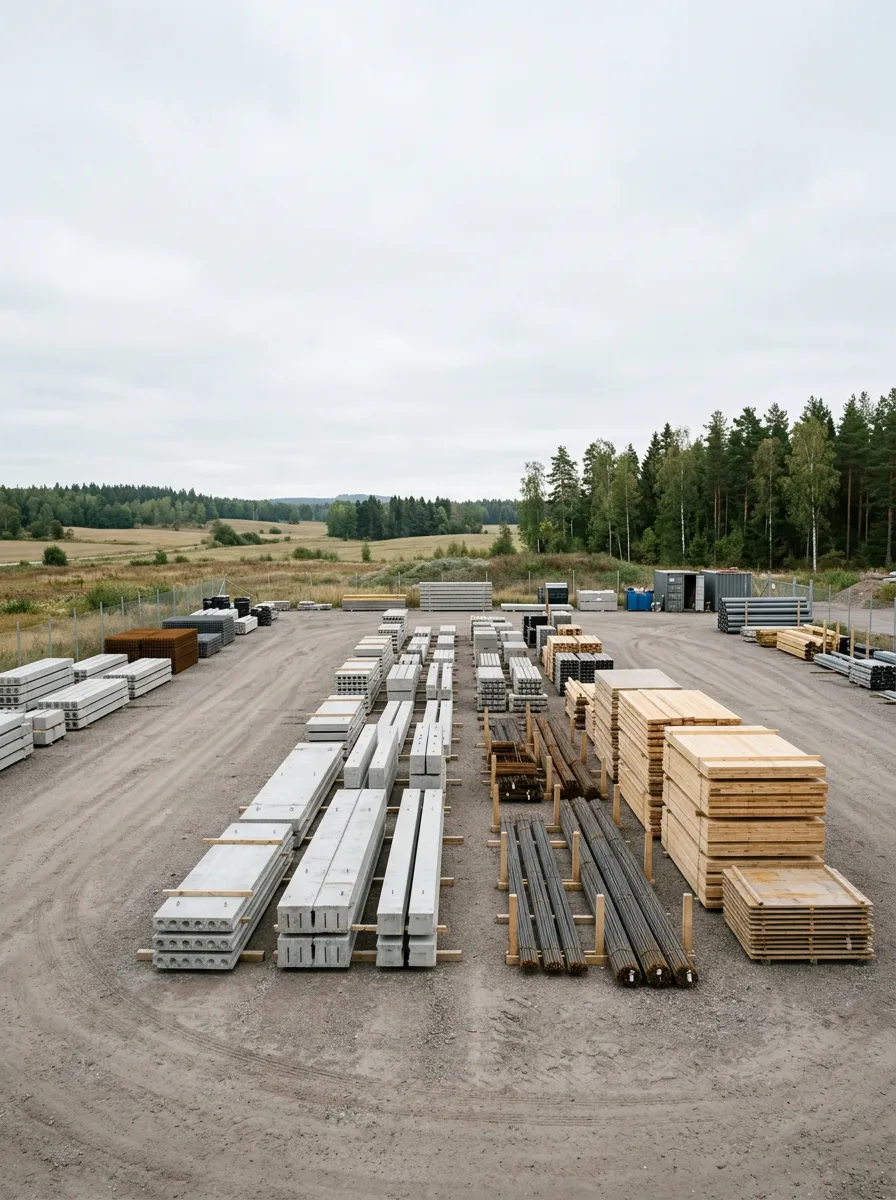
Then one week in June. On Monday 22 June 2026 the government directed Trafikverket to prepare the railways for total defense: 100 million kronor immediately, Inlandsbanan singled out, report due 9 November. On the Tuesday, at 13.45 on Hansaplatsen in Visby, Trafikverket's director general Roberto Maiorana and its security director Mattias Dejke shared a stage with Lieutenant General Carl-Johan Edström, chief of the defense staff, and the companies that move Sweden's food, ore and steel, under the title "Transportsektorn – en ryggrad i totalförsvaret"; the programme listed the infrastructure minister, Andreas Carlson, and set the task "i vardag, kris och ytterst krig", in everyday operations, in crisis, and ultimately in war. On the Wednesday the Nordic Investment Bank lent Peab 125 million euros, running to 2031, against a list of strategically important assets: rock quarries, concrete plants, asphalt plants, prefabrication factories, equipment depots.
Strengthening defense infrastructure is a shared priority across the Nordic-Baltic region. By supporting Peab's delivery capacity, NIB is helping to ensure that critical infrastructure can be built and maintained in the current challenging geopolitical environment.
Jeanette Vitasp, Vice-President and Head of Lending, Nordic Investment Bank, June 2026.
Items are entering the books that no peacetime spreadsheet carried. The state has secured the Trelleborg–Rostock rail-ferry line to 2031 through an agreement with Stena Line, whose Skåne and Mecklenburg-Vorpommern are the world's largest rail ferries. And each new line generates engineering. A Scania transporter with a sixty-tonne tank aboard grosses about 110 tonnes; BK4, the strongest bearing class on the Swedish road network, allows 74. The comparison is our own arithmetic on public figures. The gap is paid for in paperwork, bridge by bridge: a calculation, an exemption or an upgrade, and behind every upgrade an investigation, a plan, a permit, a review.
Measure
Figure
Source
NATO commitment, annually by 2035
5% of GDP
Hague Summit Declaration (2025)
Of which defense- and security-related, incl. critical infrastructure
Up to 1.5% of GDP
Hague Summit Declaration (2025)
Total defense bill, added spending to 2030
+SEK 170bn military, +37.5bn civil
Prop. 2024/25:34 (October 2024)
National transport plan 2026–2037
SEK 1,171 billion
Regeringen (April 2026)
NIB loan to Peab, total defense buildup
EUR 125 million, to 2031
Peab press release (June 2026)
Fortifikationsverket, invested 2023 → 2025
SEK 5.5bn → 20.1bn
Annual report 2025
Fortifikationsverket, staff in one year
1,175 → 1,375
Annual report 2025
Rail directive to Trafikverket, immediate funding
SEK 100m, report 9 Nov 2026
Government directive (22 June 2026)
Tank transporter, loaded, vs strongest road class (BK4)
~110 t vs 74 t
Own calculation, Scania/Trafikverket figures
Exercise Aurora 26
18,000+ participants
Försvarsmakten (2026)
The constraint
The builder itself blames the paperwork
Nobody has more reason to blame the physical world than Fortifikationsverket, the state agency that builds and owns the defense estate. Its investments ran 5,467 million kronor in 2023, 9,521 million in 2024 and 20,138 million in 2025, the highest figure in its history, and it grew by two hundred employees in a year, from 1,175 to 1,375. In the middle of that curve, its own annual report for 2025 sets out what is delaying the projects. The obstacles it names are not rock or machine capacity. They are documents.
Säkerhetsskyddad upphandling med säkerhetsskyddsavtal är fortsatt en stor utmaning.
Fortifikationsverket, annual report 2025. "Security-protected procurement with security protection agreements remains a major challenge."
The same report says the delays "beror på långa handläggningstider för säkerhetsskyddad upphandling", stem from long processing times for security-protected procurement, and puts its scarcest competencies "främst inom specialistroller på ingenjörsområdet samt inom säkerhet och IT", above all in specialist engineering roles, security and IT. The property behind those sentences is classification. Documents describing infrastructure of importance to Sweden's security stay under the security protection regime, the engineers who produce and review them must be cleared, and the material cannot leave the country. The two standard answers to an engineering capacity shortage, sending the work to an offshore delivery centre or recruiting globally, both disappear here. In Byggindustrin in January 2025, Fortifikationsverket's Jan Kinnander described how security-classed procurement pushes firms toward fewer subcontractor tiers and more staff of their own. The delivery chain narrows while the volume through it multiplies.
The state's auditors have measured both ends of that chain. Riksrevisionen, Sweden's national audit office, found in 2021 that the systematic cost increases in infrastructure occur in the planning phase, before construction begins. In March 2025 it judged nine years of civil-defense planning ineffective, singling out the standing instruction "beakta totalförsvarets krav", take total defense requirements into account, as "så allmän och generell att den inte ger någon vägledning", so broad and general that it gives no guidance. The chain is funded and it is instructed. It is not yet fast.
Readiness
Review capacity is a readiness asset
Total defense planning now counts quarries and asphalt plants as strategic assets, a Nordic bank lends against them, and a stretch of riksväg 44 works as a runway again. One step earlier in each of those chains sits the capacity that decides when the downstream work may begin: the investigation, the plan, the permit, the design, the review, produced and checked inside the boundary. Demand has noticed; Sweco's chief executive Åsa Bergman named critical infrastructure and defense capabilities among the year's investment drivers in the firm's 2025 annual report. Supply is the harder half, for the reason the builder's annual report spelled out.
That capacity can be built, and not by lowering the bar: on defense work the scrutiny is the point. It grows the way the physical inventory grew, by being counted and invested in: machine pace on the drafting and the checking, human judgment on every verdict, all of it inside the boundary where the material must stay. A country that counts review capacity as a readiness asset makes its 2035 deadline; a country that leaves it off the list finds out in 2033. The ledger's next entry already has a date. On 9 November Trafikverket answers the government's June directive on the railways, and the answer, like everything upstream of the concrete, will arrive as documents.
Benjamin GlaserCo-founder at Yesper. Writes about AI and the industry that builds the world.benjamin@yesper.ai
Get news and articles in your inbox.
Unsubscribe anytime.
The bottleneck isn't the rock but the pace of the documents: studies, permits, design, review. That's where Yesper adds throughput without lowering the bar. Book a demo and we'll work through your capacity.