7 step method statement process for project managers & safety officers

A method statement is a written, step-by-step plan that explains exactly how a specific task will be carried out safely and who is responsible for each step. It accompanies the risk assessment, turning identified hazards into a defined sequence of controls. Done well, it gives operatives something they can actually follow and gives auditors something they can actually verify.

Construction crew reviewing work sequence on site
  • A method statement must be site-specific, clearly embedded with controls within each step, and signed off by a competent person before work begins.
  • It is most necessary for high-risk activities such as working at height, excavation near utilities, demolition, or lifting operations involving mobile plant.
  • Common errors include reusing generic templates without adjustments, listing controls separately, and failing to record crew briefings or responsible roles.
  • To ensure operability, draft steps with the crew present, add controls afterward, and use visuals or plain language tailored to the workforce’s literacy levels.
  • Digital tools with AI capabilities can significantly streamline the creation and review process, reducing time without sacrificing safety or clarity.

What a method statement is and how it differs from a risk assessment

A method statement describes the order of work: what happens first, what happens next, and what controls sit inside each step. A risk assessment, by contrast, identifies hazards and rates their likelihood and severity before any sequence is written. The two are typically bundled together as RAMS, but they answer different questions. The risk assessment asks what could go wrong; the method statement answers how the job will be done so that it does not.

This distinction matters because the documents get treated as interchangeable more often than they should be, and that habit produces paperwork nobody on site can use. HSE guidance on method statements is explicit that a method statement must be site-specific and usable by the people doing the work, not a rewrite of the risk assessment in prose form.

Method statements are standard in construction and other high-risk sectors, wherever a task involves height, confined spaces, excavation, heavy plant, or public exposure. They show up in three recurring contexts:

  • Tender submissions, where clients expect a demonstrable safe system of work before awarding the contract.
  • Pre-start audits, where principal contractors check the document against the actual site before allowing work to begin.
  • Ongoing compliance reviews, where the statement is checked against what is actually happening on site.

When you need one and who should write it

Not every task needs a formal method statement, but certain triggers make one close to unavoidable. High-risk activities, work with complex sequencing, jobs with public exposure, and anything named in a tender’s compliance schedule all call for a written plan rather than a verbal briefing.

Common examples include:

  • Work at height, including roofing, scaffolding, and window or cladding installation.
  • Excavation and groundworks near services or unstable ground.
  • Demolition, asbestos removal, and hot works in occupied buildings.
  • Lifting operations and any task involving mobile plant near pedestrians.

The person drafting the statement should have direct knowledge of the task, not just administrative familiarity with the format. On larger jobs that is usually a supervisor or site engineer working with the safety officer; on smaller ones it may be the same person who assessed the risk. Whoever writes it, the statement needs sign-off from someone competent to judge whether the sequence and controls are realistic, and it needs to be briefed to the crew before work starts, not filed after the fact.

Core components every method statement should contain

A method statement earns its place on site when it has the same fields every time, in the same order, so reviewers and operatives know where to look. At minimum, it should include:

  1. Project and job identifiers: project name, location, task description, and the scope and limitations of what the statement covers.
  2. Reference to the linked risk assessment and any permits required, such as hot works, confined space entry, or excavation permits; homeowners can check details using a Concrete Permit Cost Calculator for projects involving driveways, aprons, and drainage.
  3. Resources and equipment: plant, tools, materials, and the PPE specific to the task, not a generic list copied across every document.
  4. The step sequence itself, numbered, with the control for each step written into that step rather than listed separately at the end.
  5. Emergency arrangements: what happens if something goes wrong, including first aid, evacuation, and who to notify.
  6. Roles and responsibilities: who supervises, who executes, and who verifies each checkpoint before the next step begins.
  7. Records and version control: a revision number, the date of issue, and a record of who briefed the crew and when.
  8. Signatures: the author, the approver, and, ideally, a line for operatives to confirm they have been briefed and understand the sequence.

The order matters less than the consistency. A reviewer working through a stack of statements for a tender or an audit should be able to find the permit reference or the emergency plan in the same place every time.

How to write a site-specific method statement, step by step

Writing a usable method statement starts before any text is drafted. Gather the drawings, specifications, the linked risk assessment, and a current site survey, then talk to the workers who will actually do the task. Their knowledge of access constraints, ground conditions, or awkward sequencing is often the difference between a plan that works and one that gets ignored by lunchtime.

  1. Break the task into numbered steps in the order work will actually happen, not the order a template suggests.
  2. For each step, write the control directly into the sentence, such as “erect edge protection to 950 millimeters before laying decking,” rather than listing controls in a separate section.
  3. Add an acceptance point or checkpoint to steps where a mistake would be hard to reverse, such as before removing temporary support.
  4. Assign a named role, not a named person, to each step and checkpoint so the document survives staff changes.
  5. Identify who verifies each checkpoint and how that verification gets recorded, whether on a checklist or in a site diary.
  6. Run the statement through a Plan-Do-Check-Act cycle: brief it to the crew, monitor how it plays out, review what needed adjusting, and re-issue if the sequence or conditions have changed. HSE’s guidance on Plan-Do-Check-Act treats this cycle as the backbone of a working safety management system, and a method statement that never gets reviewed against actual site conditions falls outside it.
  7. Before issue, check the statement against a short list: is it specific to this site, does every step have an embedded control, does it match the linked risk assessment, and has a briefing record been prepared.

The OSHA Job Hazard Analysis booklet recommends writing the steps first and then attaching a control to each one, prioritizing engineering controls over administrative measures and PPE. That order of operations, steps before controls, is a reliable way to stop a statement from turning into two disconnected lists.

Pro Tip: Write the numbered steps in the field with the crew present, then add the controls afterward; a plan drafted at a desk tends to miss the awkward step that actually causes problems.

A compact sample method statement for working at height

A short example shows the structure better than a description of it. For a window installation task at first-floor height:

  • Step 1: Erect and inspect the mobile scaffold tower, checking outriggers and locking castors. Supervisor verifies before use.
  • Step 2: Fit edge protection to the working platform to 950 millimeters. Operative confirms before loading materials.
  • Step 3: Lift the window unit using two operatives and a sash lifter, keeping the load below shoulder height during the carry.
  • Step 4: Set the unit into the opening and temporarily fix with props before removing the lifting equipment.
  • Step 5: Permanently fix and seal the unit, then remove props only once fixings are verified by the supervisor.

Each step names who does it and what control is built in, rather than appending a separate hazard list. To expand this into a full project-level statement, add the project identifiers, the linked risk assessment reference, emergency arrangements, and the sign-off fields described earlier. The structure stays the same regardless of scale.

Common mistakes that get method statements rejected

Most rejections trace back to a small number of repeat offenses. HSE guidance identifies generic, non-site-specific statements as the single most common reason principal contractors send documents back, and the pattern shows up across industries, not just construction.

  • Reusing a previous project’s statement without adjusting it for this site’s access, ground conditions, or sequencing.
  • Listing controls in a separate section instead of writing them into the step where they apply, which leaves readers to cross-reference two documents in their head.
  • Missing a briefing attendance record, so there is no evidence the crew was told about the plan before starting work.
  • Unclear version control, where two copies of the same statement circulate with no way to tell which one is current.
  • Assigning responsibility to a named individual rather than a role, which breaks the document the moment that person is reassigned.

Fixing these is mostly a matter of discipline rather than redesign: adapt the template every time, embed controls in the steps, and keep a record of who has seen the current version.

Briefing, issuing, and keeping the statement current

A method statement that sits in a folder unread does nothing for anyone’s safety, which is why briefing and review are treated as part of the document rather than an afterthought.

  • Brief the crew before work starts, walk through the steps in order, and record attendance with names and the date of the briefing.
  • Confirm understanding rather than just attendance, for instance by asking a worker to describe the control at a specific step.
  • Re-issue the statement whenever the sequence, site conditions, or personnel change meaningfully, following the same Plan-Do-Check-Act cycle used to draft it.
  • Run spot checks against the live document while work is underway, not only at the pre-start stage.
  • Keep the briefing record, the revision history, and the sign-off together, since auditors generally expect all three as evidence that the plan was followed, not just written.

The CDM 2015 guidance on construction phase plans sets out similar expectations at the project level: key dates, who is on site, and the main dangers and controls need to be recorded and kept current, and a simple plan is often sufficient for smaller jobs.

Writing method statements operatives will actually read

A method statement that reads like a legal disclaimer gets skimmed, not followed. Short sentences, active voice, and steps that open with the action itself, “erect,” “fix,” “check,” read faster and land clearer than steps that bury the verb in the middle of a clause.

  • Write one action per sentence and avoid stacking two instructions into a single step.
  • Use diagrams, photographs, or laminated step cards on site where a written sequence alone would be hard to follow mid-task.
  • Account for literacy levels and language needs on the crew, and translate where the workforce requires it.
  • Cut jargon and unexplained acronyms; if a term must stay, define it once, plainly, the first time it appears.

Pro Tip: Test the draft on the crew who will use it before issuing it formally; a step that confuses the person reading it on site will confuse an auditor too.

Where to find authoritative guidance and templates

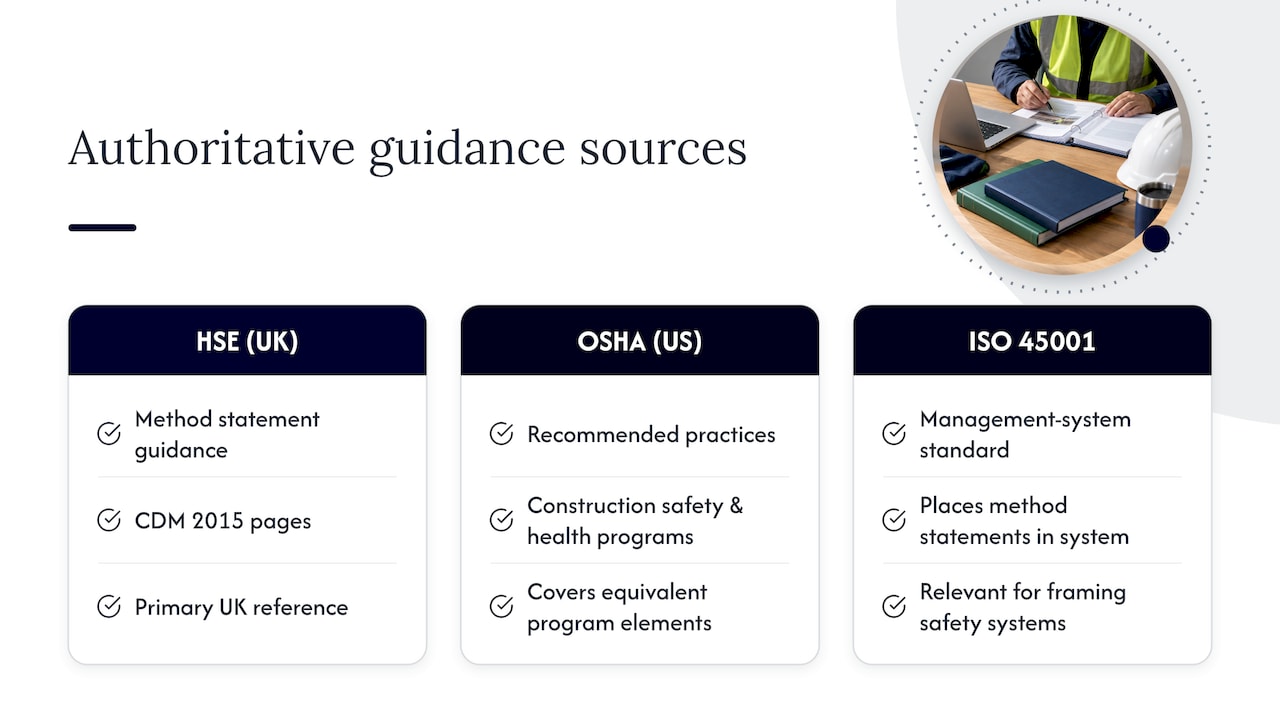
HSE’s method statement guidance and its CDM 2015 pages are the primary reference for UK construction work. OSHA’s recommended practices for safety and health programs in construction cover the equivalent program elements in the United States. For a management-system framing that places method statements inside a broader safety system, ISO 45001 is the relevant standard to consult.

Where to Find Authoritative Guidance and Templates — overview diagram

Keep it brief and keep it operable

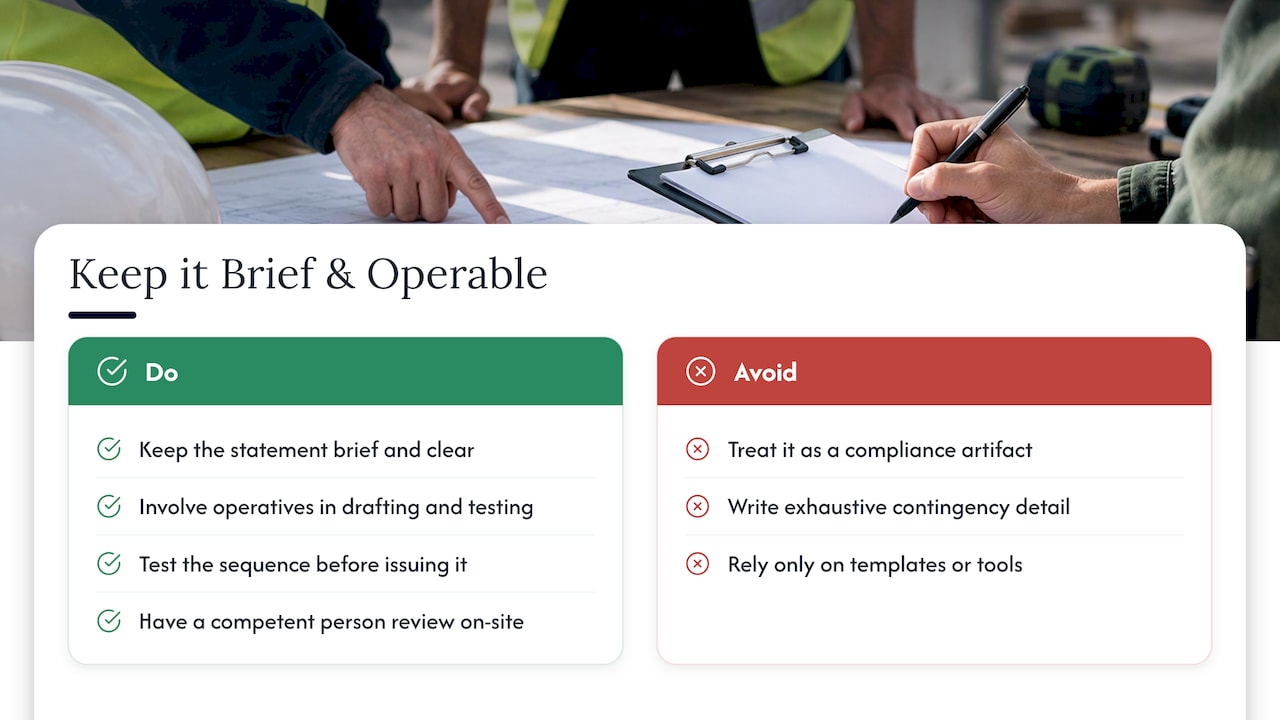
Keep It Brief and Keep It Operable — overview diagram

The temptation on most projects is to treat a method statement as a compliance artifact, something produced to satisfy a tender box or an auditor’s checklist, and that temptation produces documents nobody reads. A method statement earns its keep only when the person doing the task can follow it without translation, which means brevity and clarity matter more than exhaustive coverage of every conceivable contingency.

Involve the operatives who will run the task in drafting and testing it before it gets issued, since their read on an awkward step is more reliable than a template’s assumptions. Specialist drafting tools can speed up the paperwork, but they do not replace a competent person reviewing the sequence against the actual site.

Turning method statements into a faster, more consistent process

Drafting a method statement from scratch for every task, then checking it against drawings, specifications, and a dozen site-specific variables, is the part of the job that eats the most time without adding much judgment. Yesper is built for construction and infrastructure teams working through exactly this kind of document-heavy task, producing deliverables end-to-end while writing down its assumptions so a reviewer can check them the way they would check a colleague’s draft. For a project manager or safety officer issuing statements across a large program, that means less time spent reformatting the same fields and more time spent on the review that actually catches a bad step before it reaches the crew. The use of AI-assisted tools can help streamline these processes. Visit Yesper’s homepage to see how the platform fits into existing document control and compliance workflows.

How do you write a method statement?

Start by gathering the drawings, specifications, and the linked risk assessment, then break the task into numbered steps in the order work will actually happen. Write the control for each hazard directly into its step, assign a role rather than a name to each checkpoint, and brief the finished document to the crew before work starts.

Can you provide an example of a method statement?

A compact example for a window installation task might run five numbered steps: erecting and checking the scaffold tower, fitting edge protection, lifting the unit with two operatives, temporarily propping it before permanent fixing, and removing props only after the supervisor verifies the fixings. Each step names who does it and the control built into it, rather than listing hazards separately.

What is a sample method statement?

A sample method statement is a short, illustrative version of the full document, usually showing the numbered step sequence and embedded controls for one common task without every project-level field. It is meant to be expanded into a full statement by adding project identifiers, the risk assessment reference, emergency arrangements, and sign-off fields.

Is there a PDF version of the method statement for civil works?

HSE and OSHA both publish guidance documents rather than fill-in-the-blank PDF templates, since a usable method statement needs to be adapted to the specific site rather than copied from a fixed form. The HSE method statement guidance and the OSHA Job Hazard Analysis booklet are the primary references to work from when building a project-specific document.

This post was written with AI assistance and published by Yesper. General information, not professional advice: requirements vary by project and jurisdiction, and the professional responsible for the project decides what applies. Spotted an error? Write to benjamin@yesper.ai.

Benjamin Glaser Co-founder at Yesper. Writes about AI and the industry that builds the world. benjamin@yesper.ai

Yesper is the AI civil engineer for construction and infrastructure. AFRY, COWI, NRC Group and other Nordic firms use it to halve the time on a study, rerun calculations in minutes, and catch errors that would otherwise slip through. Get in touch if you'd like to see what it can do for you.

Book demo