Method statement automation uses software, often AI-assisted, to assemble the structured draft of a method statement from project inputs such as activity, location, plant, and hazards. Done well, it can help produce consistent, auditable drafts. CITB guidance describes the information a method statement commonly covers. It does not replace the competent-person review and jurisdictional checks that a document like this has always required, and platforms such as Yesper are built around that distinction.
In short
01
A method statement sets out, in logical sequence, exactly how a work activity will be carried out safely. According to CITB guidance, that typically covers scope and sequence, supervisors and responsibilities, labor and competence, plant and materials, hazards and controls, protection of workers and the public, monitoring, emergency arrangements, communication, and briefing records.
The term gets used loosely alongside a few neighbors, and the distinctions matter for anyone automating the paperwork:
Automation suits this work precisely because the required depth is not fixed. CITB guidance is explicit that detail should be proportionate to the hazards, risks, and novelty of the task, so a tool that applies the same template shape to a routine task and a first-time high-risk lift is already failing its brief.
02
An automated draft earns trust only if it contains the same substance a competent writer would include by hand, and nothing less. Based on CITB’s framework, the essential fields are:
Each field earns its place for a reason beyond paperwork. Named competence records let a supervisor confirm, in seconds, that the person on the tool is the person approved for it. Step-specific controls are what an inspector or an incident investigator reads first, because a control detached from its step tells them nothing about what actually happened on site.
The output format matters as much as the content. A workable system keeps an editable structured source for revisions, exports a PDF carrying version number and sign-offs for issue, and attaches metadata so the document is searchable later during an audit or a claim.
03
Automating the draft does not mean automating the decision. The workflow that holds up under scrutiny keeps a human gate at every point where judgment, not pattern-matching, is required.
Pro Tip: Treat any automated draft that skips straight from “generated” to “issued” with no named reviewer as unfinished, not just unsigned.
04
Before anything goes to site, a short verification pass catches the failures that cause real harm later.
A document missing an important element may need further review, regardless of how complete its narrative sections read, because CITB’s guidance ties adequacy to proportionate detail and traceable sign-off rather than to prose length.
05
Automation becomes a box-ticking exercise the moment the human step turns into a rubber stamp. A few design choices keep it from drifting that way.
A roofing crew, for instance, needs controls specific to edge protection and weather thresholds rather than a generic fall-risk line, a level of task-specific detail roofing safety guidance illustrates well for that trade.
06
The most useful automated method statements are the ones that connect to everything around them rather than sitting as isolated PDFs. The outputs worth insisting on are an editable structured source for ongoing edits, an exported PDF carrying version and sign-off data, and metadata that makes the document searchable inside a project’s QA/QC and document management systems.
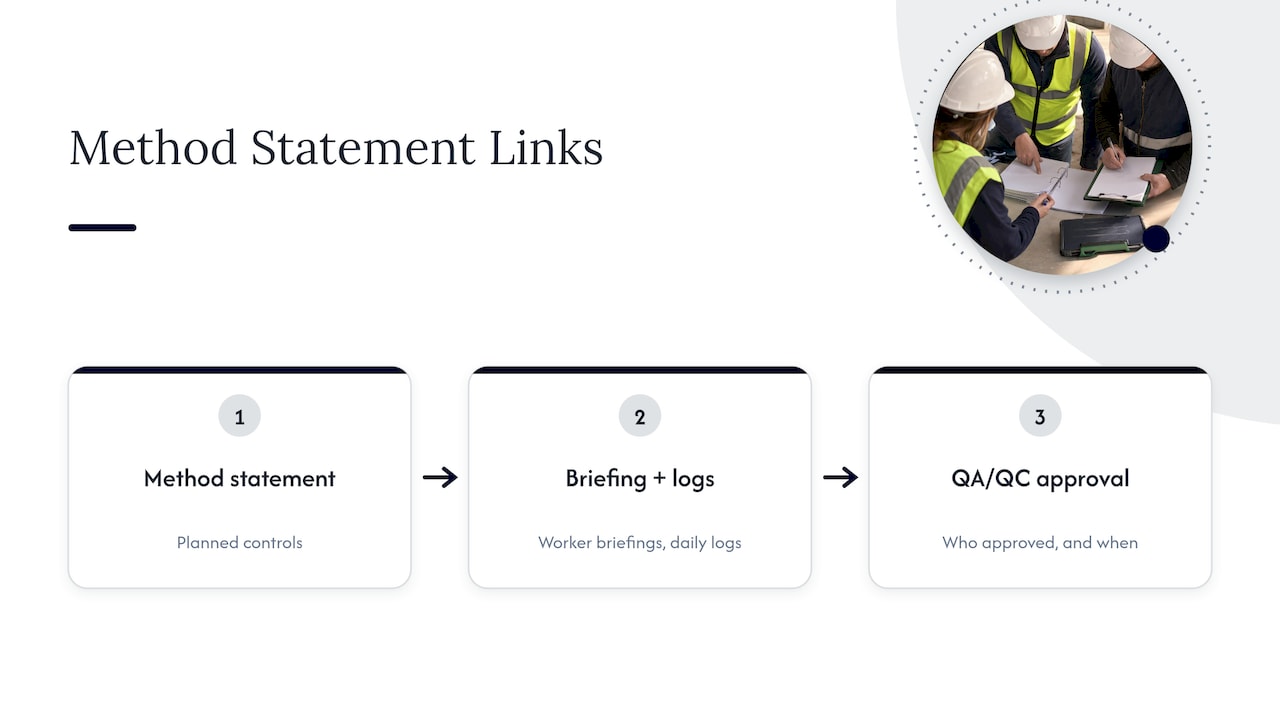
Linking method statements to briefing records and daily logs closes the loop between what was planned and what workers were actually told, while connecting them to QA/QC automation means a reviewer can trace who approved a control and when, which matters as much during a routine audit as during an incident investigation.

07
Rolling out method statement automation fails more often from adoption gaps than from software limits. Supervisors who have spent years writing documents from scratch need a reason to trust a generated draft, and that trust is built through visibility, not instruction.
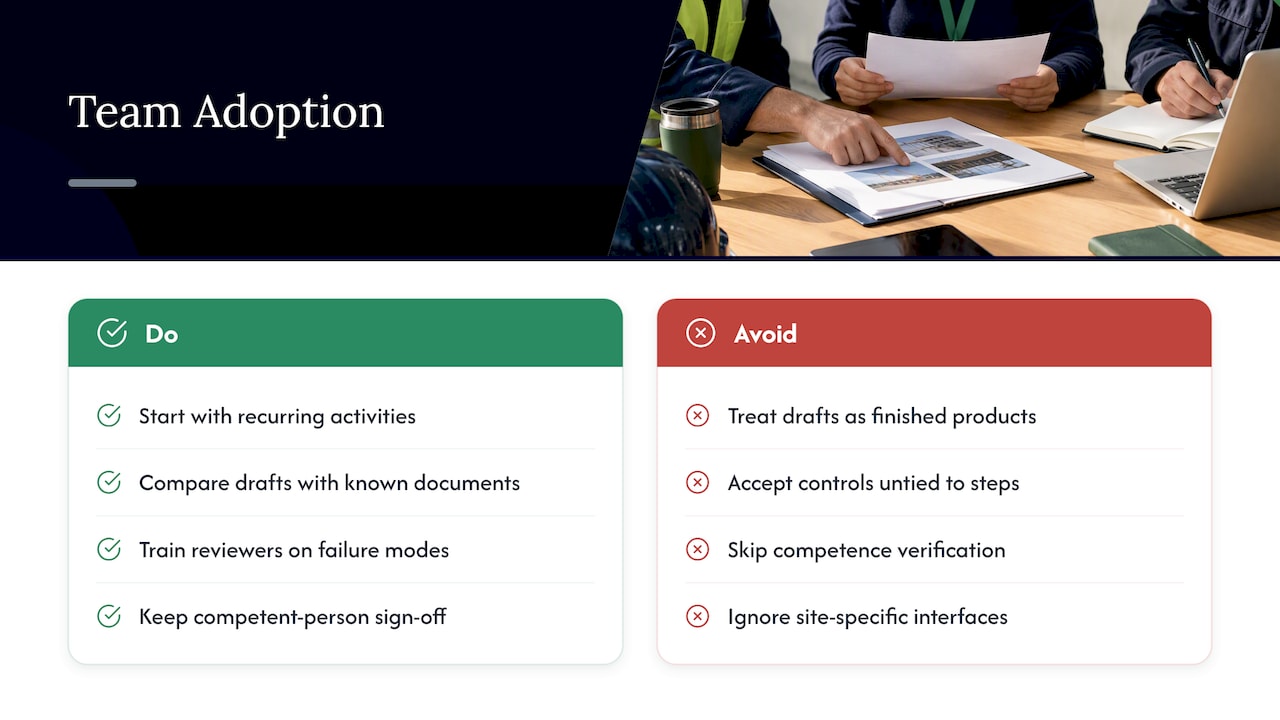
Start with a small set of recurring activities, the kind a team writes method statements for every month, so reviewers can compare automated drafts against documents they already know well. Reviewers should be trained to spot the specific failure modes automation introduces: controls that sound plausible but are not tied to the actual step, competence references that were not verified, or sequences that skip a site-specific interface the system had no way to know about.
Give reviewers a short, explicit checklist rather than general guidance, mirroring the operational-specificity standard in CITB’s guidance, so “does this read well” never substitutes for “does this say what, how, and who.”
Adoption also depends on who signs off. Keeping the same competent-person accountability that existed before automation, rather than diffusing it across a system, keeps the review step meaningful rather than ceremonial. Teams that treat the automated draft as a starting point written by a fast but inexperienced colleague, one whose work always needs a second set of eyes, tend to adopt the tool faster and trust it more than teams that treat it as a finished product.
A practical workflow for project managers and safety officers is laid out in our method statement process.

08
Legislation and guidance around method statements and RAMS change over time, and a document generated once at project start can drift out of step with current requirements. The Health and Safety Authority’s 2025 guidance frames RAMS as a planning and control document that gets updated when local conditions or the system of work changes, not a document frozen at approval.
Automation can track which regulatory version informed a given method statement and flag documents for review when the underlying guidance updates, but no vendor claim of automatic compliance should be taken at face value. Country-specific duties differ meaningfully: Ireland’s HSA guidance centers on signed-off RAMS before work starts, while Australia’s SWMS obligations attach to defined high-risk construction work under its own WHS framework. A method statement that cites a regulation is not compliant by virtue of the citation; it is compliant when a competent person in that jurisdiction has verified it against current requirements.
The practical discipline is treating regulatory currency as a trigger alongside site-condition triggers: when guidance changes, documents built against the old version get flagged for review rather than left to expire quietly.
09
A single-house renovation and a multi-phase infrastructure build do not need the same method statement machinery, and treating them identically is where many automation rollouts go wrong. CITB’s proportionate-detail principle, that routine repetitive work needs less documentation than a novel or high-risk task, applies as much to the rollout design as to any individual document.
For smaller contractors, the priority is usually speed on a narrow set of recurring activities: recurring trades and hazard categories, with documents drafted and reviewed by competent people. For larger programs spanning multiple contractors and work packages, scaling means consistent fields and terminology across every document so a safety officer reviewing many method statements can compare them without relearning a new format each time.
Interfacing with Building Information Modeling (BIM) data becomes more relevant at this larger scale, since plant and sequencing details for complex structural or temporary works often live inside the model rather than in a text brief. Our piece on keeping human sign-off with AI for BIM covers where that extraction needs the same reviewer scrutiny as any other automated input. Whatever the project size, the proportionality test stays the same: detail should match hazard and novelty, not project budget.
10
A method statement that gets reissued after every near-miss or site change carries more institutional memory than one drafted once and filed away. Automation’s advantage here is structural: when controls, reviewer comments, and post-task observations are captured in a consistent format, patterns across projects become visible in a way they rarely are when every document lives in its own folder.
If a particular control keeps getting flagged by reviewers as too vague, or a particular hazard keeps reappearing across projects despite a standard control, that pattern is a signal worth feeding back into future drafts. The discipline required is the same one that governs the document itself: feedback improves the system only when a competent person interprets it, not when pattern frequency alone rewrites a control. Lessons learned documentation, long a manual and often neglected step, becomes more useful when it is structured enough to actually inform the next draft rather than sitting in a closeout report nobody reopens.
11
Automation removes the repetitive drafting labor and, in doing so, makes clear exactly where supervisor judgment is still needed: mapping a hazard to the right control, verifying a competence record, deciding whether site conditions have shifted enough to warrant a reissue. When the system also preserves the evidence trail, briefings, approvals, version history, it improves audit readiness as a byproduct of better documentation discipline, not as a separate exercise. None of that removes the governance burden; it relocates it to the review step, where competent-person accountability and worker consultation still have to hold.
12
For construction and engineering teams bringing this workflow into daily operations rather than running it as a one-off exercise, we built Yesper to help teams automate complex, document-heavy tasks with traceability and source verification. We prioritize traceability, because it helps make a method statement defensible later, not an add-on bolted onto a generic document generator. Our platform architecture explains how that fits into existing project systems, and our technical architecture page covers integration specifics for teams evaluating enterprise fit.
FAQ
A method statement outlines how a work activity will be carried out safely, covering scope and sequence, supervisors and competence, plant and materials, hazards and controls, monitoring, and emergency arrangements. CITB guidance treats the required level of detail as proportionate to the hazard and novelty of the task rather than fixed by template.
They are related but distinct: an SOP describes a repeatable organizational procedure, while a method statement explains how one specific activity will be carried out safely in its actual site context. The Health and Safety Authority’s guidance frames the method statement as tied to a particular task, not a general process.
A method statement is typically one half of a RAMS document, paired with a risk assessment of the same activity. The Health and Safety Authority’s 2025 guidance describes RAMS as a combined planning and control document developed before medium to high-risk work and updated when conditions change.
A typical example, such as a steel erection task, sets scope and site setup, identifies competent personnel and equipment, sequences the lift through positioning, temporary stability, and connection, and attaches step-specific controls for falling objects, work at height, and plant interaction. Exact controls always need verification against the actual site and jurisdiction rather than copied from a generic example, per CITB’s guidance.

13
For primary guidance beyond this article, see CITB’s method statement guidance and the Health and Safety Authority’s RAMS guidance and template.
This post was written with AI assistance and published by Yesper. General information, not professional advice: requirements vary by project and jurisdiction, and the professional responsible for the project decides what applies. Spotted an error? Write to benjamin@yesper.ai.
Get news and articles in your inbox.
Yesper is the AI civil engineer for construction and infrastructure. AFRY, COWI, NRC Group and other Nordic firms use it to halve the time on a study, rerun calculations in minutes, and catch errors that would otherwise slip through. Get in touch if you'd like to see what it can do for you.
Book demo