Regulatory code interpretation: Sort guidance and code commentary

Regulatory code interpretation is the process of establishing who issued a rule, who it binds, whether the text is legally binding, and which authorities settle its technical variables. Your first action is to classify the document in front of you as code text, commentary, or agency guidance. The sections below cover agency statements, code commentary and National Annexes in turn.

Engineer comparing a code volume and commentary
  • Means based clauses require a scope check or approved deviation, while performance based clauses permit alternatives only when calculations or testing prove the required outcome.
  • Agency guidance may signal inspection practice but cannot create duties; anchor contested readings in binding text, using official statements of purpose and commentary as support.
  • For international projects, use the National Annex or local amendment for the project’s jurisdiction and matching edition; it may set binding numerical parameters.
  • Confirm the jurisdiction, effective edition, and authority first; for material ambiguity, send the regulator a yes or no question citing the clause and your proposed reading.

What are the four components of a regulation, and why do they matter for interpretation?

A regulation looks like a single block of text, but it can be taken apart. The regulatory taxonomy published by George Washington University’s Regulatory Studies Center analyzes regulatory instruments into four core components: the regulator, the target, the command, and the consequences. The same breakdown appears in a short essay on regulation’s four core components, which observes that instruments differ widely in form yet share normative statements backed by consequences. Once you read a provision through these four lenses, a vague passage usually narrows into a specific question you can answer.

The components work as follows:

  • Regulator. The body that issued the text and holds enforcement authority. A national statute, a municipal amendment and an industry standard have different weight, and the issuer determines who may later clarify the text.
  • Target. The party the rule addresses: owner, designer, contractor, operator or inspector. Many disputes over a provision are really disputes over its target, such as whether a duty falls on the designer of record or on the installer.
  • Command. What the target must do. This is either means-based (use a specified process, material or technology) or performance-based (achieve a stated outcome by whatever method works).
  • Consequences. The penalty or reward attached to compliance or breach: permit denial, stop-work orders, fines, liability, or a presumption of compliance. Consequences tell you how much interpretive risk a reading carries.

Why the command type changes your options

The means-versus-performance distinction deserves the most attention. Writing on effective rule design stresses that practitioners should identify whether a command is means-based or performance-based, because that distinction determines how much flexibility a regulated entity has. A means-based clause leaves little room: if the text names a specific fastener spacing, you meet it or you seek a formal deviation. A performance-based clause states an end state, such as a required fire-resistance period or a maximum deflection, and invites alternative solutions supported by calculation or testing.

For engineering work the practical result is a different posture toward each clause type. Against a means-based command, your interpretive effort goes into scope: does the clause apply to this element, in this occupancy, at this date? Against a performance-based command, the effort goes into evidence: which method demonstrates the outcome, and will the reviewing official accept it?

How the framework changes a response

Consider two short cases. A drainage provision requires a specific pipe material for a defined use. The regulator is clear, the target is the installer, the command is means-based, and the consequence is a failed inspection. Your response is a scope check and, if the material is unavailable, a request for an approved equivalent. Now consider a provision that requires egress to be completed within a stated time under defined conditions. The command is performance-based. You have design freedom, but you also carry the burden of proving the outcome, so the interpretation shifts from reading the text to building a defensible technical case.

The framework also exposes soft instruments. The Australian Law Reform Commission’s review of regulatory forms notes that codes range from voluntary self-regulation to legislated mandatory codes, and that the name alone does not settle legal effect. Function and enforcement do. A document titled “code” may be a binding obligation in one jurisdiction and a voluntary benchmark in another, so test it against the four components before you rely on it.

Which documents bind you, and how much weight does guidance carry?

Legal readers and code officials work from one organizing distinction: legislative rules versus guidance. Administrative-law practice, as summarized in an Administrative Conference of the United States document on agency guidance through interpretive rules, separates legislative rules, which are binding, from guidance documents, which are generally intended to clarify existing law rather than create new legal obligations. That sentence governs most practical disputes. If an agency memo adds a requirement that no binding rule contains, the memo is not the source of your duty, and you can ask which binding provision it claims to interpret.

The working definitions are these:

  • Legislative (binding) rule. Issued under delegated authority, usually through a formal procedure with notice and an opportunity to comment. It carries the force of law and creates enforceable obligations.
  • Interpretive rule or guidance document. Explains how the regulator reads an existing provision or how it intends to exercise discretion. It informs, but it does not bind the public in the way a legislative rule does.
  • Industry or consensus code. Binding only when a legislative instrument adopts it by reference or a contract requires it. Otherwise it is evidence of good practice.

Persuasive, not binding

Guidance is persuasive. A court or reviewing official may find an agency’s reading sensible and follow it, particularly where the underlying text is genuinely ambiguous and the reading is consistent with the rule’s purpose. But guidance cannot override unambiguous binding text, and it cannot create a new duty by itself. For the practitioner this has two consequences. First, you should treat guidance as a strong signal of how the regulator will behave at inspection, which is a reason to read it carefully. Second, if a guidance document appears to stretch the binding text, you have a principled basis to say so in writing and to ask for a formal determination.

Statements of basis and purpose

The most useful interpretive material often sits beside the rule rather than in it. When an agency issues a binding rule, it usually publishes an explanatory statement describing why the rule exists and what problem it addresses. The Michigan Law Review article “Interpreting Regulations” discusses methods for interpreting regulations and argues for purposive approaches, treating agency statements of basis and purpose as privileged interpretive sources. The reasoning is straightforward: the people who wrote the rule explained its aim at the moment of writing, before any particular dispute gave them a reason to shade the explanation.

In practice, a statement of basis and purpose can help when two readings of a clause are both grammatical, when a clause seems to produce an absurd or unsafe result when read literally, or when you must decide whether a new technology falls within a rule written for older methods. A reading that serves the stated purpose is far easier to defend than one that exploits a gap in the wording.

A note on weight and risk

Hierarchy in practice runs roughly as follows: binding text first, then the regulator’s contemporaneous explanation of that text, then formal interpretations issued through a defined channel, then informal guidance, then commentary and industry literature. Keep that ladder in view when you write a justification. A memo that cites only an informal guidance document for a contested point is weaker than one that anchors the same point in binding text and the regulator’s own statement of purpose.

How do you interpret a specific provision on a project or inspection?

The workflow below is designed to be repeatable. Run it each time, in the same order, and the resulting record will read consistently whether it ends up in a design file, an appeal or an audit.

  1. Triage the jurisdiction, date and regulator. Confirm which jurisdiction governs the site, which edition of the code was in force when the permit application was filed or the contract was signed, and which body is the authority having jurisdiction. Many apparent conflicts come from reading the wrong edition or a superseded amendment.
  2. Classify the text. Decide whether the passage is binding code text, commentary, agency guidance or a voluntary industry code. Write the classification down. Everything later depends on it, and a mislabeled document is the commonest source of an overstated requirement.
  3. Decide means versus performance, and look for variables. Identify whether the clause prescribes a method or an outcome, then scan for numerical parameters that another document may set, such as values left to a national annex, local amendment or project specification.
  4. Seek and record authoritative interpretive sources. Check the regulator’s statement of basis and purpose, any formal interpretation, and the relevant commentary. Rank what you find by the hierarchy described above, and note the date and edition of each.
  5. Document the rationale and decide how to proceed. State your reading, the evidence for it and the alternatives you rejected. If the point is material and still ambiguous, prepare a written request for formal interpretation. Archive the request, the response and the underlying texts together.

Pro Tip: Write the interpretation request as a question the regulator can answer yes or no, attach the exact clause number and edition, and state your proposed reading so the official only has to confirm or correct it.

Applying the steps to an inspection dispute

Suppose an inspector cites a clause as requiring a feature your design omits. Begin with step 2: is the cited text binding code, or is the inspector reading from a guidance memo? If it is guidance, ask which binding provision it interprets and whether that provision actually says what the memo claims. Move to step 3: if the clause is performance-based, you may be able to meet it by an alternative demonstrated by calculation, which turns a confrontation into a technical submission. Step 4 supplies the supporting record. Only then, at step 5, do you decide whether to redesign, to request a determination, or to appeal.

Notice what the sequence avoids. It does not begin with an argument. It begins with facts about edition, authority and document type, which are the facts most often wrong at the start of a disagreement and the facts a reviewing body checks first.

Keeping the record usable

A well-formed interpretation record has a consistent shape: the clause quoted verbatim with edition and date, the classification, the interpretive sources consulted, the reading adopted, and the name and date of whoever approved it. This structure also makes the work easy to review. Our guide to audit-ready construction safety compliance steps covers documentation habits that help keep a record defensible when someone asks for it.

How do national annexes and code commentaries change what a code says?

Technical codes rarely deliver every number you need from a single document. Eurocodes are the familiar example: the base standard sets out the method, while a National Annex fixes the Nationally Determined Parameters, the values and choices each country selects for itself. Reading a Eurocode clause without its national annex can leave you with a method but no usable value. If you work across borders, the annex for the country of the project, not the country of your office, controls those parameters.

That is also why technical interpretation and legal interpretation overlap. A partial safety factor in the base text may be bracketed or recommended, and the binding figure lives in the annex. For readers working on UK projects, a Eurocode-aligned steel deck design example from a remote engineering services firm shows how design deliverables reconcile standard text with national parameters in practice.

What to check in an annex

  • Scope. Which clauses of the base standard does the annex modify, and which does it leave as written?
  • Status of values. Whether a figure is mandatory, recommended or merely informative, since the label changes its weight.
  • Edition alignment. Whether the annex matches the edition of the base standard you are citing.
  • Local additions. Whether the authority has added project-type restrictions or supplementary rules beyond the annex.

Using the IBC code and commentary without over-reading it

In the United States, many practitioners reach for the International Building Code and its companion commentary. The table of contents for the 2024 IBC Code and Commentary, Volume 1 shows how the publication is organized, and its framing is explicit: the commentary is advisory, intended to be used alongside the code, and it provides background, intent statements and examples without substituting for the code text. The code official retains interpretive authority.

That framing tells you how to use it. The commentary is excellent for understanding why a provision exists and what situation its authors had in mind, which is exactly the purposive evidence discussed earlier. It is not a source of obligations. Citing it as if it were binding invites an easy rebuttal. Citing it as evidence of intent, next to the binding clause, is a sound technique. The same advisory role applies to the commentary for existing-building codes, which also stresses that the commentary is not binding and that the code official has final interpretive authority.

A scenario: Which document controls a numeric value?

Say a design calculation needs a wind or snow parameter. The base standard gives a method and a recommended value. The National Annex or the locally adopted amendment sets the mandatory value. A commentary or a consultant’s design guide may discuss a different figure from a newer research paper. The controlling number is the one in the adopted, binding instrument for that jurisdiction, which here is the annex or amendment. The commentary explains the reasoning, and the research paper may support a request for a deviation, but neither replaces the adopted value. If you believe the adopted value is unsuitable for your site, the proper route is a documented request to the authority, not a silent substitution.

This ordering mirrors the legal hierarchy from the previous sections, and that is deliberate. The skill is the same in both settings: identify the controlling instrument, use the explanatory material for what it is, and keep the two separate in your written record.

Primary documents to gather

  • The code text itself, in the edition and with the amendments that apply on the relevant date.
  • Official gazettes and registers, which show when a rule was adopted, amended or repealed.
  • Agency statements of basis and purpose, which accompany the binding rule and explain its aim.
  • National Annexes and local amendments, which carry the binding numerical values.
  • Formal interpretations and rulings, issued through an official channel by the body with authority.
  • Commentaries and guides, which supply intent and examples but carry no binding force.

Search tactics that save time

Start by verifying version and effective date before you read anything else. A clause quoted from a superseded edition is a frequent error in interpretation work. Next, cross-check any formal interpretation against the current text, because a later amendment can quietly overtake an older ruling. Use agency registers to trace a provision’s history, and use the bibliographies in code commentaries to locate the research behind a requirement. When you are searching across a large project archive, the same discipline applies: search by clause number and edition, not by topic alone, so results stay tied to the right version.

For engineers working internationally, the World Federation of Engineering Organizations’ interpretive guide to its Model Code of Practice adds a useful professional expectation: keep current knowledge of local legislation, document compliance, and draw on international or other national regulations where local standards are absent. Contractors will recognize the same theme in a practical explanation of why updating building code compliance matters, which approaches the subject from the owner and contractor side.

Recordkeeping that survives scrutiny

A record is only as good as its traceability. For each interpretation, cite the clause with its edition and effective date, name the regulator and the document type, and attach the interpretive sources you relied on. Label a request for formal interpretation clearly, with a reference number, the date sent, the question asked and the proposed reading. File the response with the request, never separately. Archive everything in one location with consistent naming, so a reviewer can follow the chain from clause to conclusion without asking you to reconstruct it. Our piece on audit-ready QA/QC automation describes how teams keep that evidence trail intact across a project’s life, and our example of a compliance matrix built from tender documents shows one way to map clauses to project requirements and record the reading behind each mapping.


Why a purposive reading beats both literalism and over-caution

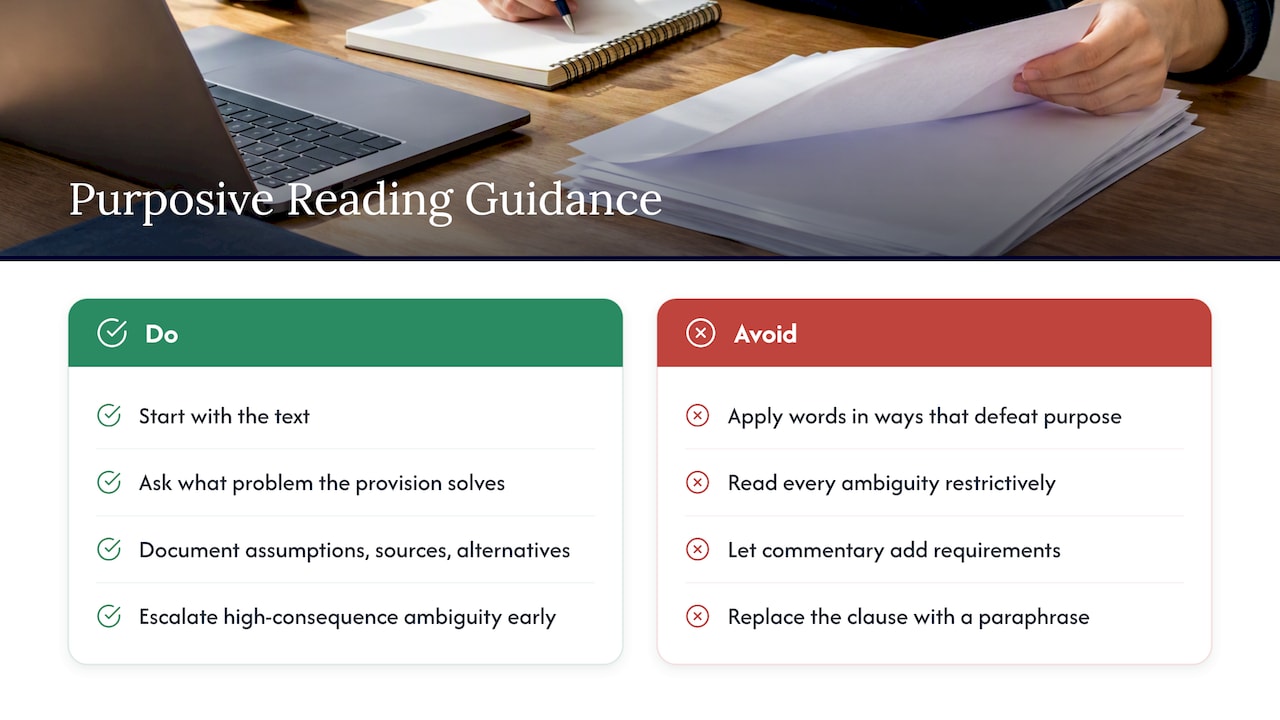
Two failure modes dominate practice. The first is mechanical literalism: applying the words of a clause to a situation its authors never imagined and producing a result that defeats the clause’s own purpose. The second is defensive over-caution: reading every ambiguity in the most restrictive way, which inflates cost and can push teams toward worse safety outcomes by encouraging workarounds. Both treat interpretation as a way to avoid blame rather than a way to reach the right answer.

A purposive reading sits between them. It starts with the text, because the text is the only part that binds, and it asks what problem the provision was written to solve. That question is answerable. The statement of basis and purpose, the commentary’s intent statements and the structure of the surrounding provisions usually point clearly to an aim. A reading that serves the aim and fits the words is defensible. A reading that fits the words but defeats the aim is fragile, and a reading that serves an imagined aim against the words is simply wrong.

Why a purposive reading beats both literalism and over-caution — overview diagram

Documentation is what makes this approach safe. Every ambiguity you resolve is a decision someone may later question, so write down the assumption, the sources and the alternatives you rejected. When an ambiguity affects public safety or carries high consequences, escalate early. A written question to the authority costs days, while a wrong assumption discovered at inspection costs months. Early engagement also respects the structure of the system: the code official decides, commentary advises, and the engineer’s duty is to bring a well-prepared case and to be candid about uncertainty.

I would add one caution about commentaries. They are persuasive precisely because they are well written and authoritative in tone, which makes them easy to over-trust. Use them to understand intent, hold them at arm’s length when they seem to add requirements, and never let a handy paraphrase replace a reading of the actual clause.

How can Yesper support traceable regulatory interpretation?

The workflow above is disciplined but document-heavy: gathering the correct edition, locating the relevant clauses across code texts and project files, and assembling a record a reviewer can follow. We built Yesper, an AI civil engineer for construction and infrastructure teams, to take on that load. It searches your project documents and regulatory material, extracts the passages that apply to a question, and writes down its assumptions so you can review them the way you would review a colleague’s work, with sources you can verify.

Two uses come up often. When you need a formal interpretation, we help you assemble the quoted clause, the surrounding provisions and the project facts into a clear request that a regulator can answer. When you need to confirm that project documents meet a requirement, we run the compliance check against the drawings and specifications and flag mismatches with a pointer to the source text. Our write-up on engineering compliance checks with BIM and AI explains how that works while keeping audit proof intact, and our article on moving regulatory compliance automation from pilot to production is a good read if you are evaluating enterprise workflows for interpretation management.

If your team handles regulatory documents at volume, book a demo to see how Yesper handles interpretation work.

What does “regulatory” mean in simple terms?

“Regulatory” describes anything related to rules made by an authority to control how an activity is carried out. In construction, that includes building codes, safety rules and permit requirements. Regulators write, interpret and enforce those rules.

What is the difference between binding rules and guidance?

Binding rules, often called legislative rules, create enforceable obligations. Guidance documents generally clarify existing law instead of creating new duties, as administrative-law practice summarized by the Administrative Conference of the United States describes. Treat guidance as a strong signal of regulator behavior, not as a source of duties.

What are the four types of regulation components?

Rather than four types of regulation, analysts describe four components that every regulatory instrument contains: the regulator, the target, the command and the consequences. Breaking a provision into these parts shows who must do what, how much flexibility exists and what follows from non-compliance.

Is a code commentary legally binding?

No. Code commentaries are advisory. They explain intent and give examples, but they do not replace the code text, and the code official keeps final interpretive authority. Cite a commentary as evidence of purpose alongside the binding clause, never as the obligation itself.

This post was written with AI assistance and published by Yesper. General information, not professional advice: requirements vary by project and jurisdiction, and the professional responsible for the project decides what applies. Spotted an error? Write to benjamin@yesper.ai.

Benjamin Glaser Co-founder at Yesper. Writes about AI and the industry that builds the world. benjamin@yesper.ai

Yesper is the AI civil engineer for construction and infrastructure. AFRY, COWI, NRC Group and other Nordic firms use it to halve the time on a study, rerun calculations in minutes, and catch errors that would otherwise slip through. Get in touch if you'd like to see what it can do for you.

Book demo