Make ISO 19650 compliance audit ready in 2026 for practitioners

ISO 19650 compliance means running a controlled information-management system, not merely producing a coordinated 3D model. Evidence includes appointed roles with defined accountabilities, an appointment-level EIR derived from OIR, PIR and AIR, a BEP with matching MIDP and TIDP records, a configured Common Data Environment holding statused information containers, and signed acceptance and delivery records that a third party could audit without asking the project team to explain them.

Practitioners reviewing audit-ready project information
  • Confirm the contract explicitly cites the specific ISO 19650 edition and part number to avoid legal and audit disputes.
  • Ensure roles, responsibilities, and workflows are unambiguous, with clear accountability for each party involved in information delivery.
  • Make acceptance criteria measurable and automatable within the EIR to facilitate ongoing verification during project delivery.
  • Verify that the CDE maintains consistent, complete metadata and log status transitions to support proper audit trails.
  • Prioritize fixing role clarity and EIR completeness early, then establish a functional CDE before progressing to advanced tooling or extensive automation.

The 2026 revision: Why edition specificity now matters

Revision activity across the ISO 19650 family has picked up, and the practical consequence for practitioners is unglamorous but unavoidable: contracts and audit scopes must cite the exact published edition, not a draft or a superseded one. ISO 19650-3:2020 remains the current operational-phase standard, and its ongoing review status means a document that quotes “ISO 19650-3” without a year or status is already vague enough to fail scrutiny. The broader ISO 19650 family is oriented around information management across the asset lifecycle, with an emphasis on decision-useful information rather than model completeness, a framing that shapes how acceptance criteria should be written into any 2026 appointment.

Teams preparing contracts or audit packs this year should check a short list before signing anything:

  • Confirm the EIR names the specific edition and part number it is built against, not a generic reference to “ISO 19650.”
  • Verify that acceptance and status workflows match the terminology of the cited edition, since wording drifts between revisions.
  • Check that any contract clause referencing “compliance with ISO 19650” specifies which parts (2, 3, 5) actually apply to the appointment.

A draft standard is not enforceable and claiming compliance against one invites the exact dispute the standard was written to prevent.

Core concepts: Roles, information requirements, and delivery plans

ISO 19650 assigns accountability through a small set of roles, and confusion about who does what is the single most common source of noncompliance. The appointing party sets requirements and is accountable for a functional CDE before any exchange happens. The lead appointed party coordinates a delivery team and authorizes information before it moves to a shared or published state. The appointed party produces information against agreed acceptance criteria. None of these roles is interchangeable, and a contract that leaves them ambiguous makes later verification close to impossible.

The information requirements chain is where most projects either become auditable or quietly stop being so. Guidance Part D treats organizational information requirements, project information requirements, and asset information requirements as inputs that feed the appointment-level exchange information requirements, and it recommends structuring that EIR so automated checks are possible rather than left to manual review. In practice, this chain runs in a fixed sequence:

  1. OIR and PIR define what the appointing party’s organization and the specific project need to know, and when.
  2. AIR defines what the operational asset will need once construction ends.
  3. EIR translates those three inputs into appointment-specific, checkable requirements for each delivery team.
  4. BEP sets out how the delivery team will meet the EIR, including resourcing and the CDE workflow it will use.
  5. MIDP and TIDP schedule what each discipline delivers and when, giving auditors a document to check actual output against.

Acceptance criteria written at the EIR stage should be measurable, since a criterion that cannot be checked cannot be verified later, and Iso19650 makes the same point: criteria that are automatable at the point of definition are the ones that hold up during delivery.

CDE and information containers: Configuration, metadata, and audit evidence

A Common Data Environment is not a piece of software. UK BIM Framework guidance describes it as workflows combined with technical solutions, and the appointing party remains accountable for a functional project CDE before any information exchange takes place, even where hosting is delegated to a contractor or a software vendor. That accountability cannot be outsourced, only the hosting can.

Auditors checking CDE compliance look for specific, checkable artifacts rather than a vendor’s assurance that a platform is “compliant.” The practical rules that hold up under review are consistent across projects:

  • Every information container carries a unique ID that follows an agreed naming convention, ideally tied to a classification system such as Uniclass.
  • Required metadata fields, typically status, revision, classification, and originator, are populated consistently, not inferred from a filename.
  • Status codes follow a defined workflow: S3 for review, then progression through checked, shared, authorized, accepted, and published, with each transition logged.
  • Container metadata survives a transfer test between systems, since a field that disappears when moved between platforms cannot support an audit trail.

Pro Tip: Run a metadata transferability test before go-live: export a sample container from your CDE and confirm every required field survives the round trip. A field that vanishes in transit will vanish again at audit time.

Published and accepted status in the CDE is the evidence auditors actually rely on, not a statement in a report that the project “follows ISO 19650.” UK BIM Framework’s single-page guidance sets out example metadata fields, status codes, and a checklist of CDE tests that recur across audits, and it flags reliance on filenames instead of metadata as one of the most common points of failure. Reviewing internal document control practices, including how discipline teams structure their document control workflows, is a reasonable early step before the CDE is locked in.

Implementation checklist: An ordered plan from tender to handover

Compliance is built in stages, and skipping one rarely surfaces until handover, when it is far more expensive to fix.

  1. Pre-award. Define the OIR and AIR, draft an initial EIR, and require CDE capability as a tender evaluation criterion so late-stage vendors cannot claim compliance they cannot demonstrate. Mapping tender clauses into a compliance matrix at this stage makes later verification considerably faster.
  2. Mobilization. Stand up the CDE, agree metadata and ID conventions across the delivery team, finalize the BEP, and issue the MIDP. Train the team on status workflows before the first container moves through review.
  3. Delivery. Produce TIDPs for each discipline, run scheduled QA checks against the EIR’s acceptance criteria, enforce status and revision discipline, and log every authorization and acceptance decision as it happens rather than reconstructing it later.
  4. Handover and operation. Assemble the asset information model from accepted containers, transfer ownership formally to the operating organization, and archive the acceptance evidence in a form the eventual operator can still read.

A compliance program built on measurable, automatable acceptance criteria is easier to verify at every stage than one relying on narrative sign-off, according to ISO19650.org’s guidance on defining checkable requirements. That single design choice, made at the EIR stage, determines whether the rest of the checklist produces evidence or paperwork.

Verification and audit: Preparing evidence and choosing a certification route

Three distinct verification layers exist, and conflating them is a common mistake. Internal QA checks a delivery team’s own output against its TIDP and the EIR. Client acceptance review confirms a container meets the appointing party’s criteria before it moves to authorized or accepted status. Third-party certification, where an organization seeks external assessment of its information-management processes, validates the management system itself rather than any single deliverable.

Whichever route applies, the audit evidence list is largely the same:

  • The EIR and its version history, showing how requirements evolved.
  • BEP, MIDP, and TIDP versions, matched to the dates they were current.
  • CDE configuration records, including the workflow definitions for each container type.
  • Authorization logs showing who moved each container between statuses and when.
  • Signed acceptance certificates tied to specific container versions, not to the project in general.

The edition risk carries through here too: an audit scope that cites “ISO 19650” without a part number and year invites a challenge later, and a certification claim against draft text rather than the published operational-phase standard will not survive scrutiny from a client’s legal team.

Common failures and governance fixes

The recurring causes of noncompliance are mundane rather than technical: ambiguous role assignment in the contract, an EIR too vague to check, filenames doing the work metadata should do, and status controls applied inconsistently across disciplines.

Each has a proportionate fix rather than a wholesale rebuild:

  • Write a RACI matrix into the appointment contract so appointing, lead appointed and appointed party duties are unambiguous from day one.
  • Rewrite EIR clauses as measurable acceptance criteria rather than general statements of intent.
  • Replace filename-based tracking with mandatory metadata fields enforced at the point of upload.
  • Run mandatory CDE transfer tests before go-live rather than discovering metadata loss during an audit.

Pro Tip: Phase remediation around the next scheduled delivery milestone rather than pausing work: fix EIR wording and metadata rules for containers not yet started, and accept that already-published containers may need a documented exception rather than retroactive rework.

Operational support: How automation and tooling reduce compliance effort

Manual evidence assembly, chasing down authorization logs and matching MIDP versions to acceptance dates, consumes time that adds no value to the asset itself. Automated tools that search project records, check deliverables against EIR clauses, and export audit-ready logs turn that work from a scramble before submission into a byproduct of normal delivery. Yesper reports customers saving significantly on time spent on document-heavy tasks while catching errors human reviewers missed. When evaluating any such tool, check three things specifically: whether it preserves traceability back to source documents, whether it produces an audit log rather than a summary, and whether it integrates with your existing CDE rather than requiring a parallel one.

Case studies or real-world examples of ISO 19650 compliance implementation

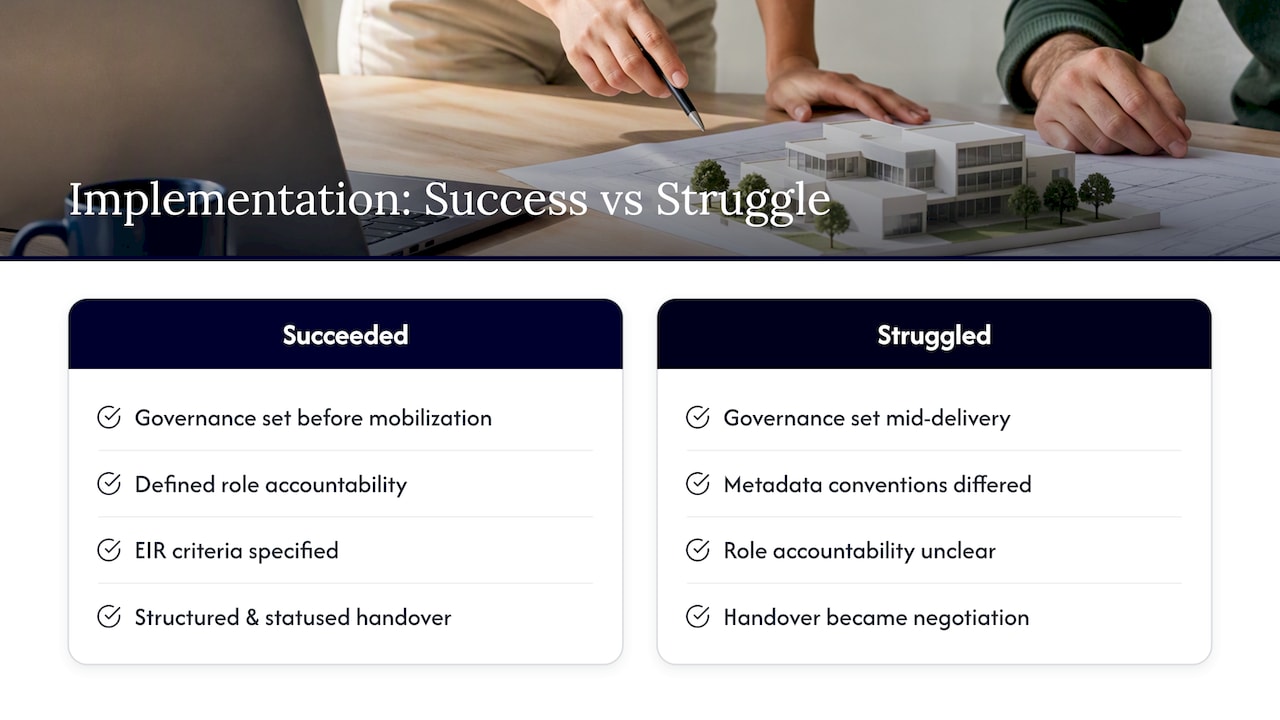
Public case material on ISO 19650 implementation tends to cluster around large infrastructure programs where the appointing party enforced CDE discipline from the outset rather than retrofitting it. The consistent pattern across documented examples is procedural rather than technological: projects that succeeded defined role accountability and EIR criteria before mobilization, while projects that struggled did so after discovering, mid-delivery, that metadata conventions differed between disciplines.

A useful illustration outside pure BIM delivery comes from adjacent trades managing their own handover documentation. Coordination of specialist deliverables, such as the sequencing and documentation practices described in guidance on plumbing blueprint coordination, shows the same underlying discipline: information has to be structured and statused before it is handed to the next party, or the handover becomes a negotiation rather than a transfer. Project management approaches for specialist trades, including the practices set out in guidance on decorating project management, reinforce the same point: decision-useful information, not exhaustive documentation, is what receiving parties actually need.

What these examples share is not a specific software stack but a governance decision made early: define what “done” looks like for an information container before anyone starts producing it.

Case studies or real-world examples of ISO 19650 compliance implementation — overview diagram

Training and skill requirements for teams to achieve compliance

ISO 19650 compliance depends on people understanding the workflow they are operating inside, not on a certificate hanging on a wall. Teams need working fluency in three areas: the role structure and who authorizes what, the metadata and status conventions specific to their CDE, and the acceptance criteria written into their EIR for the discipline they are producing information for.

Training that focuses narrowly on software mechanics, which button moves a container from shared to published, tends to underperform training that explains why the status change matters and what evidence it creates. Delivery teams that understand the audit consequences of skipping a metadata field make fewer of those mistakes than teams told simply to “fill in the required fields.” Refresher training at the start of each delivery phase, rather than once at project kickoff, holds up better across long infrastructure programs where team composition changes.

Practical prioritization: What to do first on a live project

On a live project constrained by time, fix role clarity and EIR completeness first, then get a minimum functional CDE running with enforced metadata and status rules. Larger tooling decisions can wait. A polished platform layered on top of undefined acceptance criteria produces faster paperwork, not better compliance.

Yesper: A practical option to help produce audit-ready evidence

Assembling audit evidence by hand, cross-referencing MIDP versions against acceptance dates across a dozen containers, is where most compliance effort actually goes. Yesper searches project documents, checks deliverables against EIR clauses, and produces exports built for audit rather than for a slide deck. Before choosing any vendor, check integration with your existing CDE, traceability back to source files, and whether the audit log shows its reasoning rather than a summary. For enterprise inquiries, see Yesper’s platform architecture or visit Yesper directly.

Cite normative text for compliance claims and use implementation guidance for the how.

What are the ISO 19650 standards?

ISO 19650 is a family of standards covering information management across a built asset’s lifecycle, using BIM. Part 3 addresses the operational phase, while other parts cover delivery and, in Part 5, security-mindedness for sensitive information.

How do I get an ISO 19650 certificate?

There is no single global certificate for “ISO 19650 compliance”; organizations typically pursue third-party assessment of their information-management processes against the standard’s requirements, alongside client acceptance review on individual projects. The specific route and accrediting body vary by country and should be confirmed with a certification body operating in your market.

Which part of ISO 19650 covers security?

ISO 19650-5 addresses security-mindedness, requiring a proportionate approach to sensitive information across the project and asset lifecycle. It covers more than access control, including sensitivity assessment and ongoing monitoring.

Why is ISO 19650 compliance important?

Compliance gives appointing parties and operators a controlled, auditable trail showing that information was authorized, statused correctly, and fit for the decisions it supports rather than simply produced. That framing, decision-useful information over model completeness, is central to how the ISO 19650 family defines successful information management.


This post was written with AI assistance and published by Yesper. General information, not professional advice: requirements vary by project and jurisdiction, and the professional responsible for the project decides what applies. Spotted an error? Write to benjamin@yesper.ai.

Benjamin Glaser Co-founder at Yesper. Writes about AI and the industry that builds the world. benjamin@yesper.ai

Yesper is the AI civil engineer for construction and infrastructure. AFRY, COWI, NRC Group and other Nordic firms use it to halve the time on a study, rerun calculations in minutes, and catch errors that would otherwise slip through. Get in touch if you'd like to see what it can do for you.

Book demo