Contract clause analysis compares each provision in a contract against a baseline playbook and returns a deviation table, a tracked-changes redline with clause citations, a plain-language memo and severity flags for escalation. Modern approaches pair playbook baselines with AI-assisted retrieval, which speeds the work and keeps every flag traceable to contract text. The aim is consistency, not just speed.
In short
01
A review is only as useful as the artifacts it leaves behind. Four deliverables carry most of the weight, and each serves a different reader.
Routing matters as much as content. Indemnity and liability flags go to legal, pricing and payment flags to procurement, scope and delivery flags to commercial leads. Because each flag carries an owner and a score, decision SLAs can be attached to bands rather than to whole contracts, which is where most of the time saving comes from. Industry guidance on contract analytics makes a similar point: AI accelerates document review, but human reviewers keep a vital role. In legal settings, transparency, explainability and human review remain conditions of adoption.
02
Not every clause earns the same attention. Triage by the families that most often create legal or commercial exposure, then work down.
For procurement documents specifically, tender document analysis applies the same prioritization to bid packages.
03
A repeatable workflow is what separates a review from an opinion. The sequence below is the one we see work across legal and procurement teams.
Pro Tip: Write the escalation threshold down before the first contract is processed. Teams that set it after seeing results tend to tune it to the workload rather than to the risk.
Open-source playbook implementations such as clausecraft formalize the rule behind step three: every flag must cite a playbook clause or be downgraded as unverified.
04
Scoring turns clause differences into negotiation priorities. Published playbook deviation scoring templates use numeric scales, impact bands, color labels and explicit confidence levels. A workable scale to adapt looks like this:
Confidence rules sit on top. A flag lacking a complete citation is downgraded or labeled unverified, and citation completeness is itself tracked per review. The overall playbook compatibility score is a weighted average of clause scores, with weights reflecting commercial importance, so one blocker in liability outweighs ten minor drift items in boilerplate. Treat the bands as starting values: calibrate them against past contracts your team already negotiated.
05
AI belongs in retrieval and first-pass reasoning, not in final judgment. The patterns that hold up are specific.
The research behind PAKTON frames the motivation plainly: large organizations manage tens of thousands of active contracts, and even simple agreements can take over a week to approve, which is why time-to-decision and consistency are the measures worth tracking.
06
Triage tools should escalate high-risk terms, never approve them. Indemnification, contingent liability and deviations from limitation-of-liability clauses require a named lawyer’s review, and automated output should arrive at that lawyer as a recommendation with its evidence attached.
Where a clause may be unlawful, the reviewer’s duty is not to assist in enforcing it, and the escalation path should be defined before the situation arises: who decides, who is informed, and how the decision is recorded. The audit trail should include immutable logging of each flag, the reviewer’s rationale, the citation completeness recorded at the time, and a change log for playbook edits. For regulated engineering work, the same discipline appears in compliance checks that keep audit proof. Start with a narrow contract class, define SLAs per band, and keep the log append-only.
07
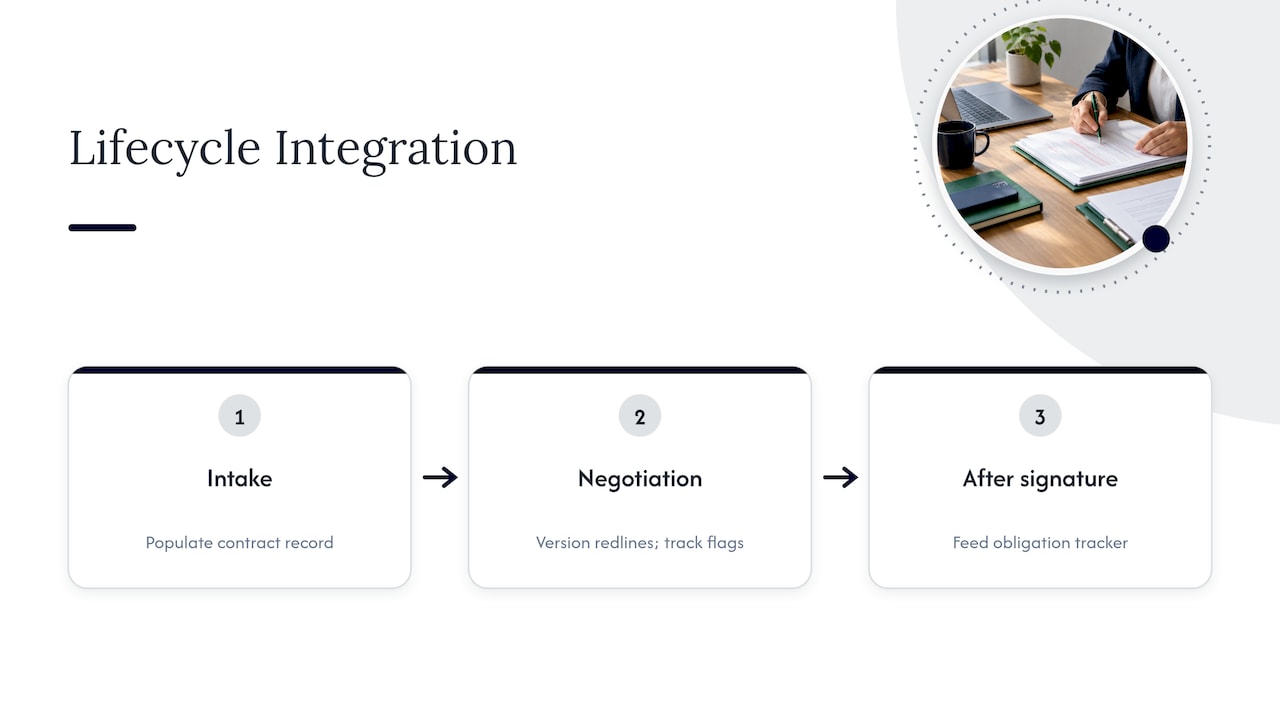
Clause analysis delivers its value when it is wired into the lifecycle rather than run as a side exercise. At intake, the analysis runs on the incoming paper, and its output populates the contract record: clause metadata, deviation scores, owners and open escalations. During negotiation, the redline and deviation table are versioned against each counterparty turn, so a reviewer can see which flags were resolved, conceded or reopened.
After signature, the same structured data pays off a second time. Obligations, renewal dates, audit rights and notice periods extracted during review feed the obligation tracker instead of being retyped. Approved exceptions stay linked to the clause that required them, which makes later disputes and renewals far easier to reconstruct. A couple of integration rules keep this honest. First, the CLM remains the system of record, and the analysis writes into it rather than holding a parallel copy. Second, every automated field carries its citation and confidence level, so a downstream user can tell a verified extraction from an unverified one. Teams that skip the second rule end up with clean-looking dashboards built on unchecked flags.

08
A generic playbook produces generic flags. The baseline should reflect the commercial reality of the contract class, and the differences are larger than they first appear.
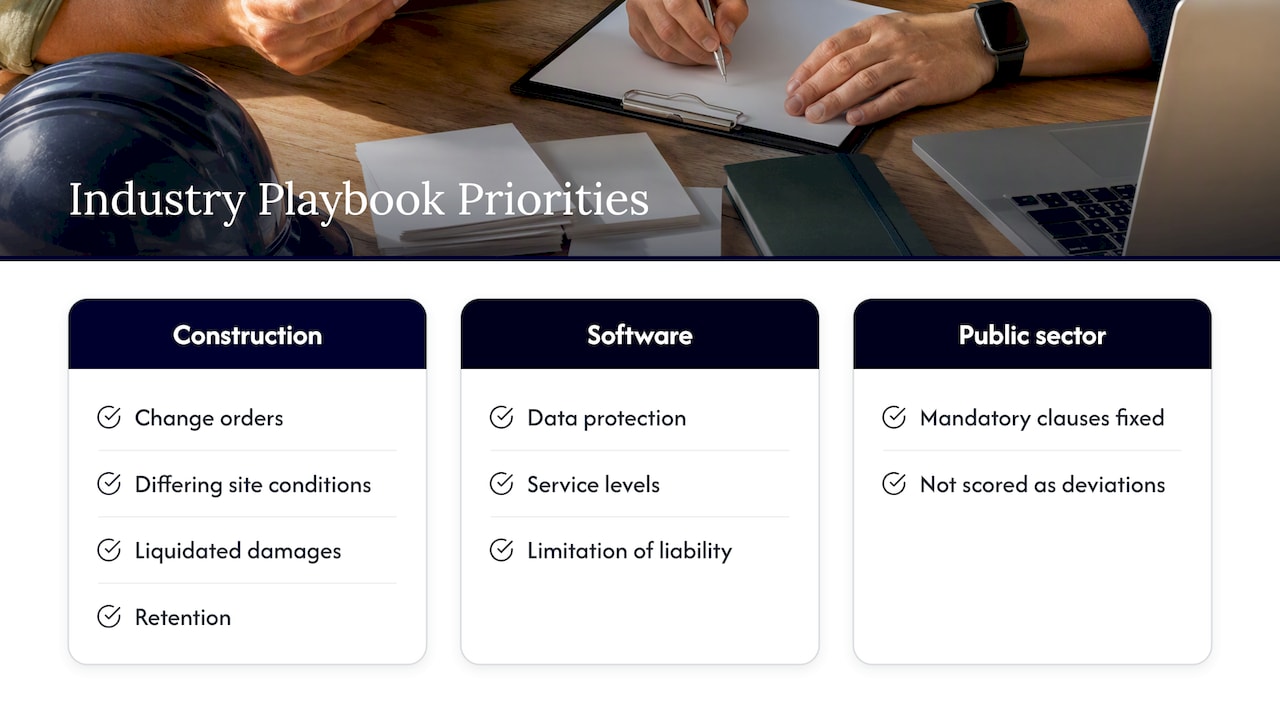
In construction and infrastructure, the playbook weights change order mechanisms, differing site conditions, liquidated damages, retention, pay-when-paid terms and performance bonds heavily. A software agreement leans toward data protection, service levels and limitation of liability. A public-sector agreement may require mandatory clauses that are not negotiable at all, as the Judicial Council of California materials illustrate for certain contract categories, so the playbook should mark those as fixed rather than scoring them as deviations.
Customization works through several levers. The first is the clause library: which clauses exist and what the preferred, fallback and walk-away wording is for each. The second is weighting: how much a deviation counts toward the compatibility score for this project type. The third is the counterparty matrix, which adjusts severity by who is on the other side, a configurable pattern shown in open-source playbook work. Keep one master playbook and derive project-type variants from it, so improvements to shared language propagate and the variants stay auditable.

09
Public case studies with measured results are scarce, so it is more useful to describe the situations where the method pays off, not to quote outcomes. Several patterns recur on construction and infrastructure work.
One example is tender review. A bidder facing a long procurement package needs the liability, payment, termination and scope clauses compared against its standard positions before pricing is committed. The deviation table tells the bid team which clauses change the price of risk and which are routine, and AI-assisted tender review shortens the pass without removing the sign-off.
Another example is subcontract flow-down. A prime contract imposes obligations that must reach subcontractors intact; clause analysis surfaces where a subcontract is weaker than the prime, such as a shorter notice period or a narrower indemnity, which is precisely the gap that creates unrecoverable exposure.
A further example is change management mid-project. When a variation order arrives, comparing its terms with the original scope and change clause shows whether it is a pricing event, a time event or both. Each of these cases rests on the same ingredients: a playbook baseline, cited flags, scored deviations and a reviewer who owns the final call.
10
Adoption fails when teams automate breadth before they have earned trust. Begin with one contract type and an explicit playbook, then measure what matters: time saved per review, citation completeness, and how many material deviations were found that a manual pass missed. Scale only when those numbers hold. Governance is the product, not an add-on: audit logs, reviewer SLAs and a clear escalation ladder let a lawyer defend the process months later. Speed that cannot be explained is a liability.
11
Some teams will want ingestion, playbook comparison and auditable deviation tables in one workflow rather than assembled from parts. That is the approach we take at Yesper: we help construction and infrastructure teams automate document-heavy tasks with source verification. When you evaluate any platform in this class, check citation completeness, deviation scoring against your own playbook, and the audit log on a narrow contract class. To see how this works for construction and infrastructure teams, start at Yesper.
This article is general information, not a substitute for advice from a qualified lawyer. Consult a qualified legal professional about your own circumstances before acting on anything here.
FAQ
A general chat model can summarize a contract and point out unusual wording, but it is not a controlled review process. Legal use needs citations to contract text, a baseline playbook and a human review gate, which a bare chat prompt does not provide. Treat any such output as a draft for a lawyer to verify.
A termination clause is a common example: “Either party may terminate this agreement for convenience on written notice.” In clause analysis, it would be compared with your playbook’s preferred notice period and flagged if the contract allows only one side to terminate or requires a much longer notice.
There is no single canonical list, and definitions vary by author. A common version in contract management is to focus on clarity, completeness and consistency, meaning terms are unambiguous, nothing essential is missing, and no clause contradicts another. Clause analysis tests exactly those qualities.
It is a principle from English case law: a particularly onerous or unusual term must be drawn clearly to the other party’s attention, or it may not be enforceable against them. Reviewers should confirm the principle and its current scope with counsel in the relevant jurisdiction, and clause analysis helps by flagging unusual terms that deserve prominent notice.

This post was written with AI assistance and published by Yesper. General information, not professional advice: requirements vary by project and jurisdiction, and the professional responsible for the project decides what applies. Spotted an error? Write to benjamin@yesper.ai.
Get news and articles in your inbox.
Yesper is the AI civil engineer for construction and infrastructure. AFRY, COWI, NRC Group and other Nordic firms use it to halve the time on a study, rerun calculations in minutes, and catch errors that would otherwise slip through. Get in touch if you'd like to see what it can do for you.
Book demo