For long, visually rich documents, the practical state of the art is multimodal Retrieval-Augmented Generation that combines image, OCR-text, and layout-aware retrieval with evidence-grounded generation. Pure-vision models and OCR-only pipelines each fail in predictable ways once documents stretch past a handful of pages, and multimodal RAG mitigates much of that failure by narrowing the evidence set before generation. The sections that follow work through architectures, retrieval granularity, agentic workflows, evaluation, and a deployment checklist in that order.
In short
01
A multimodal RAG system for document question answering is built from three moving parts: one or more retrievers, a reranker, and a generator that produces an answer conditioned on retrieved evidence. What distinguishes document-focused systems from standard text RAG is the input channel: instead of a single passage embedding, a well-built pipeline indexes page images, OCR-extracted text, and layout features side by side, sometimes alongside a vision-language model’s own page summary. A recent survey of multimodal RAG for document understanding frames this explicitly: practical systems mix page-level image encodings, OCR text passages, and VLM-generated summaries, and the fusion strategy chosen (score fusion, reranking, or simple union) determines which errors the system tends to make.
Three design patterns currently compete for the same workloads:
The comprehensive survey of RAG architectures categorizes these into retriever-centric, generator-centric, hybrid, and robustness-oriented designs, and identifies retrieval optimization as the lever with the largest effect on multi-hop question answering. For a single, closed-domain document, exhaustive retrieval across the whole file (or even a context-stuffing approach) can outperform open-domain retrieval, since the search space is small and the cost of missing a passage is high. Domain adapters and specialized embeddings, trained on in-domain layouts and vocabulary rather than generic web text, close much of the remaining gap when documents carry specialized tables, codes, or diagrams.
02
Retrieval granularity is the single design choice with the biggest downstream effect on both accuracy and cost. Coarse, page-level retrieval is cheap to index and fast to query, but it frequently returns a page that contains the right answer buried beside several irrelevant tables or figures, forcing the generator to search within noisy context. Fine-grained retrieval at the region or segment level (a specific table, chart, or paragraph) delivers tighter evidence but multiplies the index size and the number of candidates a reranker has to score.
The practical answer is hybrid: retrieve coarsely first, then refine within the candidate set. The survey on multimodal RAG for document understanding notes that retrieval granularity is moving from page-level toward region and segment-level approaches, and that coarse-to-fine retrieval combined with region guidance improves precision for evidence localization specifically. A workable indexing recipe stores three parallel representations per atomic unit: a page-level image encoding, OCR-extracted text with token spans mapped to bounding boxes, and a condensed VLM-generated summary, which keeps coarse retrieval fast while making fine-grained reranking cheaper once candidates are narrowed.
Channel selection matters as much as granularity:
Adaptive-k retrieval, where the number of retrieved pages varies by query difficulty rather than staying fixed, reduces latency without sacrificing accuracy. Training-free adaptive-k methods show this directly: letting the retriever decide how many pages a question actually needs, rather than always fetching a fixed top-k, cuts retrieval-augmented generation latency while holding or improving accuracy. Lightweight rerankers distilled from a larger teacher model into a compact selection head give much of a full cross-encoder’s precision at a fraction of its inference cost, which matters once query volume climbs.
Pro Tip: Start with page-level retrieval and a single reranker; add region-level indexing only for the specific question types (tables, charts) where page-level evidence demonstrably fails.
03
Static, single-pass retrieval struggles with multi-hop questions that require pulling evidence from several pages and reasoning across them. The emerging alternative treats document question answering as an agent loop: the model inspects the document, decides what more it needs, fetches it, and repeats until it has enough evidence to answer confidently.
The Doc-V* framework for multi-page document visual question answering demonstrates that this coarse-to-fine, multi-turn pattern, with explicit thumbnail overview and targeted fetch steps, improves out-of-domain performance and evidence aggregation over standard single-pass RAG baselines. Forcing the model to output explicit evidence pointers, page identifiers and region coordinates, both improves interpretability for a human reviewer and acts as a regularizer that reduces hallucination during generation, since the model has to commit to a location it can be checked against.
Training these agents follows three complementary paths. Imitation learning on expert trajectories (sequences of retrieve, fetch, integrate steps recorded from strong teacher models) gives a reasonable starting policy. Distilling an “answerability” teacher, a model trained to judge whether current evidence suffices, teaches the agent when to stop searching rather than looping indefinitely. Reinforcement learning approaches, including evidence-aware variants of GRPO, optimize the policy directly against a reward that combines answer correctness with evidence grounding, which the evidence-aware GRPO work shows is effective when the reward function jointly scores format correctness, grounding, and accuracy rather than accuracy alone.
Pro Tip: Cap the agent loop at a fixed maximum number of retrieval turns in production; unconstrained loops occasionally spiral on ambiguous questions and inflate latency without improving the answer.
04
Exact match and F1 remain the default metrics for extractive document question answering, and ANLS (Average Normalized Levenshtein Similarity) is standard where answers tolerate small string variation, but all three share the same blind spot: they measure surface agreement with a reference string, not whether the model actually looked at the right evidence. A model can produce the correct number by coincidence, or paraphrase correctly while citing the wrong page, and none of these metrics would notice.
Groundedness-aware evaluation closes that gap. Composite evaluation methods in the SMuDGE line of work combine type-aware similarity (treating a numeric answer differently from a free-text one) with multimodal localization scoring, and the authors find these composite scores align with human judgment more closely than exact match or F1 alone. The practical implication is that measuring only answer correctness systematically overstates how trustworthy a document question answering system is.
A workable evaluation recipe for a production system includes:
These grounding and evidence-support scores belong not only in offline evaluation but in the reward functions used for reinforcement learning fine-tuning, since optimizing for answer accuracy alone tends to produce models that are confidently wrong rather than appropriately cautious.
05
Benchmark choice should match the task a system is actually meant to perform, since the current generation of datasets emphasizes different failure modes. DocVQA and its variants established the baseline task of extractive question answering over scanned document images, with answers typically short spans drawn directly from the page. Longer and more demanding benchmarks have since emerged specifically to stress multi-page, multimodal reasoning.
Task types worth distinguishing when building an evaluation suite include extractive span answers (single page, single fact), multi-hop cross-page reasoning (combining facts from separate locations), chart and table question answering (which stresses layout understanding specifically), and open-ended synthesis questions that have no single correct string.
Building a custom dataset for a specialized domain generally means leaning on automated distillation and synthetic augmentation rather than exhaustive manual annotation. A strong teacher model can generate candidate question-answer pairs with evidence labels over a seed document set, which a smaller model then learns to reproduce; the work on scalable training via teacher-student distillation treats this as standard practice for building large supervisory signals without prohibitive annotation cost. The main hazard when scaling this way is leakage between training and evaluation documents, especially when synthetic generation draws repeatedly from the same small seed corpus.
06
Shipping a document question answering system comes down to a handful of concrete decisions made in roughly this order.
Pro Tip: Log every evidence chain, not just final answers; when a hallucination surfaces weeks later, the retrieval and fetch history is usually the fastest way to diagnose where the pipeline went wrong.
Latency and fidelity trade off directly against each other at nearly every step: wider retrieval and deeper agent loops improve accuracy on hard multi-hop questions but cost more time and compute per query, so the right setting depends on whether the workload is an interactive assistant or a batch report-generation job.
07
Construction and infrastructure projects generate exactly the kind of long, visually rich, heterogeneous documents that motivate multimodal RAG in the first place: tender packages mixing scanned forms with pricing tables, BIM exports encoding geometry rather than prose, geotechnical reports built around dense numeric tables, and regulatory documents that cite clause numbers a generic model has no reason to know. A multi-hop question like “does this tender’s steel quantity match the structural drawings” requires exactly the cross-document, cross-modality evidence threading described above.
Our own platform, Yesper, is built around this pattern: domain-specialized agents retrieve evidence across project documents and produce deliverables with their assumptions written down for review, the way a colleague’s work would be reviewed. We are used across the organization by thousands of people at companies including AFRY, NRC Group, and Netel, and customers report 50 to 95 percent time saved on projects, along with higher quality outcomes since the platform catches errors that human reviewers missed.
What maps most directly from the research above to engineering deliverables:
08
General-purpose vision-language models carry broad visual and linguistic competence but little grasp of domain-specific layouts, so fine-tuning is usually where the largest accuracy gains come from once a base architecture is chosen. Retrieval-aware tuning, training the generator jointly with examples of both correct and distractor retrieved evidence, teaches the model to notice when retrieved context does not actually answer the question rather than fabricating a plausible response anyway. The M-LongDoc benchmark work shows measurable correctness gains from this kind of retrieval-aware tuning specifically on long, multimodal documents.
Transfer learning across domains works best when the base model has already seen substantial document-layout diversity during pretraining, since fine-tuning on a narrow domain (say, geotechnical tables) with too little diversity risks overfitting to that layout and degrading performance on anything slightly different. A common and effective pattern is staged fine-tuning: first on a broad, varied document corpus to establish general layout competence, then on a smaller, domain-specific set to sharpen vocabulary and structure recognition.
Parameter-efficient fine-tuning methods (adapters, low-rank updates) are worth considering before full fine-tuning, particularly for teams without large labeled domain corpora, since they tend to preserve the base model’s general competence while still absorbing domain-specific patterns. Whichever approach is used, holding out a genuinely distinct evaluation set, documents the model never saw during either pretraining or fine-tuning, is the only reliable way to tell whether a fine-tuned model generalizes or has simply memorized its training distribution.
09
Failures in document question answering systems cluster into a few recurring patterns, and recognizing which one is occurring usually points directly at the fix. Retrieval failures, where the correct evidence was never fetched in the first place, are often the single largest source of wrong answers, and they are easy to misdiagnose as a generator problem when the real issue sits upstream.
Table and chart questions fail at a noticeably higher rate than plain-text questions, a pattern the M-LongDoc benchmark documents explicitly, since OCR tends to flatten table structure and chart semantics in ways that lose the spatial relationships a human reader would use to answer correctly. Multi-hop questions fail when working memory loses track of earlier retrieved evidence across a long agent loop, producing answers grounded in only part of the required context. Confident hallucination, where a model states a wrong answer with no hedge and no citation, is the most damaging failure mode precisely because it is the hardest for a downstream user to catch without independently checking the source.
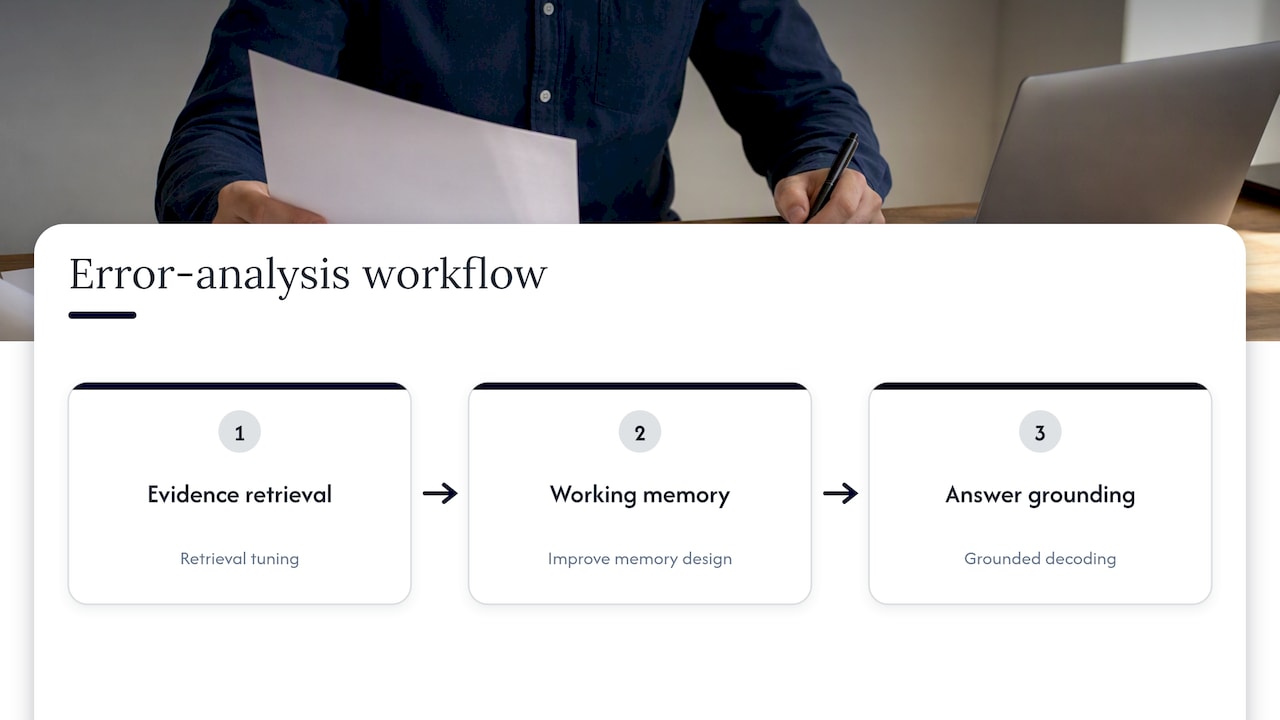
A practical error-analysis workflow separates these failure modes rather than treating every wrong answer the same: check first whether the correct evidence was retrieved at all, then whether it was correctly integrated into working memory, then whether the generator’s final answer is actually supported by the cited evidence. Each stage points at a different fix, retrieval tuning, working-memory design, or grounded decoding, and conflating them tends to produce fixes that improve one metric while leaving the underlying failure untouched.

10
Not every question a document question answering system receives can be answered from the document alone. A regulatory clause referenced by number, an industry standard cited by its code, or a term of art that the document assumes the reader already knows all require context the document itself never states. Augmenting retrieval with an external knowledge base, a standards database, a glossary, or a prior project archive, extends the system’s reach without requiring every fact to be re-derived from the current file.
The design challenge is keeping these two evidence sources distinguishable in the final answer. A system that silently blends document-internal evidence with externally retrieved context risks producing an answer that reads as grounded in the document when part of it actually came from elsewhere. The safer pattern tags each piece of retrieved evidence with its source type, internal document or external knowledge base, and carries that tag through to the citation shown to the reader, so a reviewer can tell at a glance which claims the document itself supports and which rely on outside material.
External augmentation is most valuable in domains with dense cross-referencing, construction codes citing other codes, financial filings citing prior filings, where no single document is ever truly self-contained. It is least valuable, and riskiest, when used to paper over gaps in retrieval quality rather than genuine information needs, since reaching for an external source when the answer was actually present in the document just adds an unnecessary point of failure.
11
Document question answering models trained on a narrow slice of layouts tend to break the moment they encounter a scanned document with a different font, a rotated page, or a table laid out unconventionally. Data augmentation addresses this by expanding the training distribution synthetically rather than waiting for enough real-world examples to accumulate naturally.
Common techniques include synthetic layout perturbation (rotating, skewing, or adding scan noise to otherwise clean document images), OCR error injection (deliberately introducing the kinds of character-recognition mistakes real OCR engines make, so the model learns to tolerate them rather than treating them as ground truth), and paraphrastic question augmentation (generating multiple phrasings of the same underlying question to prevent the model from overfitting to specific wording).
Teacher-student distillation, already discussed as a training-scale technique, doubles as a robustness tool: a strong teacher model can generate question-answer pairs over documents with deliberately degraded quality, teaching a smaller model to handle exactly the noisy inputs it will face in production. The notes on scalable training via automated data construction describe this kind of rule-based augmentation paired with teacher-generated supervision as a standard way to build large, varied training corpora without prohibitive manual annotation.
The limit of synthetic augmentation is realism: augmented noise that does not resemble the actual failure modes of production documents trains the model to handle a problem it will never encounter while leaving real gaps unaddressed. Validating augmentation strategies against a sample of genuinely messy production documents, rather than assuming synthetic noise generalizes, catches this mismatch early.
12
Document question answering systems often operate on material that was never meant for broad circulation: contracts, financial records, personnel files, or technical drawings carrying commercial value. Retrieval architectures complicate privacy management because evidence, once indexed, can surface in response to queries that have nothing to do with its original purpose unless access controls are enforced at the retrieval layer itself, not just at the application layer.
Access control needs to apply per document and ideally per region, so that a retriever cannot surface a sensitive table to a user who lacks permission to see the document it came from, even if that user’s query happens to match it semantically. Logging retrieved evidence chains, useful for error analysis as discussed earlier, also creates a secondary data-retention surface that needs the same protection as the source documents, since a log of retrieved passages can reconstruct sensitive content even if the original document access is later revoked.
Where documents contain regulated personal or financial data, redaction or tokenization before indexing reduces exposure, though this trades off against retrieval quality when the redacted information happens to be what a question asks about. For any deployment handling genuinely sensitive material, the safest default is treating the retrieval index itself as sensitive data requiring the same encryption, access logging, and retention policy as the source documents, rather than assuming indexing is a neutral intermediate step.
13
The gap between benchmark leaderboards and deployable systems is mostly a grounding gap, not an accuracy gap. A model that answers correctly 90 percent of the time but cannot reliably flag the other 10 percent is less useful in a high-stakes setting than one that answers correctly 80 percent of the time and abstains cleanly on the rest. Research priorities should follow accordingly: fine-grained retrieval that localizes evidence precisely, evaluation that rewards grounding over surface similarity, and agentic workflows efficient enough to run multiple retrieval turns without unacceptable latency.
Benchmark realism deserves more attention than it currently gets. A dataset built from clean, well-scanned documents tells us little about how a system will behave on the messy, inconsistent documents that actually populate most organizations. For safety-sensitive domains, careful abstention thresholds and visible provenance matter more than squeezing out another point of accuracy, and teams building these systems for their own fields would do well to treat that as the design center rather than an afterthought.
14
The architecture this article describes, hybrid retrieval, agentic evidence-seeking, grounded generation, is exactly what we have built for construction and infrastructure work, specialized for the documents that field actually produces. Generic document question answering prototypes can retrieve a passage and generate a plausible answer; what they cannot do is understand that a quantity on a drawing needs to reconcile with a line item in a tender written in a different currency, or that a geotechnical table follows a convention specific to a regional standard. That domain layer is where general models hit a wall and where purpose-built systems earn their keep.
We work inside your projects rather than alongside them, searching across your document set, running regulatory compliance checks, and producing deliverables end-to-end while writing down the assumptions behind them so you can review the output the way you would review a colleague’s work. For a closer look at how this plays out across a project, see our platform overview or visit Yesper directly to see the platform in context.
FAQ
Document question answering is the task of producing an accurate answer to a natural-language question using the content of one or more documents, which can include text, tables, charts, and scanned images. Modern systems typically retrieve the relevant evidence first, then generate an answer grounded in that evidence rather than relying on a model’s memorized knowledge.
OCR-based pipelines extract text first and hand it to a language model, which loses table structure and visual layout in the process. Multimodal RAG retrieves evidence using image, text, and layout signals together, which the survey on multimodal RAG for document understanding credits with better precision on documents where visual structure carries meaning that flattened text does not capture.
Exact match, F1, and ANLS remain standard for checking whether an answer’s text matches a reference, but they do not verify whether the model used correct evidence. Groundedness-aware composite metrics, such as those in the SMuDGE line of work, add multimodal localization scoring and align more closely with human judgment.
DocVQA variants suit short, single-page extractive questions, while M-LongDoc and benchmarks like MMLongBench-doc and LongDocURL target long, multi-page documents requiring cross-page reasoning. Choose based on whether the deployment task resembles single-page extraction or multi-hop synthesis across many pages.
Yes, for long and visually complex documents, iterative workflows that overview, retrieve, fetch, and integrate evidence across multiple turns outperform single-pass retrieval on multi-hop questions. The Doc-V* framework shows improved out-of-domain performance and evidence aggregation specifically from this coarse-to-fine, multi-turn pattern.

This post was written with AI assistance and published by Yesper. General information, not professional advice: requirements vary by project and jurisdiction, and the professional responsible for the project decides what applies. Spotted an error? Write to benjamin@yesper.ai.
Get news and articles in your inbox.
Yesper is the AI civil engineer for construction and infrastructure. AFRY, COWI, NRC Group and other Nordic firms use it to halve the time on a study, rerun calculations in minutes, and catch errors that would otherwise slip through. Get in touch if you'd like to see what it can do for you.
Book demo