One metre of metro, four Volvos

In 1975 a metre of new Stockholm metro cost about as much as Sweden's best-selling car, one Volvo 240. The expansion now being blasted out under the same city prices the metre at four Volvo XC60s, in real terms. Where the other three cars went is a question with an audit trail, and the trail leads away from the tunnel.

Railway tracks stretching toward the horizon

Thirty metres under Kungsträdgården

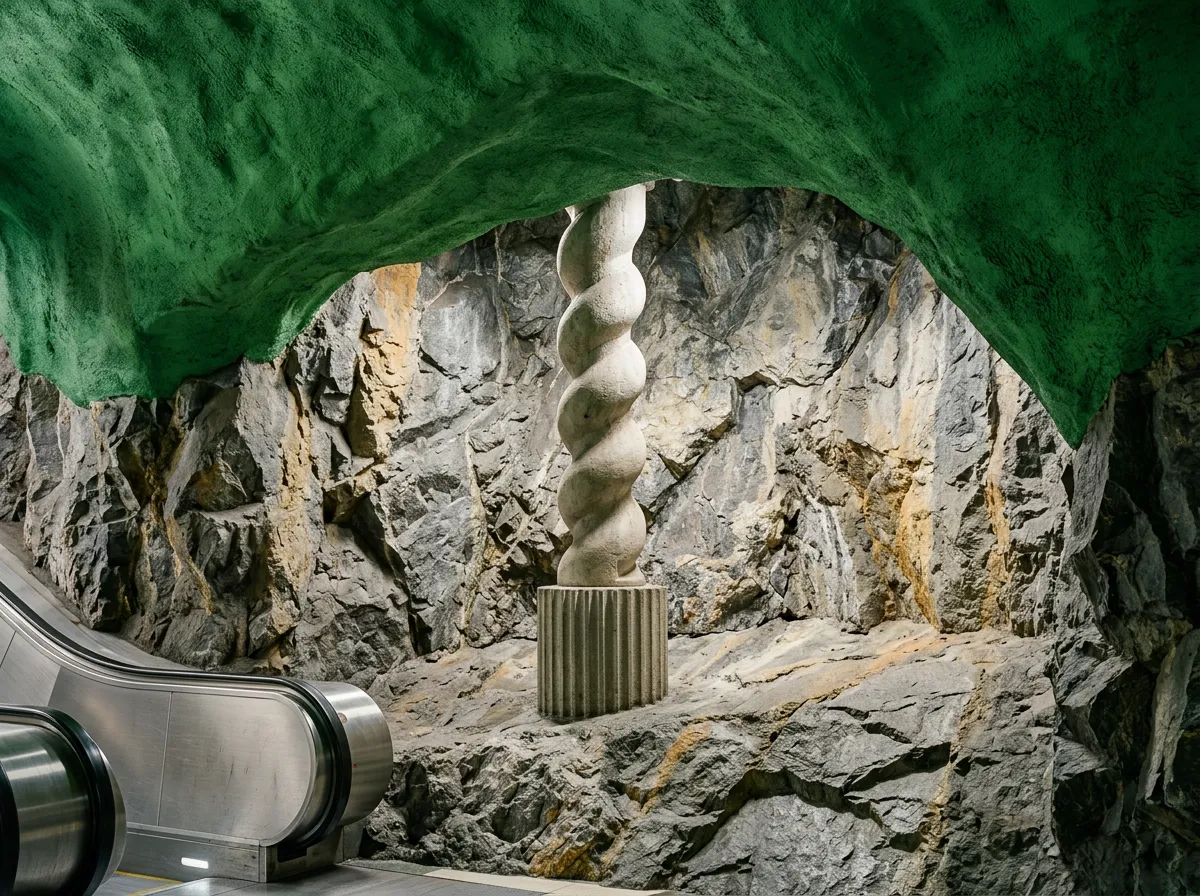
The Blue Line is the newest of Stockholm's three metro lines and the one that runs deepest through rock: nineteen of its twenty stations are caverns. Begun in 1966 to reach the million-programme suburbs rising north-west of the city, it opened in stages between 1975 and 1985. At Kungsträdgården, the terminus since October 1977, the platform lies nearly thirty metres below sea level, and the artist Ulrik Samuelson dressed the cavern as a fictional archaeological dig: a war god salvaged from the roof of Riddarhuset, columns from Makalös, the seventeenth-century palace that once stood in the park above. The station has since acquired real archaeology of its own. Its raw rock walls host Sweden's only known colony of Lessertia dentichelis, a cave spider that has lived there since the trains arrived and made national news in 2024, when a contractor with a pressure washer nearly rinsed the colony away.

A kilometre of that line cost 331 million kronor, in today's money. The kilometre in the expansion planned for 2027–2035 is budgeted at 2,405 million: 7.3 times more, in fixed prices, through the same granite. Fredrik Bergström, the economist who compiled the series for Innovationsföretagen, gave the increase its unit:

På 70-talet kostade en meter tunnelbana som en Volvo 240, idag kostar en meter tunnelbana fyra Volvo XC60.

Fredrik Bergström, Skenande kostnader, Innovationsföretagen (2025). "In the seventies, a metre of metro cost as much as a Volvo 240. Today, a metre of metro costs four Volvo XC60s."

A 244 DL listed at about 30,000 kronor new in 1975; an XC60 starts at 579,900 today.

1990, the year the prices left

Rail investment prices used to behave. Between 1950 and 1990 they rose in step with consumer prices, 6.0 against 6.4 percent a year. In 1990 the two series parted and have never met again: 4.0 percent a year for rail investment against 2.1 for inflation, thirty-four years running. Stockholms Handelskammare put the compounded result plainly in 2026: a krona spent on infrastructure today buys a fifth less than it did sixteen years ago.

The years around 1990 left a paper trail of their own. A new planning and building act in 1987. Banverket split from SJ in 1988, separating the track from the trains. Environmental impact assessment entered Swedish law in 1991, following a European directive. Public procurement law, with mandatory advertising and court review of contract awards, arrived in 1994 with the EEA agreement; full EU membership followed a year later. A dedicated railway-planning act in 1996 added the formal railway plan, consultation rounds and county-board approval. The environmental code of 1999 merged fifteen laws and sent groundwater questions to environmental court — for a rock tunnel under a capital, groundwater is not a footnote. In 2013 the whole sequence was reorganised into one "coherent" planning process, on the argument that it had grown too slow.

Two things are true about that stack at once. Each layer answered a real failure of its era, several were required by European law, and every one of them is met with genuine engineering: investigations, assessments, plans, calculations, reviews. And nobody ever priced the stack as a stack. The work it demands has grown for four decades while the way the work is produced has barely moved: written, circulated, reviewed and revised by hand, at the pace of the profession that built the Blue Line, with PDF standing in for paper.

Measure Figure Source
Blue Line, cost per km (2024 prices) SEK 331 million Skenande kostnader, table 2
Coming expansion (2027–2035), cost per km SEK 2,405 million Skenande kostnader, table 2
Real-terms increase 7.3×
Rail investment prices, 1990–2024 +4.0% per year Skenande kostnader, figure 2
Consumer prices (CPI), 1990–2024 +2.1% per year Skenande kostnader, figure 2
Infrastructure per krona spent, vs 2010 One fifth less Stockholms Handelskammare (2026)
Blue Line, ground-breaking → first passengers 9 years (1966–1975) Spårvägsmuseet
Barkarby, ground-breaking → first train 9 years (2018–2027) nyatunnelbanan.se
Funding index (CPI) vs construction index, gap since 2016 11.5% Byggindustrin (May 2026)

The digging is acquitted

If the money were disappearing into steel, concrete or wages, it would show while the machines are running. Riksrevisionen went looking: across 285 projects in the national transport plans, finished projects landed on average within a few percent of what they were expected to cost when construction began. Meanwhile, projects that sat in the 2014–2018 national plan grew 39 percent in estimated cost during those four years, and projects in the system since 2004 grew 165 percent. They were not being built during those years. They were being planned.

De systematiska kostnadsökningarna förefaller främst inträffa under planeringsfasen; i byggfasen hittar Riksrevisionen inga systematiska kostnadsavvikelser.

Riksrevisionen, RiR 2021:22. "The systematic cost increases appear to occur mainly during the planning phase; in the construction phase, the National Audit Office finds no systematic cost deviations."

The pattern is international. Bent Flyvbjerg's study of 258 transport projects found cost escalation rising 4.64 percentage points for every year a project is delayed; across 78 Dutch projects, Cantarelli and colleagues measured five points per extra year before construction. "Sluggishness may, quite simply, be extremely expensive."

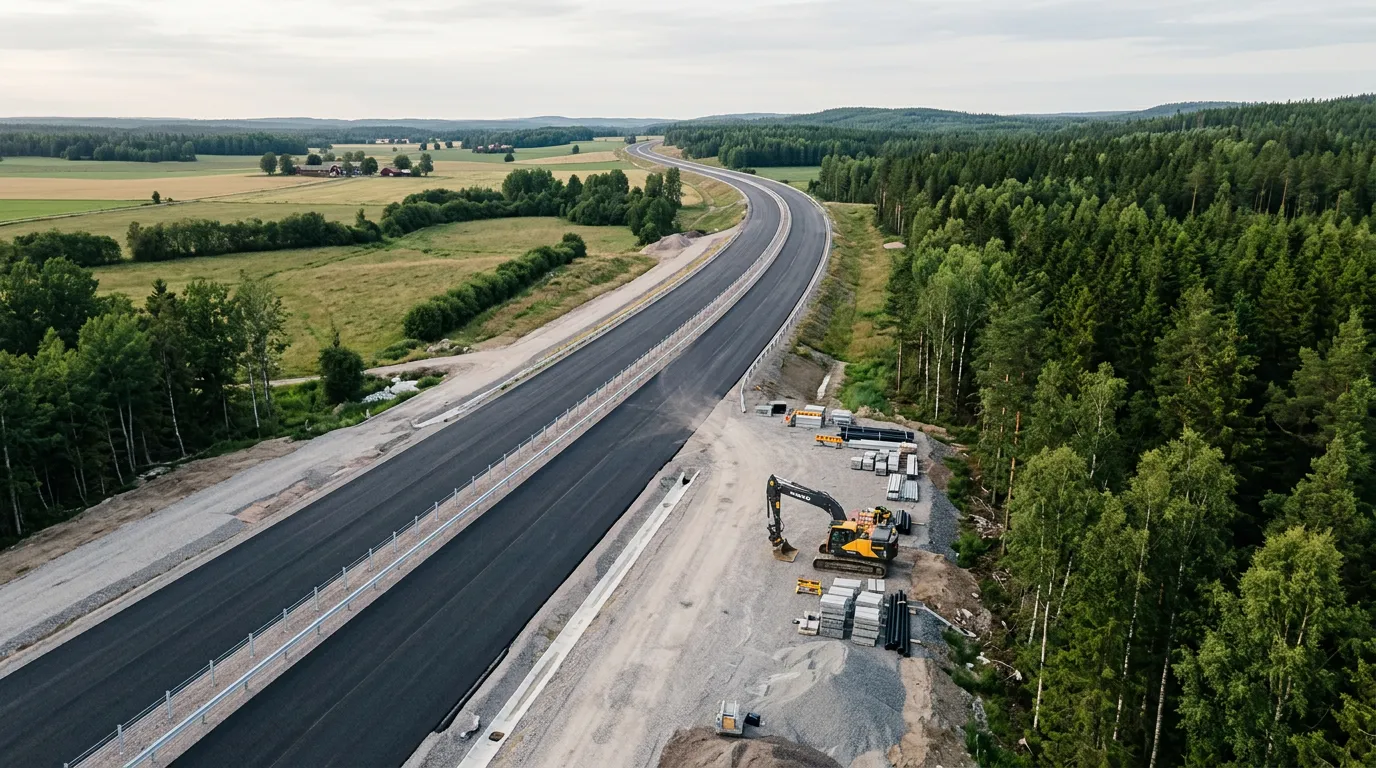
The tunnelling itself, meanwhile, keeps its own tempo. In Stigbergsparken on Södermalm, the lift shaft for the new Sofia station, a hundred metres straight down, the deepest in the system, was blasted through in 126 salvoes over three and a half years: first charge November 2021, the last one on a Friday in April 2025, over a hundred thousand tonnes of granite in all. The station is due to open in 2030.

Nine years then, nine years now

Nine years passed between the Blue Line's ground-breaking in 1966 and its first passengers in 1975. Nine years will pass between ground-breaking at Barkarby in 2018 and its first train in December 2027. Half a century apart, with half a century of better machines in between, the construction tempo of a Stockholm metro is unchanged. What the decades added sits in front of the digging: the agreement behind Barkarby was signed in January 2014, four and a half years of planning before ground was broken, and the negotiation has never really closed. By November 2019 the projected cost had grown nine billion kronor, seven of them attributed by the region to new safety and environmental requirements. By late 2024 the running risk list echoed the years around 1990: appealed plans and challenged procurements, stricter environmental rulings, new restrictions on sulphide-bearing rock. In March 2025 the government appointed a new negotiator to reopen the 2013 agreement, and in May 2026 the project reported four billion more since New Year, plus a widening gap between the consumer-price index its funding follows and the construction index its costs follow: 11.5 percent since 2016, still widening.

Sweden's national plan, fixed this April, intends 1,171 billion kronor of transport infrastructure by 2037. If the past thirty-four years set the terms, a krona at the end of that plan buys a fifth less than a krona at the start. There is no geology in that sentence. The expensive years are made of engineering: investigations, assessments, plans and reviews, still produced and checked by hand, at a pace the drawing board would recognise. Of everything in the plan, that pace is the one quantity that is neither physics nor politics. The firms that change it first, consultancies or contractors, will set the price of the metre that everyone after them has to match.

  1. Fredrik Bergström & Tore Englén, Skenande kostnader, Innovationsföretagen, September 2025.
  2. Stockholms Handelskammare, Bättre styrning, bättre infrastruktur, April 2026.
  3. Riksrevisionen, Kostnadskontroll i infrastrukturinvesteringar, RiR 2021:22, June 2021.
  4. Bent Flyvbjerg, Mette Skamris Holm & Søren Buhl, "What Causes Cost Overrun in Transport Infrastructure Projects?", Transport Reviews 24(1), 2004.
  5. Chantal Cantarelli, Bert van Wee, Eric Molin & Bent Flyvbjerg, "Different cost performance: different determinants?", Transport Policy 22, 2012.
  6. Spårvägsmuseet, "Historien om tunnelbanan" (ground-breaking 1966, openings 1975–1985).
  7. Prop. 2013/14:76, Utbyggnad av tunnelbanan och ökad bostadsbebyggelse i Stockholms län (the 2013 Stockholm negotiation).
  8. Förvaltning för utbyggd tunnelbana, "Färdigsprängt i Stigbergsparken" (April 2025) and on the risk outcome (November 2024).
  9. SVT Nyheter, "Nya tunnelbanestationer nio miljarder dyrare", 13 November 2019.
  10. SVT Nyheter, on the Kungsträdgården cave spider, 4 January 2024.
  11. Byggindustrin, "Ny kostnadssmäll för tunnelbanebygget", 27 May 2026.
  12. Regeringen, appointment of a negotiator to reopen the Stockholm agreements, 13 March 2025.
  13. Regeringen, adoption of the national transport infrastructure plan 2026–2037 (SEK 1,171 billion), 24 April 2026.
Benjamin Glaser Co-founder at Yesper. Writes about AI and the industry that builds the world. benjamin@yesper.ai

Yesper is the AI civil engineer for construction and infrastructure. AFRY, COWI, NRC Group and other Nordic firms use it to halve the time on a study, rerun calculations in minutes, and catch errors that would otherwise slip through. Get in touch if you'd like to see what it can do for you.

Book demo