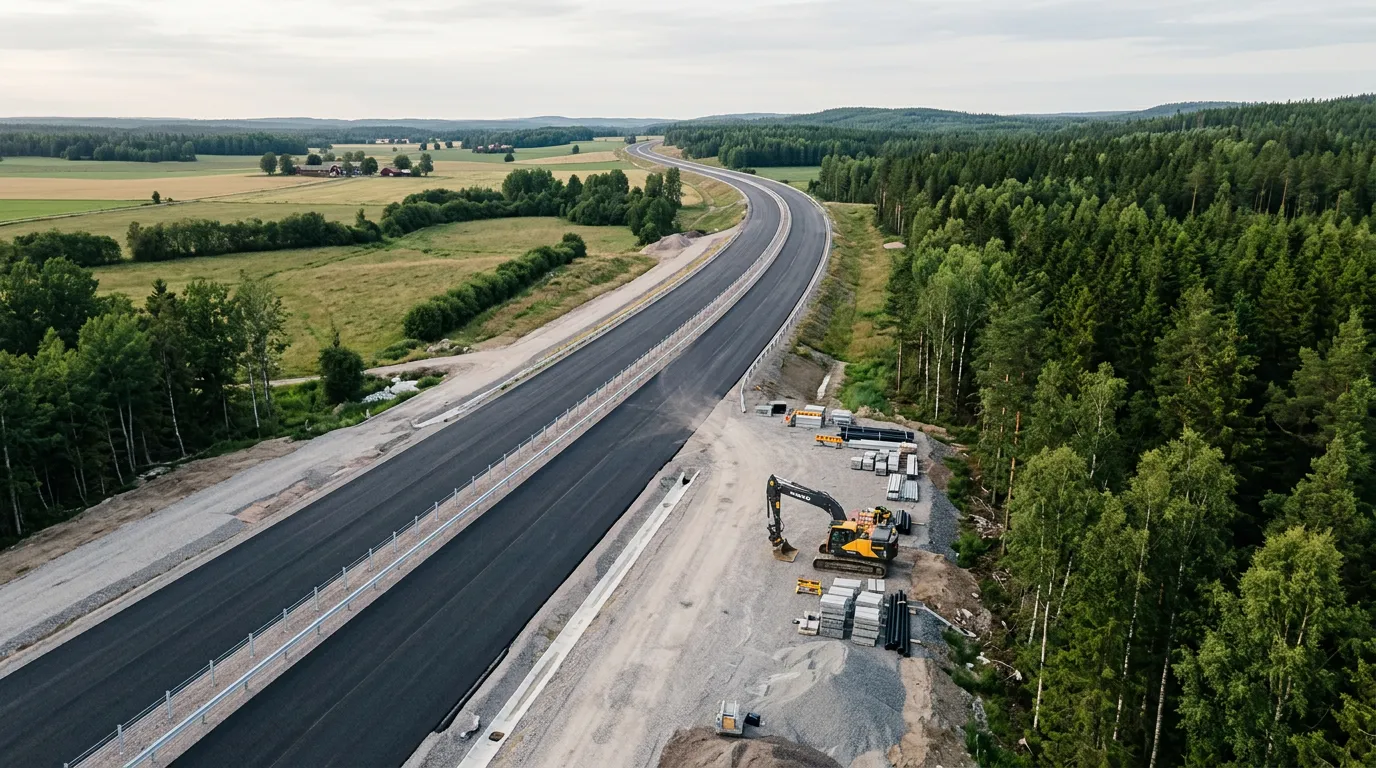
Cost overruns are born before the first shovel

When a road or railway ends up far over budget, the building phase takes the blame. The evidence points earlier: most of the cost growth is already locked in before construction begins. Three datasets, from three countries and three eras, arrive at the same conclusion.

Sunlit room with wooden panelling and a large window facing a garden

Overruns happen in planning, not on site

In planning. Studies that follow cost estimates through a project's whole life keep finding the same shape: the estimate grows year after year while the project sits in planning, then holds roughly steady once construction starts. The overrun is real. It is just older than the construction site.

The distinction matters, because the remedy depends on it. If costs ran away on site, the answer would be tighter contracts and better site management. If costs run away during planning, controls introduced at build-start arrive too late: the money was committed years earlier, on paper. The public debate almost always aims at the first problem. The data describes the second.

Three countries, three eras, one result

The widest lens belongs to Bent Flyvbjerg, Mette Skamris Holm and Søren Buhl, who assembled 258 rail, road, bridge and tunnel projects worth 90 billion US dollars, built between the 1920s and 2000. Their 2004 study in Transport Reviews found that cost escalation grows by 4.64 percentage points for every year of delay, significant at p < 0.001. Rail projects in the dataset exceeded their estimates by 44.7 percent on average.

Chantal Cantarelli, Bert van Wee, Eric Molin and Flyvbjerg narrowed the lens to 78 Dutch projects in Transport Policy in 2012. For each additional year the pre-construction phase takes, cost overrun increases by 5.0 percentage points (t = 2.365, p = 0.022). In a companion paper on the same dataset they state it directly: in the Netherlands, the majority of the cost overrun occurs before construction begins.

Jonas Eliasson closed the loop for Sweden in 2025, in Transportation Research Part A, following the projects in the national transport plans of 2010 to 2022. On average, cost estimates grew 24 percent during early planning and another 27 percent during late planning. At the decision to build they grew 4 percent, and during construction 3 percent. Of the total growth, 51 percentage points landed before the build decision and 7 after it.

Country Sample Finding Source
Worldwide 258 projects +4.64 percentage points per year of delay (p < 0.001) Flyvbjerg et al., Transport Reviews (2004)
Netherlands 78 projects +5.0 percentage points per extra pre-construction year (p = 0.022) Cantarelli et al., Transport Policy (2012)
Sweden National plans 2010–2022 +51 percentage points before the build decision, +7 after Eliasson, Transportation Research Part A (2025)

Three countries, three eras, three methods: a worldwide archive, a Dutch regression, a Swedish plan-by-plan panel. None of the teams depended on the others' data, and all of them found the growth in the same place. Sweden's national audit office reached the same verdict by a fourth route, as covered in One metre of metro, four Volvos: in the construction phase, Riksrevisionen finds no systematic cost deviations at all.

Years in planning cost money through lock-in

Because commitments harden while the design is still soft. The literature's name for it is lock-in: decisions taken early, on thin information, that become politically and organisationally impossible to revisit. An alignment gets promised to a municipality. A budget line gets written into the national plan. By the time the design work reveals what the project actually costs, no one is in a position to choose differently, and the incentive to keep searching for a cheaper solution is gone.

Eliasson is explicit that the damage goes beyond the overrun itself:

Lock-in of premature decisions does not only cause cost overruns; even worse, it distorts project selection and design, reduces incentives to search for more cost-efficient designs, and increases opportunities and incentives for project beneficiaries to underestimate costs and overestimate benefits.

Jonas Eliasson, "Cost overruns of infrastructure projects – distributions, causes and remedies", Transportation Research Part A (2025).

Each additional year in planning gives scope another year to accrete, and lets the locked-in choice drift further from the cheapest workable design. Flyvbjerg's summary of his 258 projects has held for two decades: "Sluggishness may, quite simply, be extremely expensive."

Faster planning would not necessarily save money

Not necessarily, and it matters to say so. All three studies show correlation: projects that spent longer before construction overran more. None of them shows that shortening the phase causes savings. Cantarelli and his co-authors raise the warning themselves: the causality is uncertain, and compressing pre-construction could even backfire, because consultation and participation are among the things that catch bad estimates. Cutting deliberation to save calendar time would treat the clock instead of the disease.

The honest claim is narrower, and still uncomfortable. Cost overruns are born in planning. That is where the growth happens and where the search for cheaper alternatives quietly stops. A cost-control regime that starts at build-start audits the 7 percent and never sees the 51.

It is also worth naming what fills those years. Mostly it is not deliberation but investigations, review rounds, redesign and permit documents, produced and checked by hand. That mechanical share of the planning years is document work, and document work can now be compressed without touching a single stakeholder meeting.

  1. Chantal Cantarelli, Bert van Wee, Eric Molin & Bent Flyvbjerg, "Different cost performance: different determinants? The case of cost overruns in Dutch transport infrastructure projects", Transport Policy 22:88–95, 2012.
  2. Bent Flyvbjerg, Mette Skamris Holm & Søren Buhl, "What Causes Cost Overrun in Transport Infrastructure Projects?", Transport Reviews 24(1), 2004.
  3. Jonas Eliasson, "Cost overruns of infrastructure projects – distributions, causes and remedies", Transportation Research Part A: Policy and Practice 198:104532, 2025.
Benjamin Glaser Co-founder at Yesper. Writes about AI and the industry that builds the world. benjamin@yesper.ai

What can be shortened isn't the deliberation but the document work in the planning years: studies, review rounds, permit documents done by hand. Yesper reads them at machine pace, without touching a single consultation. Book a demo and we'll show you how.

Book demo