Why software never reached engineering work, and why AI does now

Nowhere in the economy is the distance greater between what AI could do and what it actually does than in the industry that designs the physical world. The comfortable explanation is that construction is slow to adopt. It does not hold: for forty years, software has been able to move the industry's documents, version them, send them, but never read them. That is what changed, and it is why the window is open now.

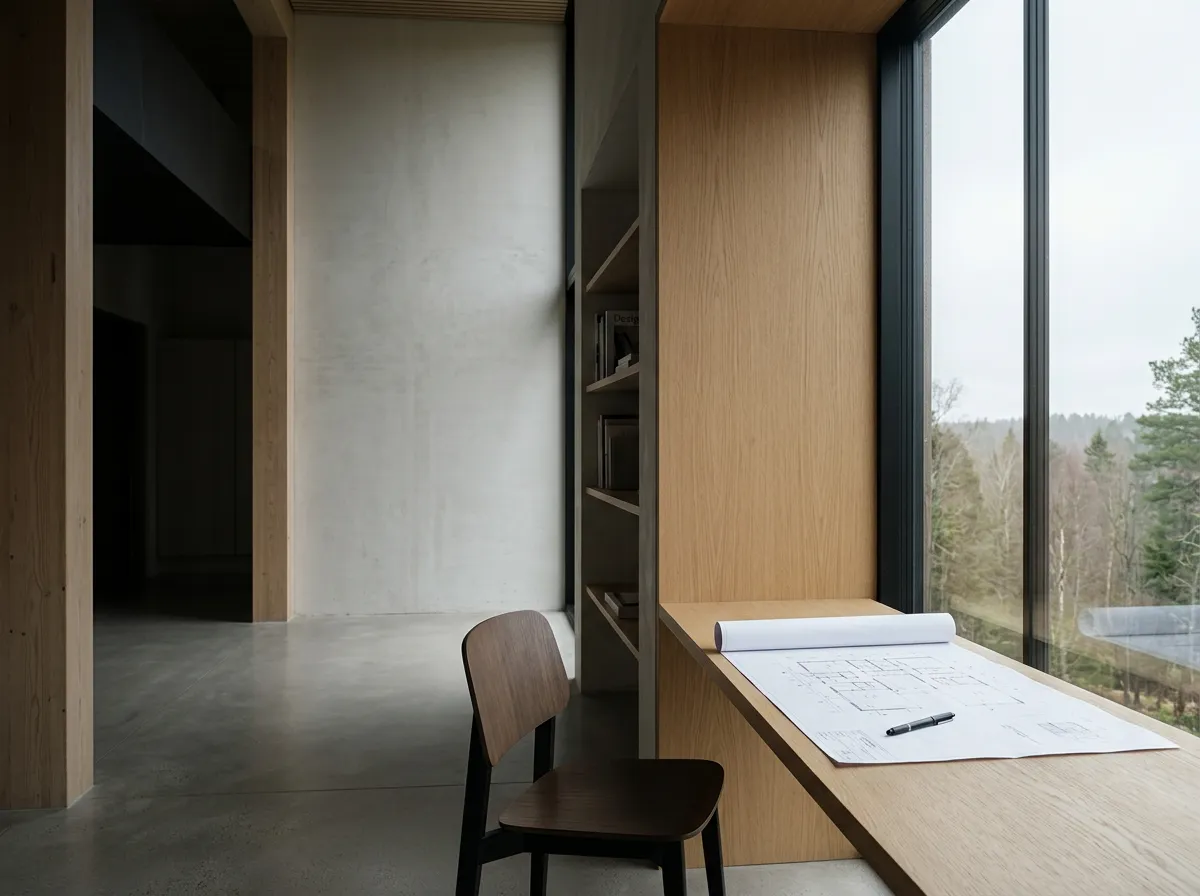
A person walks past a tall window overlooking bare trees under an overcast sky

The most to gain, the least in use

Anthropic measured it in March 2026. In its labor-market study, architecture and engineering sits among the fields where the largest share of work tasks could theoretically be sped up by AI, in the same league as law and finance: roughly 85 percent. Observed use in the same occupations lands around 5 percent of that potential, the widest gap between could and does of any major industry in the study. The researchers also find no systematic rise in unemployment among exposed workers. The wave has not crashed over the profession; it has not arrived.

Theoretical AI exposure vs observed use, architecture and engineering. Source: Anthropic (2026).

The standard explanation is a conservative industry. It does not survive contact with the industry's own history: the drawing board gave way to CAD in roughly a decade, and BIM went from acronym to procurement requirement within a generation. When software has actually been able to do the work, construction has bought it. Something else has kept it out of the work itself.

Software digitized everything except the work

Look at what forty years of construction software actually did. AutoCAD, from 1982, digitized the drawing. Revit and BIM digitized the model. Project platforms digitized the filing, the versions, the approvals. Each wave was adopted, and each stopped at the same line: the core operations stayed manual. Reading a technical specification against a drawing. Checking a structure, a load, a clause against the code. Turning a set of drawings into a bill of quantities. Getting two documents to say the same thing. Engineering runs on the meaning of its documents, and the meaning was precisely what the software could not touch. A document can be fully digital and still say nothing to a machine.

The reason is structural, not cultural. Deterministic software needs stable, repeatable, machine-readable input, and construction offers none of it: every site is its own, every client, every regulatory environment, every project organization; every project specifies itself anew. The industry has tried to standardize its way out, the IFC format has existed since the 1990s, and learned that a shared file format does not create shared meaning. So the documents remained what they had always been: legible to trained humans, opaque to machines. Software could move them, never read them.

Meanwhile, the reading outgrew the readers

While software waited at the edge of the documents, the documents grew. The Eurocodes went from ten standards in roughly 58 parts to eleven standards and two technical specifications in 74 parts in their second generation. AMA Anläggning, the reference work behind Swedish civil-works specifications, grew from 742 pages in 2007 to 926 in 2023. The processes grew with the texts: after the 2011 planning-law reform that was meant to speed things up, the average detaljplan in Stockholm county went from 35 months to 62, according to an expert report to the government's Productivity Commission, and in the UK, consent for nationally significant infrastructure went from 2.6 years in 2012 to 4.2 in 2021.

Det framstår som klart att PBL har blivit för reglerande och för betungande.

Kristina Alvendal, Ineffektivt stadsbyggande, expert report to Produktivitetskommissionen (2024). "It seems clear that the Planning and Building Act has become too regulating and too burdensome."

The reader did not grow. An engineer reads at the same speed as in 1990, holds the same amount in working memory, works roughly the same hours. The rulebook outgrew the reader. And the traditional response, more hands, is closing: CEDEFOP projects that around 4.1 million people leave Europe's construction workforce through retirement by 2035, while most European markets already report skills shortages. More had to be read every year, by a workforce that could not grow, with software that could not read.

The first software that can read the documents

A large language model is not a better version of the old software; it is a different kind. It needs no standard to parse a document, because it reads the document the way it was written to be read: as language, in context, tables and clauses and cross-references included. Interpreting a specification, checking it against a code, reconciling it with a drawing list, turning it into a requirements register: the operations that stayed manual for forty years are the exact operations this technology performs. What changed is not the speed of the tools around the work. It is that the work itself became reachable.

The shift is measured, on two axes. In February 2024, Google released Gemini 1.5 Pro with a context window of one million tokens, roughly 700,000 words, up from the 128,000 that had been standard: for the first time, a model could hold an infrastructure project's whole document set in one pass, codes, tender documents, investigations. And METR, a research group that measures what AI agents can actually complete, finds the length of task an agent finishes at 50 percent reliability doubling roughly every seven months since 2019, with the pace since 2023 closer to a doubling every four. The metric is built on software tasks and carries wide error bars. The direction is not in dispute.

In a liability industry one question remains, and it is the right one: who owns the mistakes when a probabilistic answer becomes concrete and steel? The answer already exists, and it is older than the technology: a named engineer reviews and signs, exactly as before. What a well-built system changes is what the signature rests on: every claim traceable to its source, every figure recalculated, uncertainty flagged rather than smoothed over. Capability without that verification layer is worthless here, which is also why these systems are an engineering discipline of their own rather than a feature bolted onto a chatbot.

The gap is not a lag. It is the window.

Put the pieces side by side and the gap in Anthropic's chart stops looking like a bad grade. Eighty-five percent theoretical, five percent in use is not a verdict on the industry; it is a measure of how much of the work has just become reachable, in the sector that needs it most. Every month the documents grow, the models improve, and the humans stay human.

Trend Change Source
Theoretical vs observed AI use, architecture & engineering ~85% vs ~5% Anthropic (2026)
Eurocodes, first to second generation 58 → 74 parts JRC (2025)
AMA Anläggning, 2007–2023 742 → 926 pages Svensk Byggtjänst
Detaljplan, Stockholm county, after the 2011 reform 35 → 62 months Produktivitetskommissionen (2024)
Human reading speed and working hours Flat
Model context window, 2023–2024 128K → 1M tokens Google (2024)
AI task horizon, at 50% reliability Doubling every ~7 months METR (2025)

A model does not do civil engineering on its own, and that is not the point: the mechanical majority of document work can now be done by a system and checked by a person, with judgment and the signature staying exactly where they have always been. The firms that put that in place within the next two years will set the standard everyone else is measured against. For forty years, software could move the industry's documents but never read them. The first technology that can read the documents has met the industry with the most unread pages. That work is what Yesper is built for: Yesper is the AI civil engineer for construction and infrastructure.

  1. Anthropic, Labor market impacts of AI: A new measure and early evidence, March 2026.
  2. European Commission, Joint Research Centre, Evolution of the EN Eurocodes, and The second-generation Eurocodes: key changes and benefits through design examples (JRC144386), 2025.
  3. Kristina Alvendal, Ineffektivt stadsbyggande, expert report to Produktivitetskommissionen, January 2024.
  4. Google, "Our next-generation model: Gemini 1.5", February 2024.
  5. METR, "Measuring AI Ability to Complete Long Tasks", March 2025; also arXiv:2503.14499.
  6. Svensk Byggtjänst, AMA Anläggning 07 and AMA Anläggning 23, publisher's catalogue.
  7. House of Commons Library, Planning for Nationally Significant Infrastructure Projects, briefing SN06881.
Benjamin Glaser Co-founder at Yesper. Writes about AI and the industry that builds the world. benjamin@yesper.ai

Yesper is the AI civil engineer for construction and infrastructure. AFRY, COWI, NRC Group and other Nordic firms use it to halve the time on a study, rerun calculations in minutes, and catch errors that would otherwise slip through. Get in touch if you'd like to see what it can do for you.

Book demo