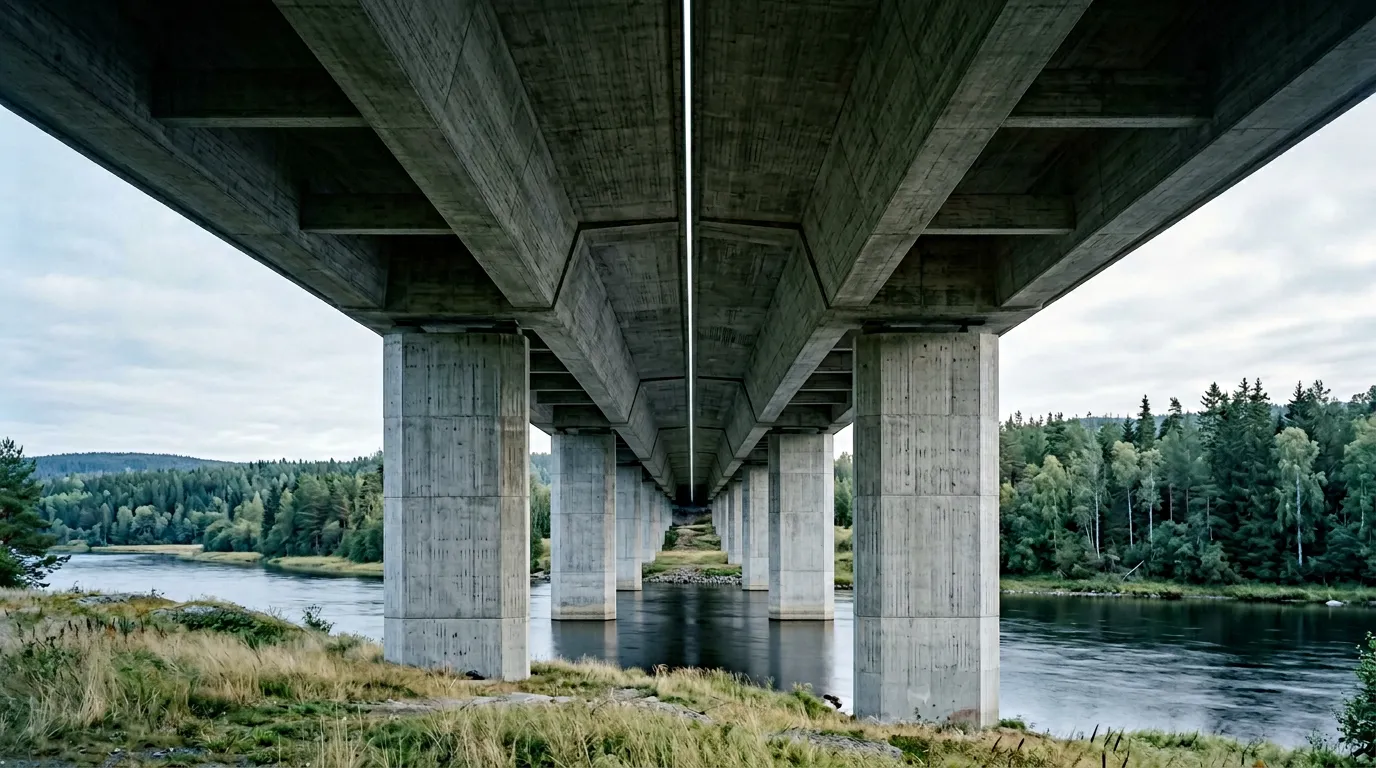
A Nordic environmental impact assessment sells for around €75,000. It is easy to read that as an expensive document. It is not a document at all: it is an assembly of a dozen specialist studies, bound into one submission at the front of a permit process that runs for years. This is the arithmetic behind the figure.
The price
Around €75,000 is a typical Nordic market price for an environmental impact assessment, an MKB, on an infrastructure project. These are market estimates, not quotes from any particular firm, and the figure swings with scope. But the order of magnitude is stable, and it puzzles people outside the industry. €75,000 for a report? The puzzlement comes from picturing a report. An MKB is not one document; it binds together a dozen separate investigations: ecology, cultural heritage and archaeology, noise, air quality, surface and groundwater, contaminated land, landscape and recreation, each a study in its own right with its own specialist. A single one of those, a noise study, or the stormwater study a housing project needs, is a deliverable a firm sells on its own for a fraction of the price. An MKB is a dozen of them, made to agree.
The price is not the paper. It is the production process behind a dozen studies at once, and that process has a precise anatomy: for each study, hours, times a loaded rate, times review cycles, times revision loops, and then the work of making a dozen of them agree. Each factor is reasonable on its own. Multiplied together, and across the studies, they explain why a submission costs as much as a small excavator.
The anatomy
Take the assembly apart and a representative split of the effort looks roughly like this.
| Part of the assembly | Typical share of the effort |
|---|---|
| Specialist sub-studies and field surveys | ~45% |
| Source data, maps and GIS | ~15% |
| Writing and reconciling the assessment | ~20% |
| Consultation and authority dialogue | ~10% |
| Review and quality assurance | ~10% |
| Total | 100% |
Nothing on that list is invention. It is production: fieldwork, fetching authority data, running standard assessments, writing them up in the form the county board and the courts expect, and checking the result. But notice the shape. The specialist studies are the bulk, and they run largely independently until the end, when they have to be made to agree. That reconciliation, a change in the noise study that moves a mitigation, which shifts the landscape assessment, which reopens the consultation, is where an MKB stops behaving like a stack of reports and starts behaving like a system.
And every hour is a loaded hour. Consultancies bill rates that cover far more than salary: office, software and GIS licences, insurance, training, and all the hours that can never be billed. The trade tracks that last part as the billable ratio, or debiteringsgrad, and even a well-run firm keeps only about 70 to 75 percent of its hours billable. Multiply a loaded rate across a dozen studies and €75,000 is not padding; it is arithmetic.
The trap
Hours and rates explain the price on a good day. Contracts and calendars explain the bad ones. In the Nordics an MKB is commissioned under the standard consultancy contract, ABK 09, usually at a fixed fee: the consultancy estimates the hours across all the studies, adds a margin, and commits to the sum. The client gets certainty; the consultancy carries the risk of every study that runs long.
Then the brief moves: the road shifts, a scenario is added, a consultation response demands a new investigation. In a single report that is one loop. In an assembly it is many, because the change enters one study and the reconciliation carries it into the others. At a fixed fee every loop comes out of the margin, and sorting out what counts as a change or addition to the assignment is itself unpaid work. A submission priced with a ten percent margin can lose it in one round of that.
But the sharper cost is time. The MKB sits at the front of a permit process that, at the environmental court, runs a median of about fifteen months to a ruling, and longer with appeals. A revision that arrives late does not just reprice the report; it can reset that clock. And the scarcest thing inside all of it is senior review: much of a review goes to fixing sloppy text and trivia, so the real technical scrutiny, the judgment only a senior brings and the part the signature rests on, is what runs out first. The overrun, the missed error and the lost year are usually the same event, seen from three sides.
The lever
Here is the number that reframes the whole discussion. A leading Nordic consultancy puts it plainly in its investor material:
Design and engineering typically 4–12% of total construction cost while it impacts 100% of cost and quality.
Read that with the €75,000 in mind. The submission is a rounding error next to the construction budget it steers, and next to the years of permit time it can save or cost. If the assessment misses a groundwater condition or a protected species, the mistake is not priced in tens of thousands of euros; it is priced in the remaining 88 to 96 percent of the build, and in the appeal that sends the permit back around. Squeezing the fee optimises the smallest number in the whole equation.
So the real economic problem with the €75,000 report is not the price. It is that producing a dozen interdependent studies by hand makes iteration unaffordable in both currencies, money and time. When re-running the assembly costs a week, alternatives go unexplored, a moving brief is a threat, and the senior review is spent on trivia. When it costs a day, the same fixed fee buys more checking, more scenarios, and a submission that survives the court the first time. The anatomy of the cost is also the map of what can improve. Project costs are born in the planning phase, and an MKB is the planning phase, written down.
Sources
Yesper is the AI civil engineer for construction and infrastructure. AFRY, COWI, NRC Group and other Nordic firms use it to halve the time on a study, rerun calculations in minutes, and catch errors that would otherwise slip through. Get in touch if you'd like to see what it can do for you.
Book demo